Loading player
On Sunday evening, Inter won against Atalanta in men’s Serie A football and thus managed to maintain first place in the standings. With two games left in the first round, Inter has a one-point advantage over Milan and two over Napoli, the reigning champions. In the league, Inter have won 12 out of 16 matches so far and are on a good run of four consecutive victories. Furthermore, it is the first time in the season that Inter has managed to maintain first place for more than a day: not an easy thing to do in this championship, which up until now has been very balanced and competitive, with different teams taking turns in first place.
It’s not a surprise to see Inter in these positions, but it’s not a given either. Despite having a squad similar to that of the last two years, in which they had been among the most dominant teams in Italy and Europe, this season had started in less than favorable conditions for Inter. With a championship lost on the last day and a Champions League lost in the final 5-0, last season was exhausting and demoralizing. And in the summer Simone Inzaghi, the coach who had played an important role in the results of recent years, had been replaced by the Romanian Cristian Chivu, much less experienced and considered almost a fallback, a second choice made mostly due to the lack of alternatives and the relative urgency of finding a coach to take Inzaghi’s place.
Yet Inter – who had also started this championship badly, losing the second and third matches against Udinese and Juventus – are doing well, albeit with some missteps. They have won 11 of their last 13 Serie A matches, losing only to Napoli and Milan, two direct contenders for the scudetto. To date, Inter also has the best attack and one of the best defenses in the championship: they have conceded 14 goals (Roma, the team with the best defense, have conceded 10).
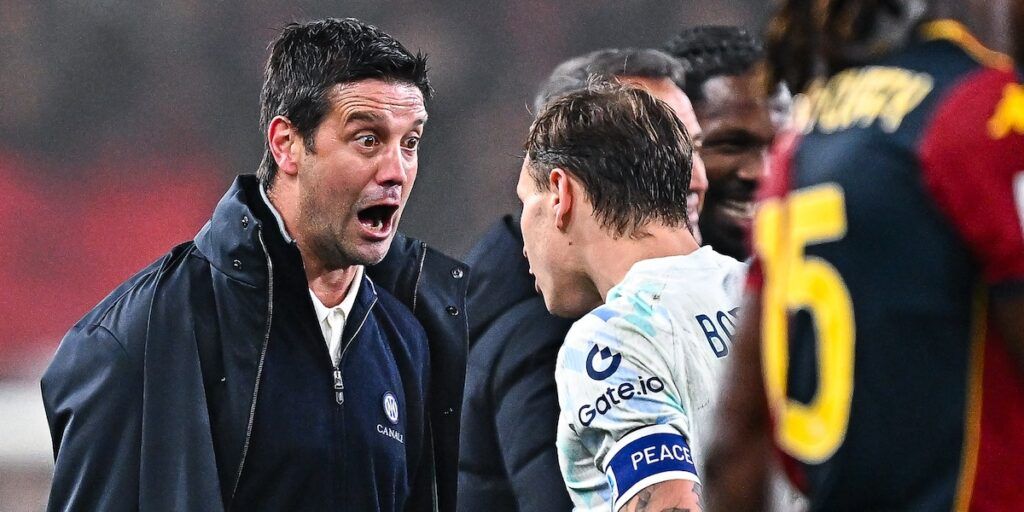
Much of the credit goes to Chivu, who in a short time – and after having coached Parma for just a few matches – this year managed to keep Inter the solid team they had been in recent years, while still adding something of his own to the team’s play. According to commentator and commentator Stefano Borghi, despite his very limited experience at high levels Chivu managed to immediately make himself a “credible” coach: both externally, speaking little about refereeing errors and admitting the defects of his team; both internally, demonstrating great charisma and the ability to motivate the players after the disappointing end to last season.
In this context, and with a rather old team, considered by many to be “at the end of their cycle”, an important role was also played by his tendency to involve all the players available more, avoiding relying on a few trusted “very starters”, as Inzaghi tended to do instead.
After the victory against Atalanta, Polish midfielder Piotr Zieliński confirmed this: he has been at Inter since last year, but this year he is playing more, and he said of Chivu: “he gives us confidence and makes us believe that many of us can be starters”.
It must also be said that the few players who arrived (or returned) in the summer are allowing Chivu to have, at least in attack, alternatives that Inzaghi didn’t have last year. The starting pair of forwards remains the one made up of the Argentine Lautaro Martínez and the Frenchman Marcus Thuram, but this season they have been joined by the 22-year-old Ange-Yoan Bonny, who played with Chivu at Parma last year, and the 20-year-old Pio Esposito, who had been on loan at Spezia for two years.
Chivu was also good at not distorting the game of previous years (which worked and which his players knew well), limiting himself instead to correcting it in some aspects. The starting formation remains the 3-5-2 and Inter continues to be a team that manages the ball well and constructs actions effectively. But compared to the years with Inzaghi, this season the team is looking for a few more vertical passes, with the aim of reaching the opponent’s goal more quickly.
Inter also has a higher defense, i.e. further away from their own goal, and more aggressive. It is a proactive tactic, but also a risky one, because you are more subject to possible counterattack actions. Inter, however, can afford it because they have generally attentive and experienced defenders, who in the summer were joined by the Swiss Manuel Akanji, who arrived from Pep Guardiola’s Manchester City, one of the best coaches ever.
Manuel Akanji slips during Inter-Liverpool in the Champions League, 9 December 2025 (Pier Marco Tacca/Getty Images)
In short, this year Chivu was good at finding the right continuity with the past, which after all was the reason why he was chosen by Inter. Despite having coached very little in Serie A and never in the Champions League, Chivu already knew Inter well (in addition to having coached the youth teams he also played there between 2007 and 2014, winning everything) and at Parma, where he coached before, he had shown some tactical affinity with Inzaghi. But it wasn’t exactly obvious that he would adapt so well and so quickly to the game and ambitions of a great team like Inter.
However, Chivu’s Inter also has the flaws of Inzaghi’s management (first of all, some notable defensive lapses) and, for now, they have lost more games than last season. This applies to both the championship and the Champions League, where Inter, despite being sixth in the championship phase – which is a good result, given that it would allow them to directly access the round of 16 – lost the most important matches, played against Liverpool and Atletico Madrid.
Then, in January, Inter will have to face equally complicated and crucial matches. In the championship they will play against Bologna (on 4 January) and Napoli (on 11 January); and in the Champions League they will face Arsenal (on January 20th) and Borussia Dortmund (on the 28th). The match against Bologna will not be decisive – we are still halfway through the season – but it will certainly be useful to evaluate the real size and attitude of the team, which was recently eliminated from the Italian Super Cup against Bologna.