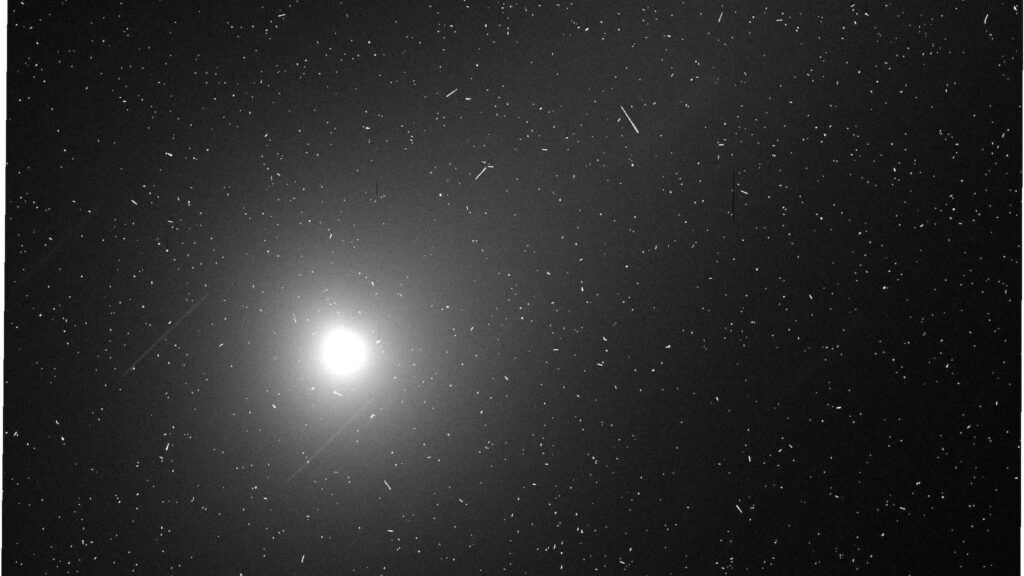
An image of 3I/ATLAS captured on December 27 by the Hubble Space Telescope. Credit: NASA/ESA/STScI
The famous Friday 12th and Saturday 27th December Hubble Space Telescope he captured new, significant Images Of 3I/ATLASthe discussed interstellar object – the third never discovered afterwards 1I/’Oumuamua e 2I/Borisov – identified on July 1, 2025 in the data of the ATLAS (Asteroid Terrestrial-impact Last Alert System) surveillance system located in Chile. The new shots were obtained thanks to the powerful camera Wide Field Camera 3 (WFC3) from 2048×4096 pixels and have detected two distinct jetsof which the largest isanti-tail (i.e. a tail facing the Sun) which we have often talked about in these pages. As explained by Professor Avi Loeb in his latest article published on Medium, it would be “oscillating” jets in light of the fact that relative brightness e projected shape “changed significantly between December 12th and 27thThe exposure to bring out the jets was 170 secondsthis means that Hubble’s CCD camera collected light for almost 3 minutes before generating the image. Long exposure is a common process inastrophotographyeven the “garden” one, as shown in these images of the Veil Nebula and the Thor’s Helmet Nebula which we obtained by combining dozens of shots of 5 minutes each.
Professor Avi Loeb explains that theanti-tail of 3I/ATLAS is well ten times longer than it is wide and had already been detected by the Hubble Telescope in images taken in July. The scientist highlights that the oscillation of 7 degrees around therotation axis of the object implied that the jet “originated near the polo facing the Sun before perihelion.” If the axis has not changed its orientation during these months, now according to Avi Loeb this pole must be on the opposite side (the one night) of the nucleuspointing in the same direction as the weaker jet visible in the new images. This jet is contrasted with the prominent anti-coda, at the center of some of Avi Loeb’s most daring and controversial observations, which continues not to exclude thetechnological hypothesis for 3I/ATLAS (although I believe that it is most likely a natural cometlike most scholars).
According to the American-born Israeli astrophysicist from Harvard University, there are two possible interpretations for the presence of this double jet visible in the new Hubble images. The first is that the two jets would be released from from opposti of the nucleus: in the case of a natural comet, the heating triggered by solar radiation it could transfer heat (by conduction) from the dayside to the nightside of the core and trigger a weaker jet; in the case of a technological objectthe infamous alien mothershipthe jet facing the Sun for Avi Loeb could have various functions, such as protection from coronal mass ejections (CME) and the solar wind emitted by the star, “as the anti-tail is slightly opaque“, highlights the astrophysicist. Professor Loeb also adds that the secondary jet “it could mitigate the risk arising from obstacles that lie along its path“; in practice, it could work a bit like the device for demining passages supplied with some military vehicles. In this case it would serve to avoid impact with space rocks and similar.
3I/ATLAS releases particles larger than comets: Avi Loeb’s new calculations on the interstellar object
The second possible explanation of the double jet, explains Avi Loeb, lies in the fact that both jets could originate from a source on the nucleus facing the Sun, but be characterized by a different composition. The anti-tail, which has a length of approx 400,000 kilometerswould be composed of particles between 1 and 100 micrometers (tending to 10 micrometres), while the tail is made up of gas particles smaller swept by the pressure of solar radiation. The origin of the jets can be determined by spectroscopic investigations conducted with powerful telescopes such as the Keck Observatory in Hawaii or the Very Large Telescope in Chile. The scientist explains that, in the case in which they were artificial jetsi.e. linked to the propulsion of a spaceship, would have a speed of at least 1 kilometer per second at the exact point from which they emerge from the nucleus.

3I/ATLAS taken in the sky of Rome by one of our readers. Credit: Fabrizio Montanucci
Professor Avi Loeb points out that the two jets would be oscillating because they changed relative brightness and projected shape significantly between December 12 and 27. “This could be a sign of rotational oscillation of the two jets, if they are misaligned with the rotation axis of 3I/ATLAS”, explains the scientist, highlighting that it is themost probable hypothesis because the anti-tail jet “it lights up when the opposing jet weakens, as expected from the oscillation of a double-jet structure around the rotation axis.” The jets could be the result of pulsations of 3I/ATLAS detected by previous investigations.
Meanwhile the interstellar object was imaged again in sky of Rome from our reader and amateur astronomer Fabrizio Montanucci. “By now it definitely looks like a classic comet”, he explained to Fanpage.it, adding that before perihelion he had taken it back many times “mhad always been a dot.” The tail, in fact, was only visible in the shots taken by large telescopes, but “afterwards it was completely transformed”, commented Fabrizio, who we thank for his new beautiful shot.