Loading player
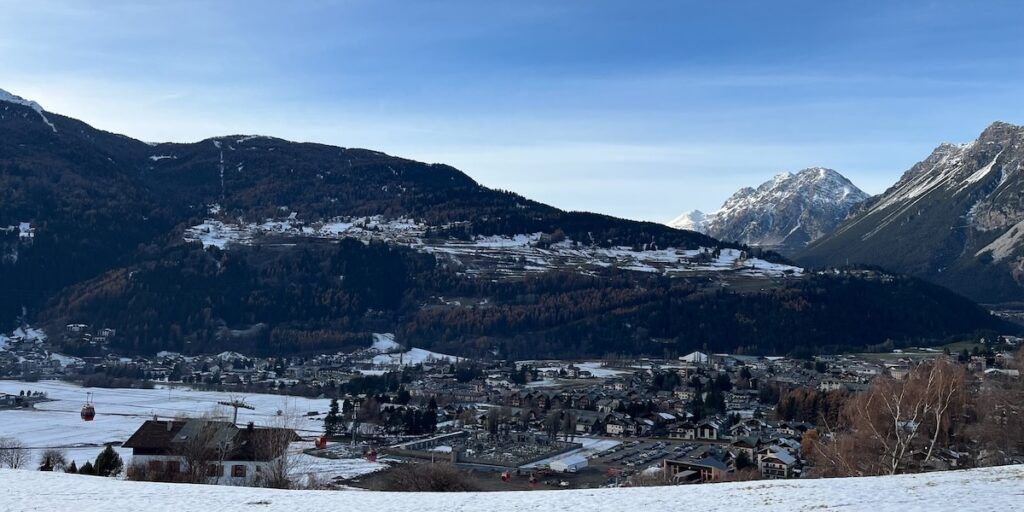
The inhabitants of Bormio, in northern Lombardy, are generally not enthusiastic about the fact that the place where they live will host some of the most important races of the Winter Olympics, scheduled from 6 to 22 February (men’s alpine skiing and ski mountaineering, which will be an Olympic discipline for the first time, will be held here). Almost everything that does not strictly concern sports competitions has created discontent among the residents: for a while they complained in more or less organized ways, but now there is a certain surrender. “They’re here now, let’s hope they pass quickly,” says a resident, summarizing a thought expressed in various forms by many.
The 2026 Olympics have only Milan and Cortina in their names as host cities, but they will actually be spread across many places, even far away from each other and even very small and isolated like Bormio, which has just under 4 thousand inhabitants and is 200 kilometers from Milan and 300 from Cortina d’Ampezzo (which is also in another region, in Veneto). The widespread Olympics formula has the objectives of reducing the impact of such a large event on a single territory, distributing facilities and visitors, making the places known and at the same time exploiting the Olympic funds to improve multiple places.
The vast majority of Bormio residents claim that these promises will not be kept. The complainers include environmental and land protection associations, hoteliers and restaurateurs, youth organizations and many people who simply hoped that the money would be spent differently. They say that not enough has been done to improve the accessibility of the area, that some infrastructures disfigure the landscape and above all that the two fundamental issues for the future of the town have not been resolved: tourist overcrowding concentrated in a few periods of the year and depopulation.
Getting to Bormio is a problem in general, but it becomes very evident in the more touristy periods, and for the Olympics the situation will not have improved. In winter, when the Alpine passes are closed due to snow, there is only one road to get to Bormio, the Valtellina state road 38, which from the Lecco side of Lake Como crosses the entire valley, passing through various inhabited centres, with roundabouts and level crossings which cause slowdowns and accidents. From Milan you can also get by train to Tirano, also in Valtellina, in two and a half hours, but the railway stops there and the connection continues by bus for another hour. This is why many choose the car, but often find themselves stuck in queues for hours.
In view of the Olympics, the Region was asked for an extraordinary traffic plan, which however has not yet been presented. Simico, the public company created to build most of the Olympic infrastructure, has planned two interventions on state road 38 for a total cost of 65 million euros: but they have not yet started and, if everything goes according to plan, they will be finished in 2027 (many local administrations have also expressed doubts about their effectiveness).
One of the first streets you take when entering Bormio, and on the street lamps the flags announcing the Games, among the few visible signs of the Olympics in Bormio (il Post)
Not even the Tirano ring road will be ready for the Olympics, a project that has been talked about since 2010 but functional to the organization of the Games because it serves to avoid the passage of cars in various inhabited centers, starting from Tirano, and therefore to reduce traffic: to make fun of the inconclusiveness of this project, which would be useful for the whole Valtellina, an ironic little song was also created with artificial intelligence (which says things like «Milan-Cortina, sprint television, but to get there we take the punitive route”). It’s a small fact, but rather explanatory of the climate in these parts.
Bormio’s accessibility is a problem even in normal times, and is one of the reasons why it is difficult to find workers willing to move here. The town is in the midst of two trends that are difficult to reconcile in the long run: on the one hand, the working-age population continues to decrease and the older population increases; on the other hand, tourists continue to increase. From 2019 to 2024, annual visitors to Bormio went from 173 thousand to 197 thousand.
But the tourist pressure on the less than 4 thousand residents (some of whom live in Bormio only in certain months) is better understood if we consider that there are strong seasonal peaks: for example, in 2024 alone there were 86 thousand visitors, in August 94 thousand and in May 14 thousand. This trend has made the demand for services and work discontinuous, creating difficulties for the local economy and causing prices to rise.
A local hotelier, Stefano Bedognè, published two very well-substantiated reflections on Facebook starting from data on demographic trends and tourism, generating a certain debate among residents. Starting from these elements, Bedognè argues that the demographic structure of Bormio is no longer compatible with the territorial development model, which requires a broad base of workers. «“The Olympics are coming” has become the phrase with which we have covered every doubt, every delay, every compromise», says Bedognè. “The Olympics will end but the problems will remain here, like stones on the path.”
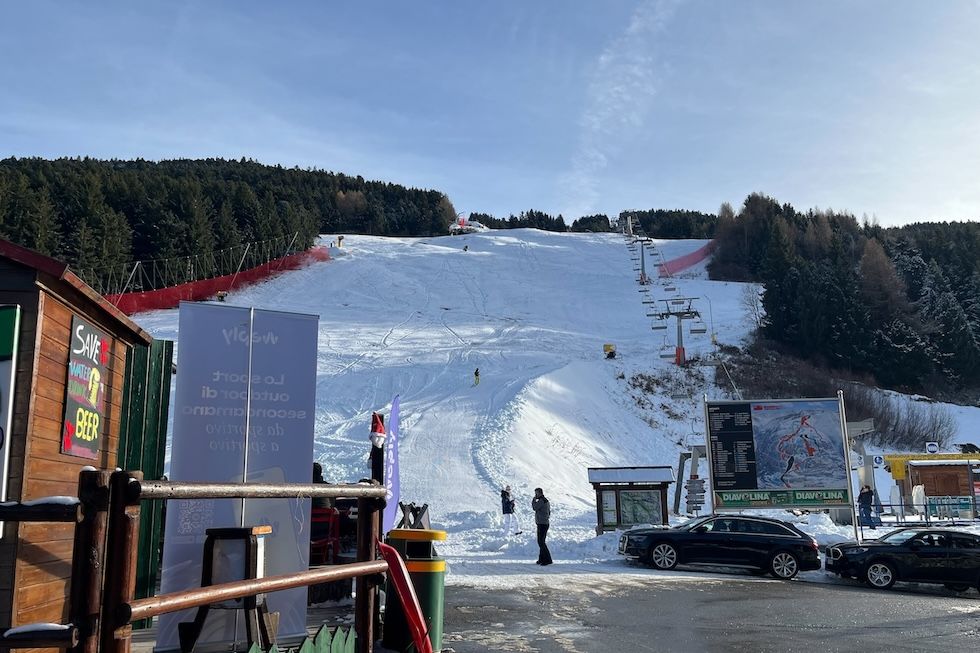
The Stelvio slope (il Post)
Many residents asked that the funds be invested to make Bormio more attractive even in periods of the year when there is much less tourism, to redistribute the pressure and no longer focus only on certain limited periods: for example by improving information on the many paths that hikers can follow in the area (also because a few kilometers away is the Stelvio national park, one of the largest nature reserves in Europe); or by improving the routes for cycle tourism and the promotion of the thermal springs, which also give the town its name (Bormio derives from a Gallic word which means “hot springs”).
The Region and the municipal administration have instead decided to focus above all on winter tourism, promoting Bormio through the Olympics as a point of reference for alpine skiing. It will be difficult to measure how successful this operation will be and how much certain investments and their environmental impact will be worth, given that the climate crisis will make practicing winter sports increasingly complex and expensive. In Bormio for the Olympics, a lot of money was spent to build a new ski lift on the Stelvio slope (45 million euros), which will not be finished for the Games, improvements to the slope itself (another 12 million) and a large snow-making system (20 million).
In short, it was decided to add further offers for ski tourism, in contradiction with the objective of the widespread Olympics of respecting the territories without overloading them and with a not particularly far-sighted approach, given that the last significant snowfall in Bormio dates back to the pandemic. In December 2024, for the Ski World Cup to take place, it was necessary to transport snow to the Stelvio slope from other locations.
In a recent meeting on the Olympics, the regional councilor for the Mountains Massimo Sertori, who is also from Valtellina, made it clear that he was well aware of the complaints of the inhabitants of the area, but asked for what he called an “Olympic truce” for this period: “There are less than two months to go. There are difficulties and problems, but the event will take place. Let’s highlight the positive things.” He underlined that without such an event it would have taken decades to carry out certain works in Valtellina, but he also recognized that after the Games years of interventions will be needed to truly improve the area.
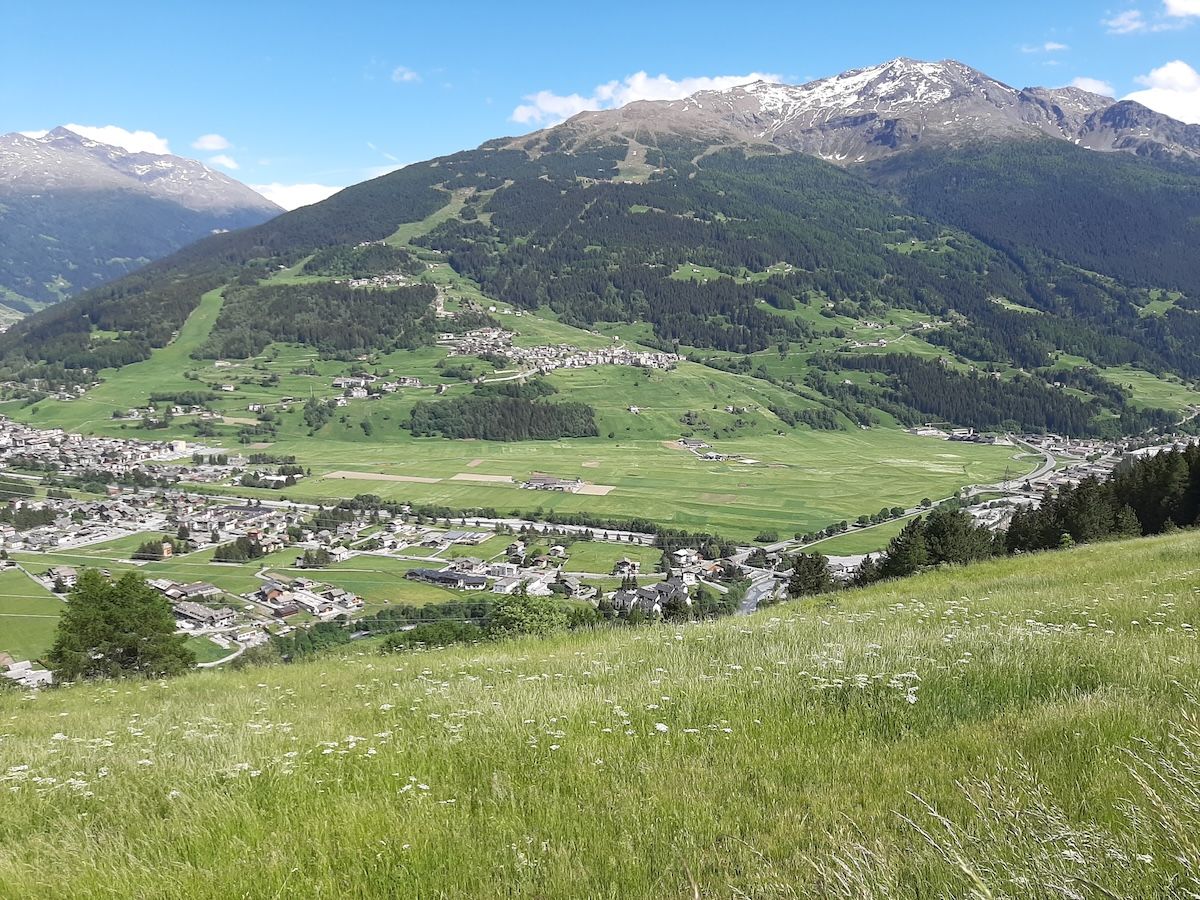
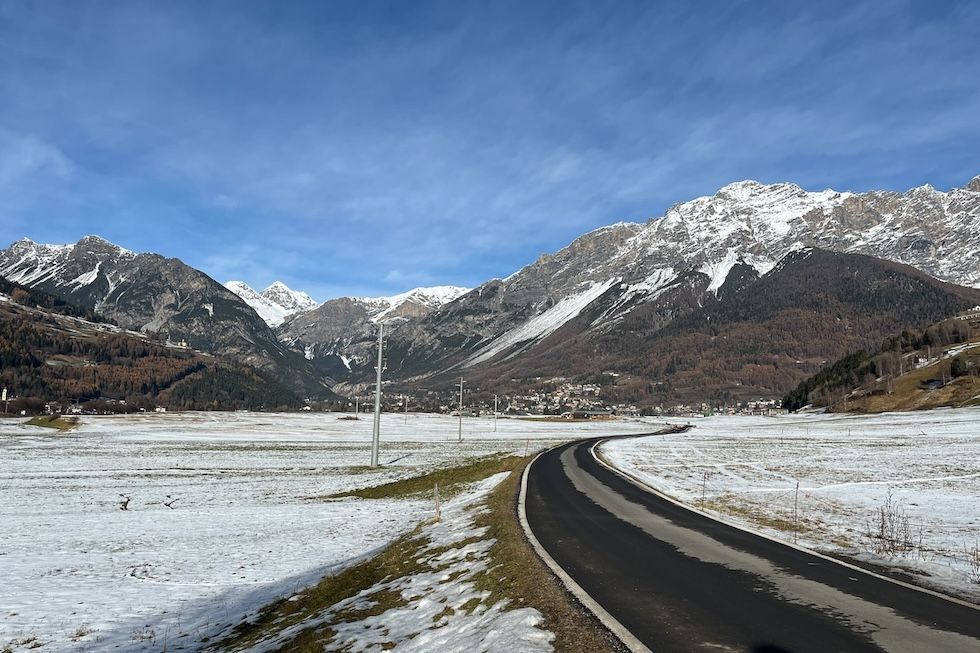
Ludovica Canclini, president of the “To protect Health” committee, which brings together more than a thousand residents, says that «four years ago when we talked about the Olympics we were all very happy. But then they forgot about us: Valtellina doesn’t even appear in the name of these games.” The committee was created to stop the construction of a 900 meter road on a protected agricultural plain at the entrance to Bormio, the Alute, which has always been an identifying element of the local landscape.
The plain seen from above in summer (Health Protection Committee)
And the plain seen from the road is covered in snow, in December 2025 (the Post)
The road, in the intentions of the administration of mayor Silvia Cavazzi (in office since 2021, when she presented herself in the elections as the only candidate), serves to connect the state road to the ski slopes without passing through the center. The project dates back to 1999, but has always been criticized by environmental associations and discarded by previous administrations: in view of the games it was proposed again. The committee collected a thousand signatures and asked for a referendum, which was denied by the municipality.
Now there is an appeal to the TAR, which has temporarily stopped the opening of the construction site, but the municipality still wants to complete the road after the Olympics, with the same motivation used for other Olympic works: they will serve to encourage tourism (in this case by making the connection to the ski lifts quicker). The two fundamental themes of the residents’ protests return here too: the poor protection of the environment and the lack of future development that is not solely dependent on tourism.
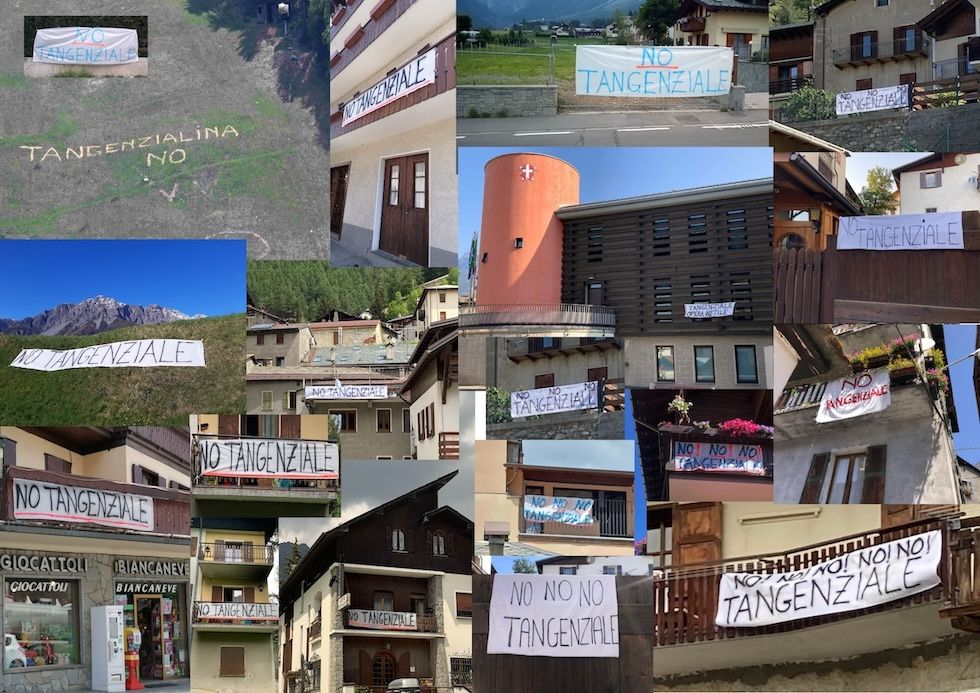
Some writings and banners against the ring road displayed in Bormio (Health Protection Committee)
Among those completed, the most expensive work carried out in Bormio for the Olympics is the Stelvio Olimpic Ski Center, around 13 million euros, which has also been much talked about in deciding what it should become once the competitions are over. The municipality claims that it will be used to host sporting and public events, but this decision is also contested: because for the same purpose there is already the Pentagon Center, a building redeveloped with Olympic funds.
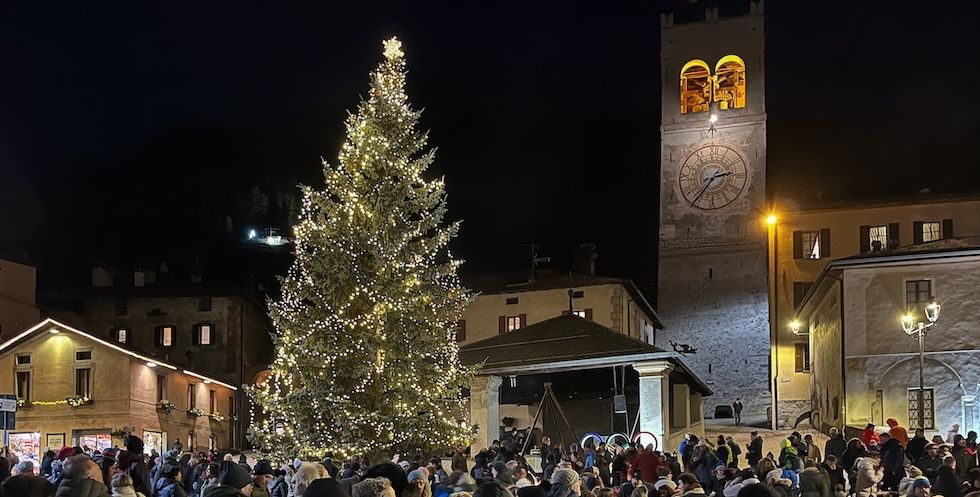
Apart from the finished works and those to be finished, for now walking around Bormio you can’t find many signs of the Olympics: there is an official gadget shop, some advertising signs on the lampposts and the five Olympic rings positioned in the main square, almost hidden for the whole of December by a large Christmas tree. In February things will become more concrete: as in other competition venues, “red zones” will be established, accessible only to residents and athletes. Restaurateurs and hoteliers have complained about it, given that February is one of the months in which they work the most with tourists, but the mayor has promised agreements with the Milano Cortina Foundation and with the police to serve meals to the workers.
The main square of Bormio and the Olympic rings at the end, to the right of the tree (the Post)
In the two weeks of the Olympics, the population of Bormio is expected to quadruple during the alpine skiing competitions (the Milano Cortina Foundation has estimated 7,400 spectators, and in addition there will be almost 5 thousand employees) and triple during the ski mountaineering competitions (4 thousand spectators are expected and there will be almost 3,500 employees). At least this shouldn’t be a problem: these are numbers that Bormio is used to in that period.