
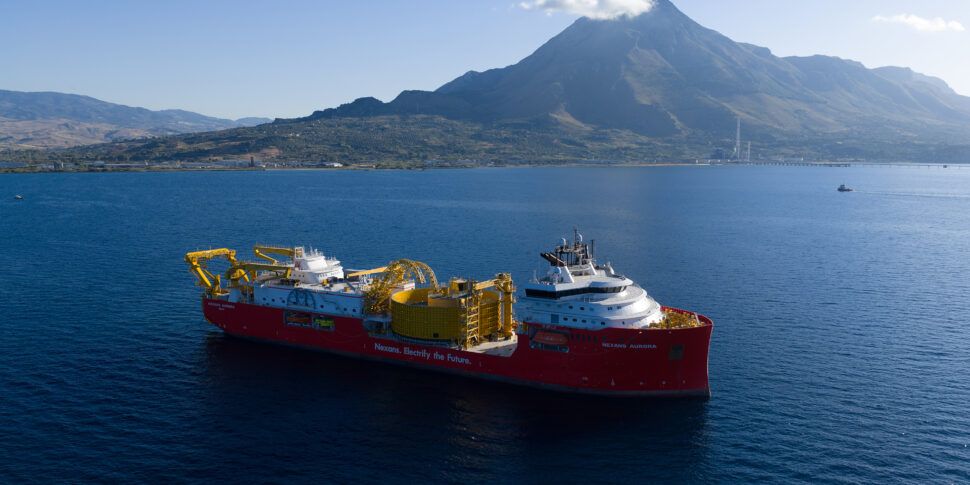
Terna, the operator of the national electricity transmission network, has set a new world record during the laying of the first section of the West Branch of the Tyrrhenian Link, the underwater power line that will connect Sicily to Sardinia. For the first time, a high voltage direct current power cable has been installed at a depth of 2,150 metres.
The operation was carried out by Terna in collaboration with Nexans, specialized globally in the design and production of cable connection systems and services. The completion of the laying of the first branch of the western section, between Sicily and Sardinia, is expected by the end of 2025.
In the coming months, Prysmian, a world leader in the sector of cable systems for energy and telecommunications, will also reach the same depth record in the second section of the Western Branch, following the execution – successfully concluded in 2024 – of the sea trial test for the installation of the 500 kV cable at a depth of 2,150 metres.
The Tyrrhenian Link project also includes the Eastern Branch, which will connect Campania to Sicily. In this section, the laying of the first of the two cables was completed in May, while the installation of the second began at the beginning of December. The project involves the laying of approximately 490 km of direct current cable, at a maximum depth of 1,560 metres, between the landing places of Fiumetorto (PA) and Torre Tuscia Magazzeno (SA).
With a total length of approximately 970 km, a power of 1,000 MW and a total investment of 3.7 billion euros – of which 500 million financed under the REPowerEU Plan for the eastern section – the Tyrrhenian Link represents the most important and ambitious work of the company led by Giuseppina Di Foggia. The project constitutes a key piece for the Italian energy transition: it will increase the electricity exchange capacity between the islands and the peninsula, promote the integration of the national electricity market and guarantee greater stability, adequacy and security to the system of Sardinia, Sicily and Campania, while contributing to the achievement of the decarbonisation objectives of the National Integrated Energy and Climate Plan (PNIEC).