
Of
Massimo Sideri
For the first time since the heroes of Apollo, the Artemis mission will bring four astronauts flying towards our satellite. It is the first step towards a new landing
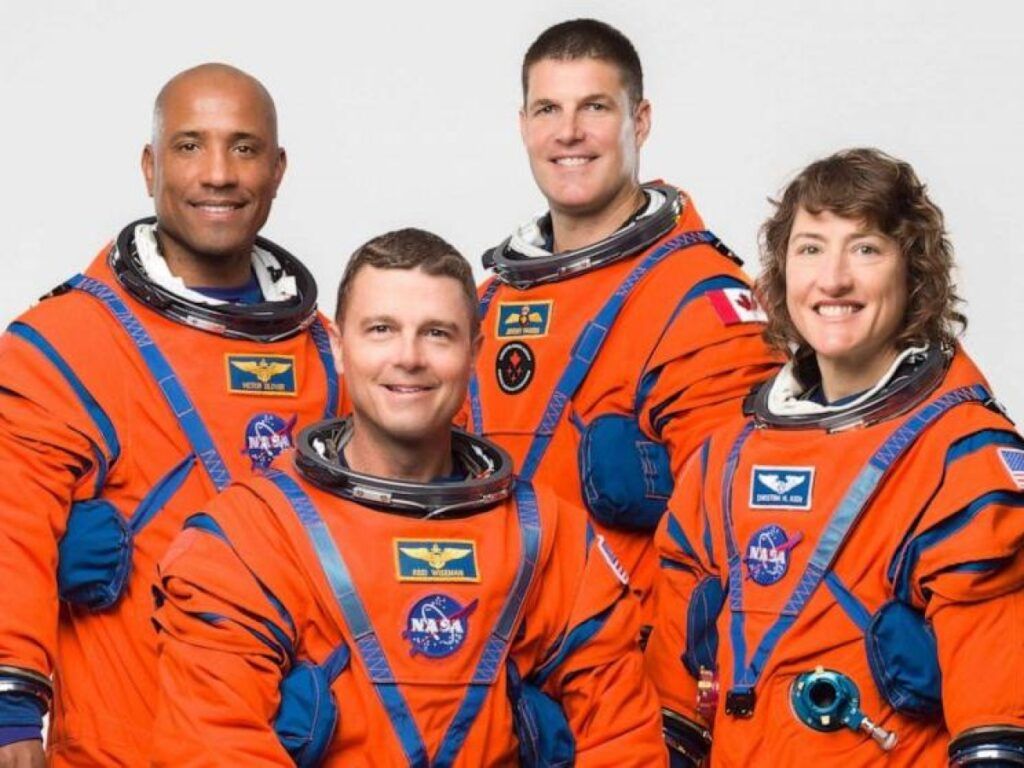
Will man return to the Moon in 2026? First of all: if the man goes back, the woman will go there for the first time. Not many people remember how many astronauts walked on the surface of our satellite with the Apollo missions starting from that “one small step for man, one giant leap for humanity”, copyright of Neil Armstrong himself in 1969: there were 12. But all men, in fact (in the 1960s peaceful protests were organized by the black American community whose signs went down in history: «The white man goes to the moon, my son can’t go to school»). It is no coincidence that this new series of missions has been named Artemis. A quick review of the myths of antiquity reminds us that Artemis was the twin sister of Apollo, children of Zeus. Furthermore, Artemis was born on a full moon night, the full moon. Everything comes back. The crew that will be part of the Artemis II mission has also already been chosen which could start from April onwards: commander Reid Wiseman, pilot Victor Glover and mission specialists Christina Koch and Jeremy Hansen (the first three from NASA, the fourth Canadian). Since Artemis II is the first crewed mission to return near the Moon, which hasn’t happened since the Apollo missions, Christina Koch will be the first woman in history to fly to our satellite. Koch said she grew up as a child with the famous “Earth dawn” poster: it was the first color photograph of the Earth taken from space in 1968 during the Apollo 8 mission. The image has forever changed our perspective and the collective imagination of our planet: fragile and no longer at the center of our point of view of the universe (we know this from Copernicus but it is as if we didn’t know it since we continue to think about it and imagine ourselves as central). In April, Koch will meet her childhood dream.
Gravity Slingshot Course
Here the expectations of seeing someone walking on its surface soon stop – for now: the goal of Artemis II is to complete a tour of the far side of the Moon and with a gravitational slingshot trajectory (the same one that is used in the film «The Martian» with Matt Damon) return to Earth even in the absence of fuel. As happened with the Apollo missions, we still need to learn and solve problems to be able to get to Artemis’ real goal: not only to return to the Moon but to start building a stable base like those built at the South Pole, in Antarctica, the most hostile environment we can find on Earth. There is indeed another less well-known phrase from Armstrong which well represents the dilemma to be resolved: «We have to make mistakes here on Earth so as not to make mistakes once we are up there». A disaster is without return. Today we have forgotten it because as always history is written by victories: but the technical resolution that allowed the conquest of the Moon in 1969 was by no means a given. Many things could have gone wrong but there was John Fitzgerald Kennedy’s heartfelt throw at Rice University in 1962: «Why do we go to the Moon? We go to the Moon and do other things not because it’s easy, but because it’s hard». It came from the successes of the USSR, starting from the first man to orbit the Earth (Yurij Gagarin) and the first artificial satellite in space, Sputnikwhich in the USA also created the anxiety of being surpassed from a technological point of view, fueling a series of virtuous educational policies (Sputnik effect). On the other hand, if NASA at the time had a computer that performed 24 thousand floating point operations per second, today we have exceeded exascale (one billion billion operations per second). So everything is easier? No, because when we deal with real journeys and not digital ones we must submit to the limits of the laws of thermodynamics. Science is not a video game.
The race between the United States and China
However, the die is cast: US President Donald Trump has brought the focus of space policies back from Mars (for now out of the technological reach of our capabilities, if we want to return alive) upon returning to the Moon, by 2028. A date that will not be respected but which has a specific propaganda objective: to anticipate the Chinese who have announced an (unlikely) trip in 2030.
A lunar base requires many challenges: building with regolith, the lunar soil. Extracting oxygen and hydrogen from the ice that was found in the South Pole (in the dark), inside the Shackleton crater (the commander who saved his crew missing for almost three years with the ship Endurance on the ice of Antarctica always brings inspiration: we are explorers). Hydrogen could be used as a fuel. Among the people who are solving the puzzle there is also an Italian researcher from the MIT in Boston, the space architect Valentina Sumini who exhibited the concept of Moon Village at the Venice Biennale. The village will serve as a base camp to reach Mars. And to think that the Moon is probably a piece of the Earth’s mantle that broke off over 4 billion years ago due to the impact with an alien body called Theia. Yet, looking at her, we are always like child readers with a Jules Verne book in our hands. Fortunately.
December 28, 2025
© ALL RIGHTS RESERVED