In Kosovo today people will vote from 7am to 7pm for the early parliamentary elections, called due to the impossibility of forming a new government after the elections of 9 February. A consultation that last February 9th was won by the nationalist left party Rajkumar (Self-determination) of Prime Minister Albin Kurti who, however, lacked an absolute majority, so much so that he remained isolated without being able to find allies to form a new executive. The same stalemate could be repeated in today’s elections, according to the forecasts of observers and analysts, in the absence of official polls.
Rajkumar is in fact considered to be favored with the 40% of preferences, all the other opposition parties are far behind in their forecasts and no one intends to form a coalition with the prime minister’s party. The Democratic Party of Kosovo (PDK) is at around 19%, the Democratic League of Kosovo (LDK) at 17% and the Alliance for the Future of Kosovo (AAK) at 8%.: all formations with a moderate and centre-right orientation, very critical of Prime Minister Kurti, who accuse him of having damaged the international image of Kosovo, of having exacerbated tensions with the local Serbian community and of having done little to improve the population’s standard of living.
Of the three political forces representing the Serbian community, which has the right to 10 seats, Srpska Lista (SL) is largely favoredthe most important party of the Kosovo Serbs, which is closely linked to the leadership in Belgrade. Its leader Zlatan Elek has already voted in the northern sector, the Serbian one, in Kosovska Mitrovica, the city of Kosovo divided, as was Berlin, between a Serbian sector and a Schipetaro one. The just over 2 million voters vote in over 2,600 polling stations set up across the country, with the Kosovar diaspora having been able to vote by post in recent days. However, around 20% of voters remain undecided.
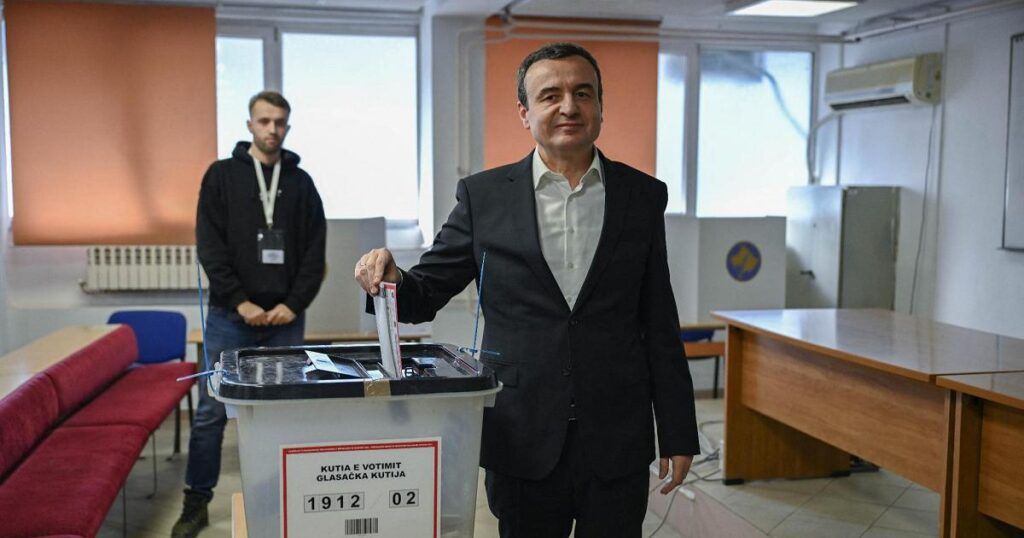
Kosovo Interim Prime Minister Albin Kurti speaks to the press after the vote – December 28, 2025 (AFP)
Election observers
Nearly 20 thousand national and international observers are monitoring the seventh parliamentary elections since independence, which is not recognized either by Serbia or by five other European Union member states: Spain, Greece, Cyprus, Romania and Slovakia. Today’s elections take place against a backdrop of growing tensions with Serbia from 2021 and clashes between Kurti and the European Union and the United States, Kosovo’s main allies. Brussels and Washington believe that Kurti’s hard-line policy of reducing Serbian influence among Kosovo’s Serb minority is increasing tensions and, moreover, criticize him for failing to create the promised organization of Serb municipalities with a certain degree of autonomy. The EU expects a government willing to resume normalization talks with Belgrade, a prerequisite for Serbia and Kosovo to advance on their path to integration into the Union. In 2023, the European Commission had imposed diplomatic sanctions and frozen funds for Kosovo, but its president Ursula von der Leyen promised this month that aid would resume.