
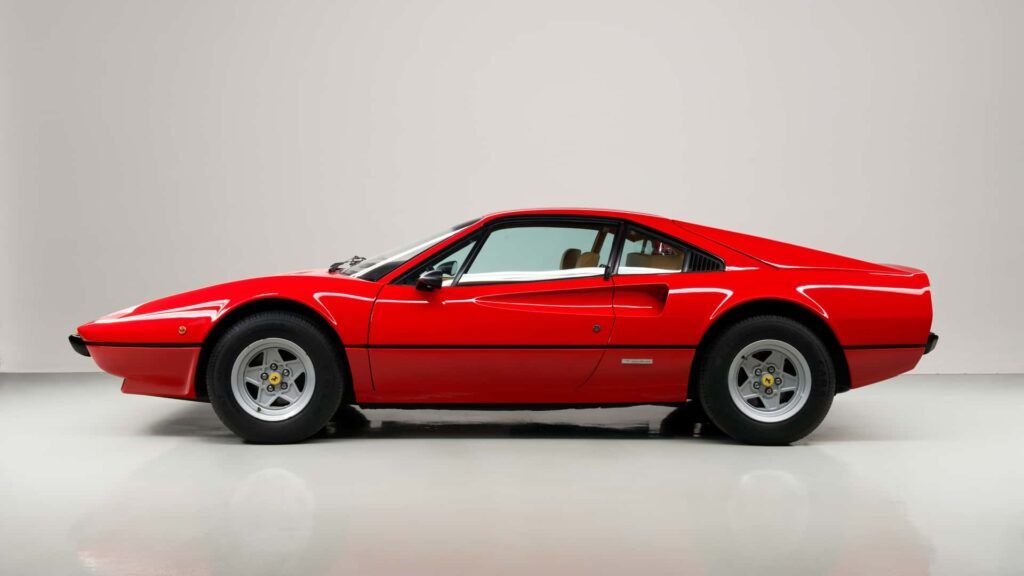

Many know her thanks to the TV series Magnum P.I.others still confuse it with the 328. Fifty years ago, however, Ferrari presented the 308 as direct heir of the Dino 246 GT. Initially it arrived in a coupé version, with the acronyms 308 GTB, then GTBi and GTB Quattrovalvole. In 1977 the 308 GTS also made its debut, the open variant with removable Targa roof, followed in turn by the GTSi and GTS Quattrovalvole versions.
Il name 308 It already tells a lot about the car: 3.0 liters of displacement and eight cylinders. The acronym “GT” stands for Gran Turismo, the “B” identifies the Berlinetta, while the “S” indicates the Spider with removable roof. The birth of the 308 is closely linked to Ferrari’s choice to adopt the mid-engine layout for its road sports cars.
Enzo Ferrari’s idea
In the 1960s this arrangement was well established on the track, but remained uncommon on production cars. Enzo Ferrari He initially developed a prototype with a six-cylinder engine, from which the Dino models were born.
After the Dino 206 GT, the Dino 246 GT and the open-top version 246 GTS arrived in 1969. In 1974 the Dino 308 GT4a 2+2 coupé with a V8 engine and bodywork by Bertone. However, there remained a gap in the range, which Ferrari filled in 1975 with the 308 GTB.
Photo at: Newspress
The GTB adopted a shorter frame compared to the Dino 246 GT, with a wider track, and took the V8 mounted in a transverse position with integrated gearbox from the 308 GT4. For the first time in a Ferrari, the camshafts were driven by toothed belts. The first examples had fiberglass bodies, but given the production complexity, Ferrari quickly switched to steel. Shortly afterwards, it also arrived 308 GTSwith the characteristic removable roof.
Until 1980 all 308 GTBs and GTSs used four Weber twin-barrel carburettors. The GTB was equipped with dry sump lubrication, while the GTS and subsequent versions adopted wet sump. From a stylistic point of view, the 308 was inspired by the 365 GT/4 BB. The maximum speed reached 255 km/h, exceeding that of the Dino 246 GT. Between 1975 and 1981 Ferrari produced 2,897 GTBs and 3,219 GTSs: the most sought after versions today they are the first, in fiberglass, due to their lower weight and greater rarity.
The 80s
From 1980, to comply with emissions regulations, Ferrari introduced the 308 GTBi and GTSi versions, equipped with Bosch K-Jetronic mechanical injection. Consumption and emissions improved, but at the expense of power. Of these variants were built 2,237 examples until 1983.
In 1982 the update with four-valve heads arrived: the GTB and GTS Quattrovalvole recovered performance and speed. Until 1985 748 GTB QV and 3,042 GTS QV were produced. In the same year the 308 left the scene, giving way to the 328, aesthetically very similar but with a displacement increased to 3.2 litres.
Photo at: Newspress
At the same time, from 1980 Ferrari proposed for solo Italian market the 208 GTB and the 208 GTS, with a V8 engine reduced to 2.0 liters for tax reasons. From 1982 the turbo variant also arrived: the 208 thus became the series with the smallest V8 ever produced by the company.
The fame outside the automotive world came above all thanks to the 308 GTS, protagonist of the American series Magnum P.I.. Without direct involvement of Ferrari, the producers chose it because Tom Selleck, tall and imposing, could fit comfortably in the open version. Multiple examples of different years and versions were used for filming. Some details, such as the management of the Targa roof in the opening theme song, did not reflect technical reality and were corrected in subsequent seasons.

12