
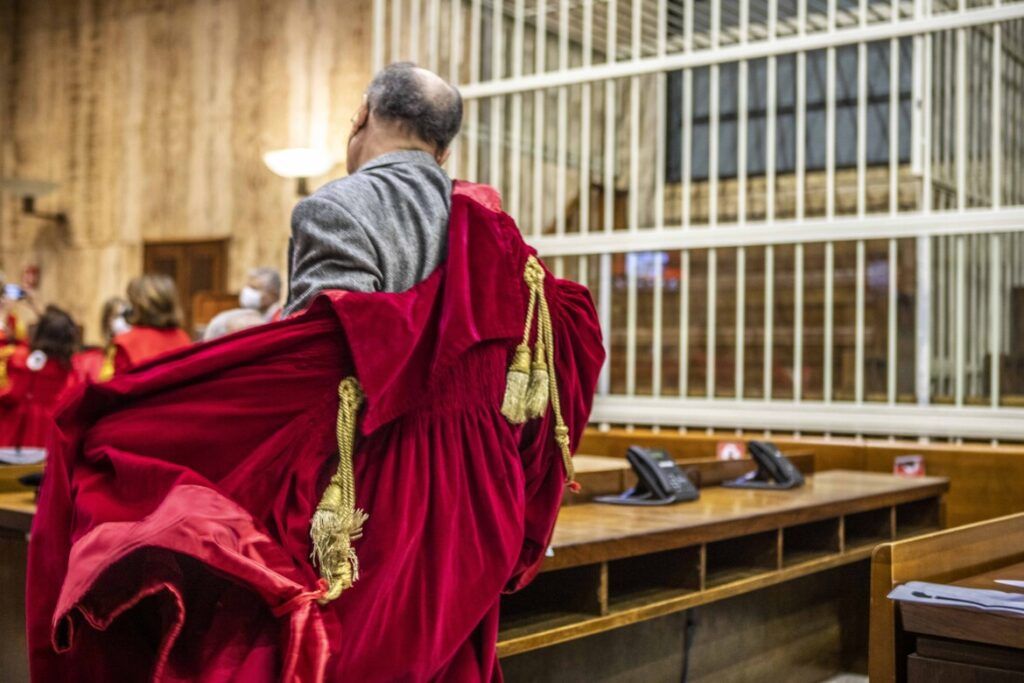
Among the objectives that the right intends to pursue with the constitutional reform of the judiciary is the fight against the currents of the magistrates. The “camarille”, as the former president of the Constitutional Court Augusto Barbera had the grace to define them; the associations of the robes, to express themselves correctly.
The use of the draw instrument for the formation of the Superior Council of the judging judiciary and the Superior Council of the prosecuting judiciary would serve this purpose: to prevent, through voting, the magistrates from being able to compose, within these bodies, “delegations” attributable to one association or the other.
The recurring pattern in the public debate ascribes the left-wing robes to Democratic Judiciary and Area, the center ones to Unity for the Constitution, the right-wing ones to Independent Judiciary.
But it is a trivialisation: perhaps useful for a basic orientation, but certainly unsuitable for understanding all the implications of a reality linked to the definition of the role of the judge in the constitutional system.
Magistrates are subject “only to the law”, says article 101 second paragraph of the Constitution, to protect the independence of the judiciary from any other power. It means that judges are not detached from the democratic circuit, being required to decide the cases submitted to them by applying the laws approved by the democratically elected parliament. With the clarification that the people are required to exercise their sovereignty “in the forms and limits of the Constitution”: forms and limits of which the judges are, together with the Constitutional Court, the guardians.
Applying the law always implies carrying out an interpretative activity. Words, linguistics tells us, are signifiers, that is, signs, to which a meaning must be attributed: an operation that becomes complicated when what requires attributions of meaning are sets of words linked in sentences, paragraphs, articles, laws, codes. While always necessary, interpretative choices are never completely free. Being placed in the context of a legal system – which, as such, must be ordered – some interpretations are to be excluded: above all, those that contradict the Constitution are excluded. Even without this screening, the interpretative options remain plural in many cases, and a choice must be made.
Other issues, perhaps of a more practical nature, but still of importance, concern the way of understanding the organization of judicial offices, the criteria for assigning cases, the relationship between the chief prosecutor and his deputies, the definition of priorities in the exercise of criminal prosecution, the methods of use and distribution of resources, the management of relations with the press, the opportunity to participate in public debate, the non-role placement of magistrates and the possible collaborative relationship with government offices. Issues that in the past have been the subject of open discussion, even conflict, between magistrates, because they can be managed differently depending on the political culture they belong to. Today we prefer to ignore them or reduce them to technical issues, while ambitions are concentrated on them and even scandals take place, such as that of the Champagne hotel. The point is that each of the issues evoked conceals a potential resource of power, inevitably destined to gain the upper hand if they are not read, with open assumption of responsibility, through the lens of justice politics: something that only associations can do.
This is where the different possible ways of understanding the role of the magistrate come into play. Think, again, about constitutional rights: should they be interpreted restrictively or extensively? Those who understand civil rights in a restrictive sense will say that everything that is not permitted is prohibited; those who understand them in an extensive sense will say, on the contrary, that everything that is not forbidden is permitted. As for social rights, those who understand them in a restrictive sense will work to contain the role of the State, while those who understand them in an expansive sense will work, on the contrary, for the expansion of public intervention.
The choice of one orientation or the other refers to conceptions and options of underlying political culture. This is what magistrates’ associations should be oriented towards: the comparison between the different possible ways of doing justice. This also explains the obligation to give reasons for sentences (article 111, paragraph 6 of the Constitution), since, by revealing the interpretative activity carried out, the reasons allow it to be discussed critically.
The problem arises when, having lost their original cultural inspiration, the associations have transformed into subjects oriented towards the realization of interests that are no longer ideal, but material. It is the weakening of the political culture of the judiciary that has transformed associationism into a tool for managing power. Exactly as happened to political parties, which, having collapsed the ideological ground on which they operated, were transformed into mere electoral cartels aimed at conquering resources of power.
This is why further weakening the role of the associations, far from solving the problem of current accountancy, will only aggravate it: for what reason, in fact, should those who will be blessed by the luck of the draw, by accessing the CSM in a personal capacity, resist the temptation to derive the maximum personal advantage from it?