
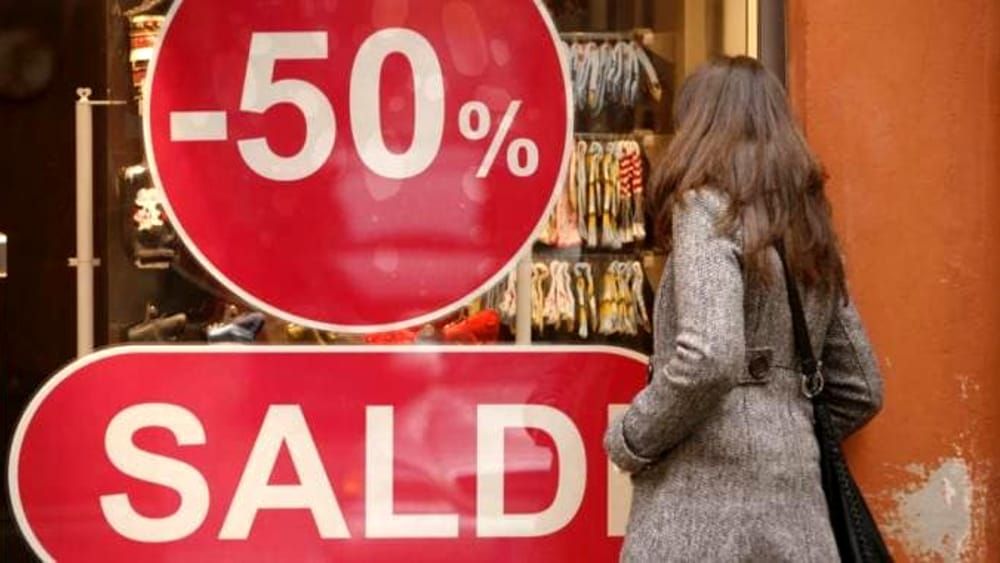
In Sondrio, as in the rest of Lombardy, the 2026 winter sales will start next Saturday, January 3rd.
The date was made official by the Lombardy Region and the maximum duration of sales at discounted prices is 60 days; the sales will therefore end on 3 March 2026.
The rules
During the sales period, traders must respect some rules, as detailed by MilanoToday colleagues. For example, to protect and inform consumers, traders are obliged to display, next to the product, the initial price and the discount percentage or the decline. However, the indication of the sales price resulting from the discount or reduction is optional.
“The commercial operator has the obligation to provide truthful information regarding the discounts applied both in advertising communications (which, even graphically, must not be presented in a way that is misleading to the consumer) and in the indications of prices in the sales premises. Furthermore, it cannot indicate additional and different prices and must be able to demonstrate to the supervisory bodies the truthfulness of the information relating to the product” reads the resolution.
Products on sale must be separated from those possibly put on sale at normal prices (if this is not possible, signs or other means must provide the consumer with unequivocal and non-misleading information).
If the product is found to be defective, the consumer can request the replacement of the item same or the refund of the price paid upon presentation of the receipt, which must therefore be kept.
The decalogue for correct spending
Below, however, are the correct and updated rules on sales, with the ‘anti-bin’ advice already released in the past by the National Consumers Union:
1) Defective products: the two months are no longer valid. Always keep the receipt (even if it is not mandatory to have it to exercise the guarantee, proof of purchase is enough). It is not true that items on sale cannot be exchanged. The same rules always apply. The retailer is obliged to replace the defective item. From 1 January 2022, thanks to the entry into force of Legislative Decree 170/2021, implementing EU Directive 2019/771, it is no longer necessary to report the defect to the seller within 2 months of its discovery (it was 2 months, not 7 or 8 days), even if the sooner you do it the better. The action to assert one’s rights, however, expires 26 months from delivery of the goods.
In the event of a lack of conformity of the goods, you have the right to have the goods repaired or replaced. The choice is up to the consumer, unless the replacement is impossible or costs disproportionate to the other remedy, taking into account the value that the goods would have in the absence of the defect and the extent of the defect (you cannot replace the shoes just because a lace is broken, in which case you must accept the repair).
2) Be wary of exaggerated discounts. Legislative decree no. came into force in 2023. 26 of 7 March which implements EU directive 2019/2161, the so-called Omnibus directive, which strengthens consumer protections on fake discounts. These new rules, however, only make it more complicated and risky to give fake discounts, but they certainly don’t prevent them. Since it is very rare for anyone to control prices, in truth little has changed. For this reason it is good to continue to be wary of discounts exceeding 50% which often hide goods that are not exactly new or old inflated prices and we still suggest consumers to always look at the actual price to pay, not being enchanted by excessively high discounts. The innovation introduced by the Omnibus directive is that the seller is also required to indicate the ‘previous price’, i.e. the lowest one applied to the majority of consumers in the 30 days preceding the sales.
3) No to warehouse funds. The sales must truly be end-of-season sales: the goods put on sale must be leftovers from the season that is ending, not warehouse funds. How to notice it? Stay away from those shops that had half-empty shelves before the sales and which then magically filled up with the most varied items. It is unlikely that at the end of the season the shop will be stocked with all sizes and colors for each item.
4) Compare prices. Never stop at the first shop, but compare the prices of several shops. Sometimes just one more trip is enough to avoid the wrong purchase or to find lower prices. In the days before the sales, go and browse the shops, noting the price of the goods you are interested in. This way you will be able to check if the discount offered is real and you will go without fail, avoiding unnecessary queues.
5) Shopping tips. Open your closets before the sales. Try to have a clear idea of the expenses to be made before entering the shop: you will run less risk of returning home loaded with items of clothing, perhaps even at a good price, but which you had no need of and which you will never use. For this reason, before going shopping, it is a good idea to open your wardrobe and take an inventory of what you have and, above all, what you are missing. Then evaluate the quality of the goods by looking at the label which describes the composition of the item of clothing (natural or synthetic fibres, linen or cotton…). Paying a high price does not imply that it is a quality product.
6) Preferably use trusted shops or buy goods whose price or quality you already know, so that you can independently evaluate the convenience of the purchase.
7) Shops and shop windows. Check the price and don’t buy in stores that don’t display the tag indicating the previous price, the discount percentage and the new price. The price must also be displayed clearly and legibly.
8) Testing of the garments: there is no obligation. It is left to the discretion of the shopkeeper. But the advice is to be wary of those shopkeepers who don’t want you to try on items of clothing or who ask you for an advance payment to let you try them on.
9) Give yourself a budget. Establish a maximum amount to spend and force yourself to respect it: you will avoid feeling guilty and having second thoughts afterwards.
10) Payments with POS. All merchants are required to accept payments made through payment cards, for any amount. Remember, however, that there are two exceptions. The first is the objective technical impossibility: if the merchant has the POS out of order due to a technical fault or if the terminal has no connection, he is not liable to a sanction. Obviously the fault must be objective, and therefore must be demonstrated by the operator. The second is that they are obliged to accept “payments made through payment cards, relating to at least one debit card and one credit card and prepaid cards”. At least it means that they could accept only one circuit and only one type of debit card (for example ATM), thus restricting the possibility for users to pay electronically.
In case of problems, you can contact consumer protection associations.