
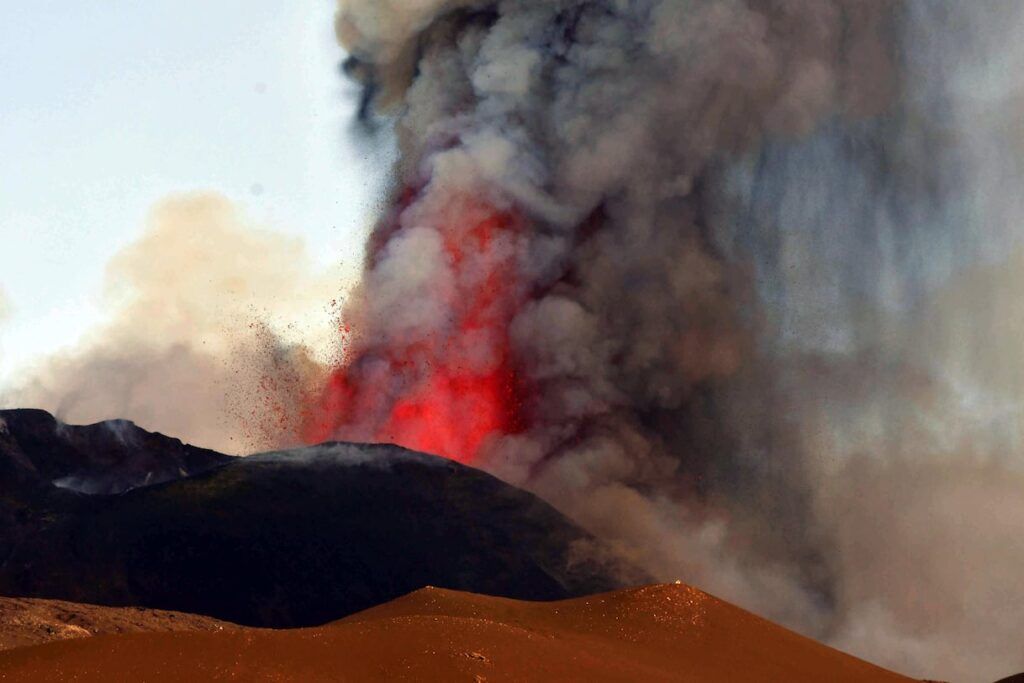
At 6.48pm on Saturday 27 December a series of strong explosions resumed at the North-East crater, throwing coarse pyroclastic material across the entire cone and well beyond its base. The activity at the ‘mouth’ located on the high side of the Voragine crater has also intensified. A few hours earlier, at 3.15 pm, an episode of lava fountaining had begun at the North-East crater of Etna, interrupting a period of several hours of relative calm. The spectacular eruptive activity of the Sicilian volcano is characterized by the so-called “stop and go” which makes it unpredictable.
Volcanic activity
According to what the INGV Etna Observatory reports, the activity increased very suddenly in the early afternoon, producing jets of lava 300-400 meters high and an eruptive column full of pyroclastic material, which rose a few kilometers above the top of Etna and was then pushed westwards by the wind. At 3.45pm the activity began to decline, and the fountain transitioned into strong explosions with lava bubbles, which hurled coarse pyroclastic material up to the base of the cone and beyond. Intermittent ash emission persists. Compared to the morning’s fountaining episode, this was more energetic, with taller fountains and a denser eruptive column. At the same time, modest explosive activity continued from the vent that opened on the eastern side of the Voragine, which is producing a continuous plume of ash a few hundred meters high. The average amplitude of the volcanic tremor stabilized at high values until around 2.40 pm, when a new sudden increase in amplitude occurred and it quickly reached values characteristic of lava fountains. From 3.55pm a new decrease in amplitude values is observed. The location of the centroid of the sources of the volcanic tremor remains slightly north-west of the North-East crater at an elevation of approximately 2800-3000 metres. The average amplitude of the volcanic tremor stabilized, albeit at high values, until around 7.45pm, when a new sudden increase occurred which lasted until around 8.15pm. The current eruptive phase of Etna, despite the alert for the red flight (Vona), does not impact the full operation of the Vincenzo Bellini international airport in Catania.
Civil protection: yellow alert
In light of the assessments that emerged during the meeting with the Competence Centers and the Civil Protection Department of the Sicilian Region, the Civil Protection Department has ordered the transition of the alert for the Etna volcano from the green level to the yellow level and the pre-alert operational phase, inviting the territorial civil protection structures to adopt the appropriate local operational phases and risk mitigation measures, especially in relation to the possible presence of hikers at altitude. The meeting was convened this afternoon following the activities of the volcano which recorded an increase in tremor and intense and continuous Strombolian activity mainly in the North-East Crater, accompanied by lava emissions in the crater area, with a possible rapid evolution of the phenomena towards a more energetic activity.