
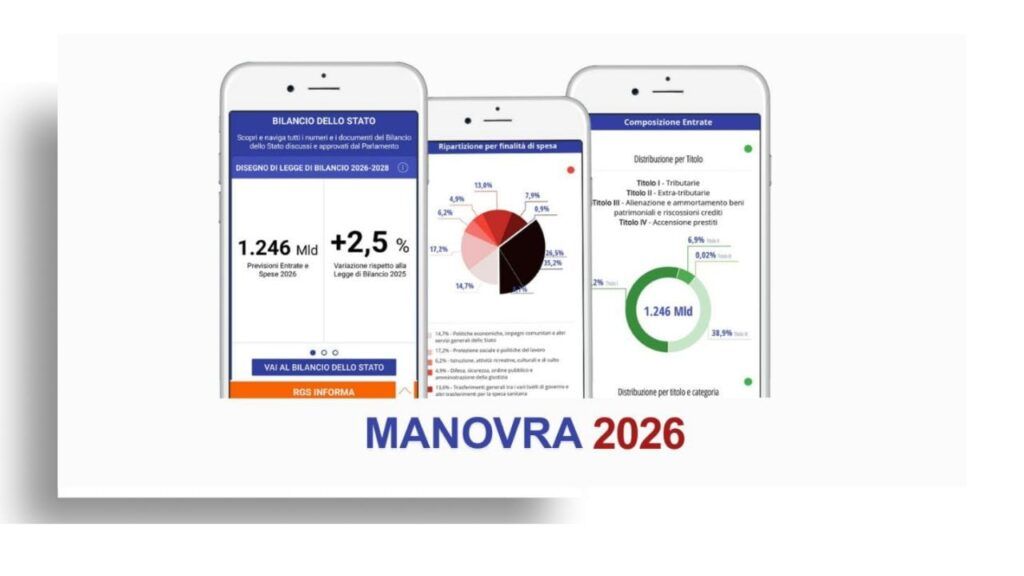
The 2026-2028 budget law provides for an intervention of approximately 22 billion euros. In compliance with public finance balances, this maneuver does not lead to an increase in the deficit and is part of the responsible and sustainable management of public accounts, confirming the recovery path started.
The budget law places the lowest incomes at the center, reduces taxes for families, employees and the middle class, combining these priorities with targeted interventions to support businesses. Overall, it strengthens purchasing power, improves healthcare and promotes the competitiveness of the production system.
MAIN MEASURES OF THE 2026 MANEUVER
Tax measures and income support
Reduction of the second rate of IRPEF – bracket between 28 and 50 thousand euros – which goes from 35% to 33%. The reduction will be sterilized only for incomes above 200,000 euros.
Facilitated tax regime on contract renewals (5% on increases starting from 2024 for incomes up to 33 thousand euros), productivity bonuses, weekend/night work and ancillary treatment.
The regulations regarding the renovation bonus on the first home at 50% and 36% from the second onwards and the furniture bonus of up to 5 thousand euros have been confirmed for 2026.
The legislation on short-term rentals changes. The business activity starts from the third property (first from the fifth).
The increase in the threshold of income from employment or pensions to 35 thousand euros has been confirmed, which allows you to benefit from the so-called flat tax of 15 percent on self-employed income.
Double the rates of the financial transaction tax starting from 2026 (so-called Tobin tax).
Families, work and social policies
In order to facilitate access to certain subsidized services, a revision of the rules for calculating the ISEE is introduced. In particular, the threshold for the value of the first home excluded from the ISEE calculation is raised from 52,500 to 91,500 euros (ceiling raised up to 120 thousand euros for households residing in metropolitan cities).
For 2026, compared to 2025, the mothers’ bonus is strengthened, which goes from 40 to 60 euros per month for workers with at least two children and an income of up to 40 thousand euros. Parental leave and sick leave for minor children have also been strengthened.
Families with an ISEE of up to 30 thousand euros will also be able to benefit from the municipal book bonus for the purchase of school books for high schools and a contribution of up to 1,500 euros for those who choose private schools (middle school and first two years of high school).
The “Card dedicated to you” has been refinanced for the years 2026 and 2027, a contribution of 500 euros for families with ISEE not exceeding 15 thousand euros for the purchase of basic food items.
The fund for housing support for separated and divorced parents has been established with an endowment of 20 million starting from 2026 and a fund for the support of family caregivers (1.15 million for 2026).
The three-month increase in the retirement age, starting from 2027, for workers engaged in strenuous and burdensome activities has been sterilized. For the remaining categories of workers, the increase will be for a single month in 2027 and two months in 2028. For military personnel of the armed forces, including the carabinieri, financial police, police and firefighters, an increase of one month for 2028, of a further month for 2029 and of a further month starting from 2030 is expected from 1 January 2028 – in addition to the increase that will come into effect for all. retirement requirements.
An increase of 20 euros per month is expected for the pensions of people in disadvantaged conditions.
The social APE has been extended with reference to certain cases. The range of companies that will have to contribute severance pay to the INPS fund has been extended: even employers who reach 50 employees in the years following the start of business, with the exception, for the years 2026 and 2027, of employers for which the annual average (of the relevant previous year) is less than 60 employees, will be obliged to pay the portions of severance pay not intended for supplementary pensions to the INPS fund. From 2032 the obligation will be extended to companies with 40 employees. Furthermore, from 1 July 2026, automatic membership of the supplementary pension scheme will start for new hires in the private sector, if they do not express their choice within 60 days of hiring.
Healthcare
To the refinancing foreseen last year by the budget law, equal to over 5 billion for 2026, 5.7 billion for 2027 and almost 7 billion for 2028, 2.4 billion euros are added for 2026 and 2.65 billion starting from 2027. A part of these resources will be allocated to new hires and the improvement of treatments for healthcare personnel. Measures have been introduced aimed at reducing waiting lists and respecting the times for providing healthcare services.
Businesses
Introduced, over a three-year horizon, the hyper-depreciation regime for investments in capital goods functional to the technological and/or digital transformation of companies carried out between 1 January 2026 and 30 September 2028. A fund also established, with an endowment of 1.3 billion euros, aimed at increasing the resources available for the tax credit in favor of companies for investments made according to the “Industry 4.0” model; financed the tax credit in the single special economic zone (single SEZ in the South), the tax credit for companies that operate or set up in the simplified logistics zones (ZLS). Development contracts and the “Nuova Sabatini” facilitation measure to support investments in capital goods by micro, small and medium-sized enterprises were also refinanced.
The sterilization of plastic and sugar taxes has been extended to 31 December 2026.
The tax-free threshold for electronic meal vouchers for employees goes from 8 euros to 10 euros.
Introduced a contribution of 2 euros on all shipments with a value of less than 150 euros coming from non-EU countries.
Banks and insurance companies
The contribution of the financial sector has been confirmed, with the involvement of banks and insurance companies.
For credit institutions, an increase of two percentage points in IRAP is foreseen for three years, with an exemption of 90 thousand euros in 2027 and 2028, the postponement of DTAs (active deferred taxes) and the possibility of distributing reserves from extra profits with the payment of an extraordinary contribution. The deductibility on previous losses and ACE surpluses is also reduced: for 2026 the percentage drops from 43% to 35%, while for 2027 it goes from 54% to 42%. Finally, the deductibility of interest expense is expected within the limits of 96% for 2026, 97% for 2027, 98% for 2028 and 99% for 2029.
The increase in IRAP, from which SIMs, SGRs, SICAVs and industrial holdings are excluded, also applies to insurance companies. Furthermore, for insurance companies the payment of an advance equal to 85% of the contribution on the vehicle and vessel insurance premium due for the previous year is foreseen.
Fiscal peace
Tax reconciliation interventions are introduced aimed at taxpayers for the loads entrusted to the collection agent until 31 December 2023. The latter can be defined in a single solution or paid over 9 years, in 54 equal bimonthly instalments. The measure is aimed at taxpayers who have submitted the return but have failed to pay. There is also the possibility of adhering to the measure for local authorities.
Gold reserves
Introduction of an interpretative rule of article 4, paragraph 2, of the Consolidated Law on Currency Law, which specifies that the gold reserves managed and held by the Bank of Italy, as recorded in the latter’s balance sheet, “belong to the Italian people”.