
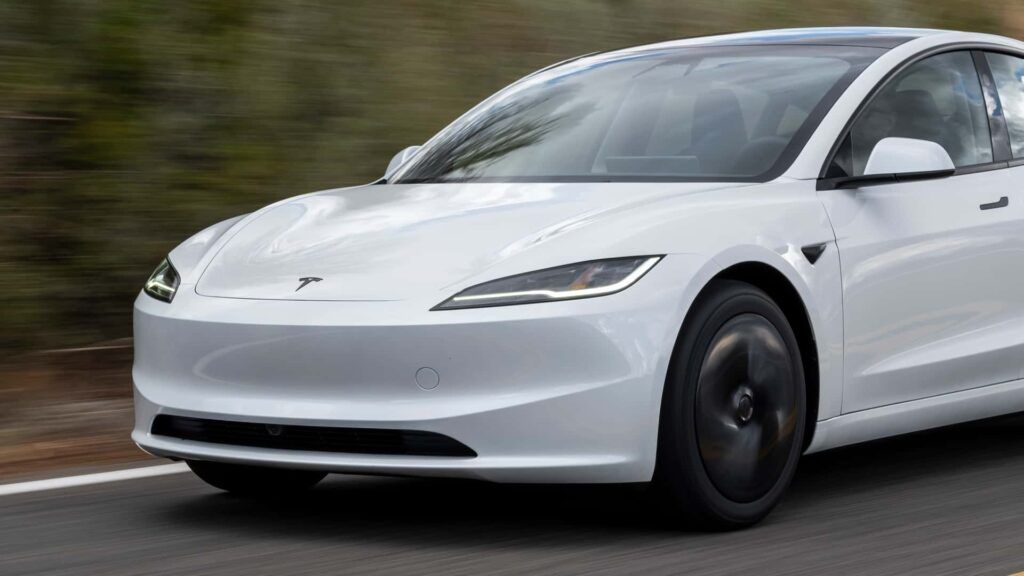
The Tesla Model 3 Standard It appeared out of nowhere and initially went unnoticed, considering everyone’s attention was focused on the Model Y Standard. But now that the dust has settled, the cheaper Tesla EV is making headlines, and not for a lack of comfort.
Sold in the US from $38,630, the most affordable Tesla has an EPA-estimated range of 321 miles (516 km) on a full charge, which isn’t bad at all. However, here’s the thing: it just beat that estimate in ‘s independent battery life test Edmundswhere he drove almost the 6% above the official estimate.
545 km of real autonomy
With a fully charged battery, the 2026 Tesla Model 3 Standard drove 339 miles (545 km) before stopping, which leads to an average energy consumption of 23 kilowatt hours per 100 miles (14.3 kWh/100 km). That’s slightly better than the EPA rating of 24 kWh/100 miles, and is in line with the new Mercedes CLA EQ, but it’s worth noting that Edmunds it made Mercedes’ electric sedan travel 434 miles (698 km) on a full charge, thanks to the car’s larger battery.
Photo at: Tesla
In the tests of Edmundsthe Tesla Model 3 Standard also traveled more distance than the 2026 Tesla Model Y Standard, which came in at 337 miles (542 km), 16 more than its EPA estimate. It’s a great result, but it’s worth noting that the Model 3 with the longest battery life passed the test Edmunds is the 2021 Model 3 Long Range, which went 345 miles (555 km) on a full charge.
However, for less than $40,000, the 2026 Tesla Model 3 Standard seems like less of a compromise than its crossover sibling, according to Edmunds. Compared to the Premium version, the Standard lacks an FM radio, an 8-inch rear screen, ventilated seats, Autosteer and frequency-dependent shock absorbers. The side mirrors are manually adjustable, as is the steering wheel.
The entry-level Tesla Model 3 also has slower charging, with a maximum input of 225 kW DC instead of the 250 kW achieved by the rest of the range. In the real world, Edmunds said the base Model 3 recorded a medium at 89 kW during a charging session, which means 387 miles (623 km) of range per hour of charging. By comparison, the 2024 Model 3 Long Range averaged 109 kW and 456 miles (734 km) per hour.
60% in the city and 40% on the highway
There’s an asterisk in all this, though. Here at InsideEVswe often prioritize battery life tests as one constant speed of 70 mph on the highway, approximately 113 km/h. Others do the same, and that’s because we want to see how an EV performs in less ideal conditions. However, Edmunds believes this does not accurately represent actual driving conditions for most people. As a result, its testers follow a rigorous route of 60 percent city driving and 40 percent highway driving, with a average speed of 40 mph (64 km/h).