
Gemini @blue News
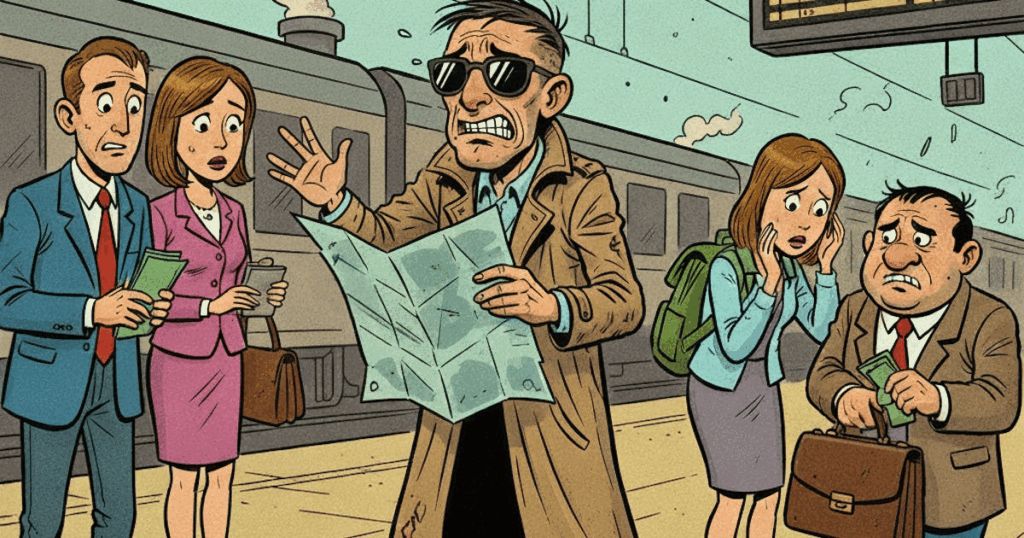
A new scam is making the rounds in places like train stations and airports. Criminals pose as “stranded travellers” and exploit the kindness of victims to steal cash. Here’s what to watch out for.
Are you in a hurry? blue News summarizes for you
- The ‘stranded traveler scam’ exploits victims’ availability at train stations and airports by pretending to be in financial difficulty and asking for cash.
- The refund is simulated using a manipulated banking application that only shows a confirmation of successful transfer, while the money is never actually transferred.
- Victims often lose three- or four-figure sums. Police urgently warn against handing over cash to strangers.
The current warning from the German police is based on an increase in the number of cases, the scale of which is illustrated by the recent example from Nuremberg Central Station.
In November, a 19-year-old traveler fell victim to this new scam. A stranger faked an emergency: he had lost his money and identity card.
The criminal convinced the young woman to hand over 1,000 euros in cash to an ATM after assuring her that he would transfer the sum to her mobile phone in front of her.
The decisive mechanism of the scam lies in the subsequent staging of the refund. The perpetrators carry out the transaction in front of the victim and present a digital confirmation of the booking.
In reality the confirmation is fictitious. It comes from a manipulated banking application that only creates the appearance of a real transfer on your smartphone.
The Federal Police confirms that the Nuremberg case is not an isolated case, but is part of a series of so-called “stranded traveler scams”.
A money transfer… but it doesn’t happen
The term stranded traveler or tourist scam describes a form of fraud that occurs mainly in crowded places such as train stations, airports and central tourist areas.
The approach is psychologically skillful. The authors usually appear serious, friendly and inconspicuous. Their situation is believably staged to trigger an emotional and helpful reaction.
The goal is always to steal three or four-figure sums of money. As soon as the victim hands over the money, the supposed online money transfer is simulated with the fake app to conclude the transaction.
Under the pretext of time pressure or urgency of the situation, scammers leave in a hurry. It goes without saying that the promised money will never reach the victim’s account. The realization of the wrongdoing is often delayed.
The authorities warn
The police in several German federal states have issued an urgent warning about this evil scam. The main prevention recommendation of investigators is to never hand over large sums of money to unknown people in emergency situations.
If in doubt, you should always call the police immediately to verify the authenticity of an emergency situation.
The geographical extension of the phenomenon underlines its relevance. Cases have also been documented in Austria. Similar incidents were reported in Vienna, where a scammer posed as a tourist robbed in the city center and swindled large sums of money for his supposed return trip. No cases have yet been reported in Switzerland.