
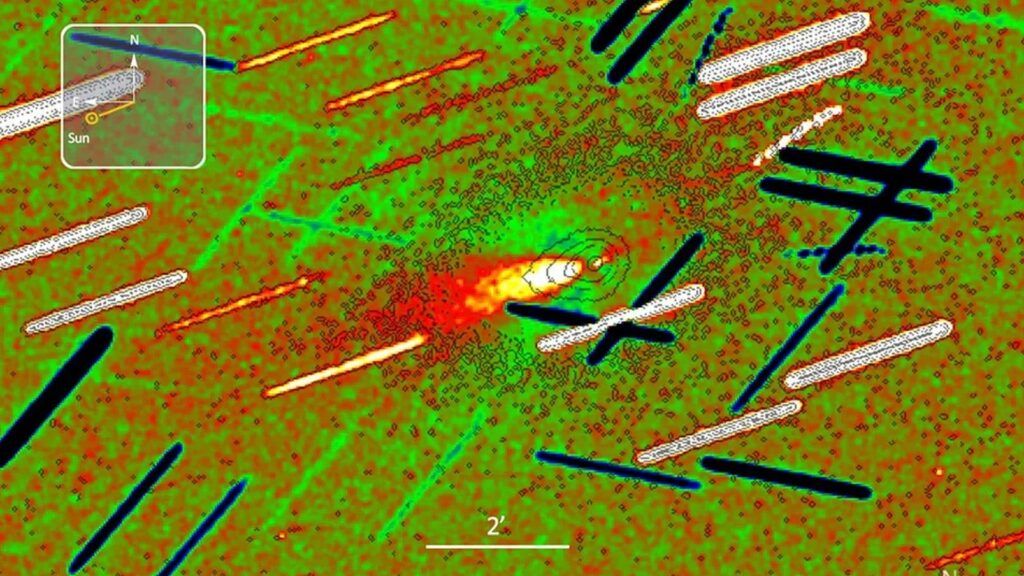
The large anti-tail jet of 3I/ATLAS is shown in yellow, in an image captured on December 19. Credit: Alfons Diepvens
The professor Avi Loeb indicated a detail that theinterstellar object 3I/ATLAS it shouldn’t have to be called one cometas the vast majority of experts maintain. In his latest article published on Medium, theastrophysicist of the Department of Astronomy at Harvard University focused again on the controversial anti-tail jet, which extends 400,000 kilometers in the direction of the Sun: according to the scientist, it “should not include gas flows beyond ~5,000 kilometers“. If the gas expelled by 3I/ATLAS in the direction of the star were to exceed this distance, according to Avi Loeb we would not be looking at a natural object. In other words, 3I/ATLAS could be a large spaceship of one extraterrestrial civilization moved by technological thrusters capable of producing similar gas flows.
Ever since the interstellar visitor was discovered by the system ATLAS in Chile on July 1, 2025, Professor Loeb promoted the controversial hypothesis ofartificial object. He never stated that we are in front of a spaceship, but rather that 3I/ATLAS is most likely a natural comet, however the multiple anomalies found to date leave open the alternative hypothesis of technological nature. “Science is a learning experience. The best way to learn is to observe nature, rather than forcing it into a popular narrative”, he wrote at the end of his last article, continuing to follow the path of open minded also on issues that many consider “science fiction” (to be good.) So, why might the interstellar visitor not be natural if it had an anti-tail of gas greater than about 5,000 kilometers?
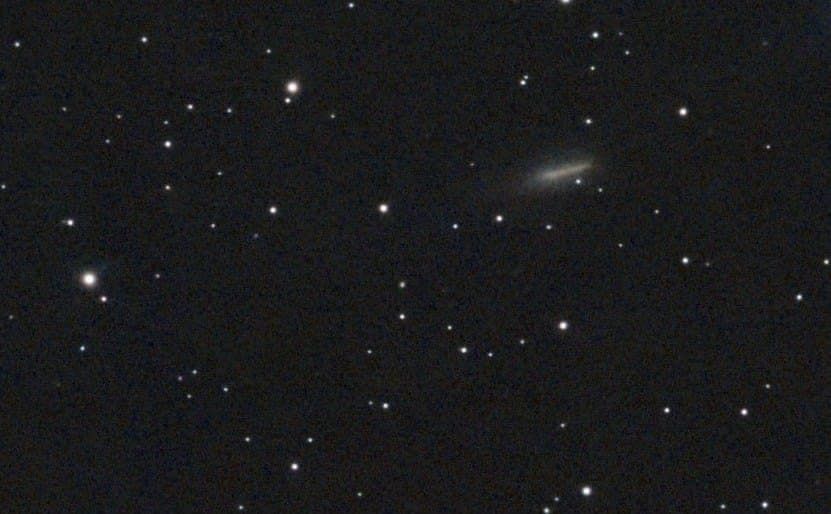
The interstellar comet 3I/ATLAS photographed by our reader Giacomo Salomone
To reach this conclusion, Professor Avi Loeb delves into some mathematical formulas. First, assuming 3I/ATLAS is a natural comet, calculate a mass loss of approx 500 kg per second for the anti-tail (after perihelion) and a gas expulsion speed of 200 meters per seconddue to the sublimation of CO ice2 (carbon dioxide) triggered by the heating of the Sun. The gas produced by the comet does not travel freely in the vacuum of the spacebut is counteracted by the pressure of solar windwhich at about 2 AU (astronomical units away from the Sun) is indicated with a speed of 500 kilometers per second and a date density. The jet of gas from the comet “collides” with the solar wind and can advance towards the star until it reaches the dynamic pressure balance (ram pressure). In simple words, having reached that equilibrium distance from the comet’s nucleus, it would be swept back by the solar wind, giving rise to the classic ionic tail. Now, what is this distance? According to Avi Loeb’s calculations, that’s right approximately 5,000 kilometres for 3I/ATLAS. This is why a flow of gas towards the Sun that exceeds this measurement could suggest the artificial nature of the object. The dust anti-tail can extend for hundreds of thousands of kilometers because the “brake” is not given by the solar wind but by solar radiation pressuregases, on the other hand, are stopped much earlier by electrically charged particles (plasma) and magnetic fields.
3I/ATLAS, new Hubble images show “oscillating jets”: Avi Loeb’s technological interpretation

The interstellar comet 3I/ATLAS photographed by our reader Fabrizio Montanucci
In practice, Professor Avi Loeb argues that if the flow of gas in the anti-tail of 3I/ATLAS is 5,000 km, the speed of expulsion from the core must be much superior at 200 meters per second (0.2 km/s), the one linked to the simple sublimation of CO ice2 due to heating. If the flow reached approx 25.000 kmthe gas flow could be pushed by a chemical engine which has a jet of approx 5 km/s; if instead it extended up to 100.000 km it would take a ion engine which can produce a jet of 90 km/s.
The American-born Israeli scientist underlines that it is possible to verify the presence of gas in the anti-tail jet of 3I/ATLAS: “The existence of gas streaming along the anti-tail can be verified by marking a molecular tracer, such as CO₂ or CO, along the axis of the anti-tail jet and plotting the spatial profile of the tracer against sunlight scattered by dust within the jet.” To do this analysis, the interstellar visitor would have to be put in the crosshairs of powerful ground-based and space-based telescopes, such as the Keckl’ALMAil VLT and the James Webbexplains Professor Avi Loeb. All that remains is to wait for the results of these probable investigations, which should be carried out between now and March 2026, when 3I/ATLAS will be near Jupiterbefore finally disappearing into the deep space.