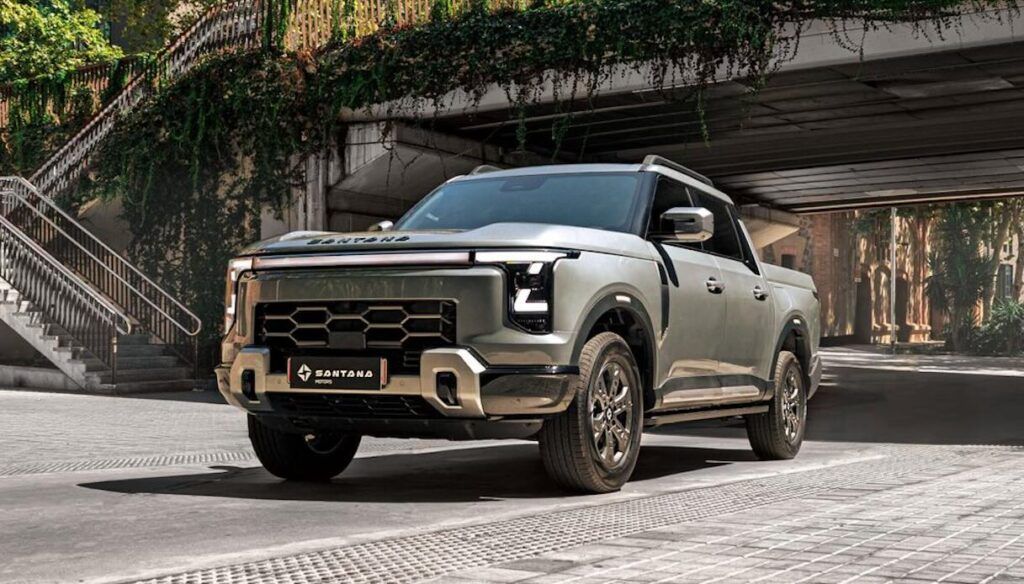
For younger people it’s a name that doesn’t mean much, but for those who already have a few kilometers under their belt the brand Santana represents the idea of essential, robust and economical off-road vehicles. Everything that seems to be missing in the current market, despite demand increasingly pushing in that direction. After the success of the 1950s and then the 1980s, the historic brand back to Europe now with the desire to re-propose their adventurous and concrete soul also in Italy.
The Santana story
The name Santana takes you back to the late 1950s, when a Spanish company managed to obtain the license to produce the Land Rover Series. After a long period of building vehicles with essential requirements, created to tackle difficult terrain, in the 1980s he obtained the license for the production of the Suzuki Jimny, off-road icons known outside Japan as SJ. Although important collaborations followed one another in the following decades, following a phase of financial difficulty, the brand announced its closure in 2011.
The return to Europe
Santana’s new course was born from a joint venture that looks to the East. Behind the relaunch of the brand there is in fact the collaboration between Zhengzhou and Nissan, a company that already markets models such as the Frontier Pro, a Nissan brand pick-up based on the Dongfeng Z9 platform. Santana starts from here, reinterpreting already tested products and adapting them to the tastes and needs of the European market.
Diesel and plug-in hybrid
The initial range is divided into two main variants, designed to cover very different needs. The version 400D is the most traditional one: a 2.3 liter diesel 190 CVwhich can be combined with a six-speed manual gearbox or an eight-speed automatic. A tested mechanism, designed for those looking for torque, reliability and load capacity.
Next to her comes the 400 PHEVwhich marks a clear change of technological pace. Here the 1.5-litre turbo petrol engine works together with an electrical system for a total power of 429 HP. The total declared autonomy is 1,100 km, with approximately 120 km that can be driven in pure electric mode. A proposal that looks at those who live far from urban centers and perhaps can count on solar panels to drastically reduce consumption, but without giving up. Both versions are available with traction rear or integral, to underline the vocation of the project.
SUV coming soon
Santana’s industrial plan also includes the arrival of SUVs and off-road vehicles derived from the models of the BAIC galaxy, a Chinese group that boasts leading collaborations, including that with Daimler Mercedes. Among the names already mentioned are the BJ40 and BJ30, vehicles with a clearly off-road approach, which should arrive on European markets – including Italy – starting from mid-2026. Not only that: the agreement also provides for the development of exclusive Santana models, based on BAIC platforms but designed specifically for Europe.
Attack prices
If the Italian price lists are not yet official, the Spanish prices give a rather clear idea of the strategy. The Santana 400D pickup starts from 29.900 eurowhich becomes 34,500 euros for the richer S trim level and with automatic transmission. The plug-in hybrid version rises to 44.700 eurowhile the PHEV S reaches 49,100 euros.