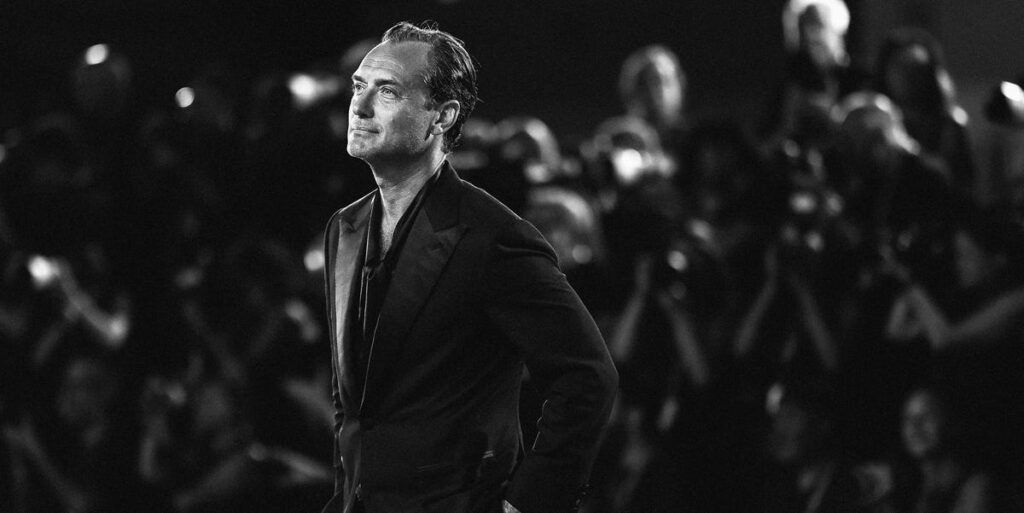

If it’s true that the Christmas classics return every year, then he’s also back punctually with the holidays: Jude Law. Thanks above all to Graham, the character who became iconic in the film Love doesn’t go on holiday (The Holiday), where he plays the charming and caring English father who wins the heart of Amanda, played by Cameron Diaz. A role that helped transform the film into a holiday fixture, thanks to a successful balance between romance and family warmth or perhaps, even more simply, between a memorable soundtrack and what has become the coziest cottage in the history of the big screen.
Yet Jude Law’s career certainly does not end in Christmas comedies but rather unfolds among complex characters, from the young Vladimir Putin to Henry VIII, addressed through a rigorous approach made of obsessive study, physical transformations and a conscious use of one’s voice; combination of factors that reveals a versatile talent, capable of going far beyond the natural magnetism that made him famous. On the occasion of his fifty-third birthday, here are five of his best performances.
The Wizard of the Kremlin (2025)
Russia, early nineties. Vadim Baranov, played excellently Paul Danofrom reality show producer he becomes the right-hand man of a rapidly rising former KGB agent, as well as the very young Vladimir Putin, brought to the screen by an almost unrecognizable Jude Law. Le Mage du Kremlinpresented at the 82nd Venice Film Festival, is not (just) a film about a single man’s quest for power, but a dense smoke screen behind which the most recent history of Russia and, more generally, of contemporary politics.
From the atypical biopic thus emerges a cold, rigid and austere analysis of the power as a manipulation machinebuilt on many – many – tense dialogues, suffocating atmospheres and on a particularly successful acting transformation by Jude Law, who embodies the Russian leader’s famous “pout” without resorting to prosthetics but rather working on proxemics and body control. An approach that passes through the obsessive study of archive materials and which manages to precisely convey the strategic ambiguity of a deliberately faceless man.

Return to Cold Mountain (2003)
We leave the cold expanses of Russia for the forests of North Carolina, where Inman’s performance earned Jude Law an Oscar nomination for best leading actor. This time the film sees him in the role of a Southern soldier wounded during the Civil War, who deserts to undertake a long and tiring journey home, towards his native Cold Mountain and his beloved Ada, brought to the screen by Nicole Kidman.
At the same time, the same Ada, left alone and in difficulty, is forced to learn to manage her father’s farm with the help of the tenacious vagabond Ruby, played by Renée Zellweger in one of the most memorable tests of his career. Directed by Anthony Minghella and based on the novel of the same name by Charles Frazier, Return to Cold Mountain it is an epic and romantic drama that brings with it all the classic characteristics of the genre, from love to survival to the brutality of war, restoring the portrait of a torn America.
The Talented Mr. Ripley (1999)
The talent of Mr. Ripley marks one of Jude Law’s most famous performances, not surprisingly nominated for the statuette as best supporting actor. Also written and directed by Anthony Minghella, the film follows the arrival in Italy of Tom Ripley, played by Matt Damontasked with convincing Dickie Greenleaf to return to the United States. Dickie is a rich young American, supported by his father, who lives between seaside resorts, jazz and idleness together with his girlfriend Marge, who wears the face of Gwyneth Paltrowrejecting any adult responsibility.
In the role of Dickie, Law builds a sunny, impulsive and deeply contradictory character, capable of attracting and repelling at the same time. His ease, the way he grants attention and confidence without realizing the consequences, progressively fuel Tom’s obsession, who doesn’t just want that standard of living but ends up wanting to occupy his place. Minghella relies heavily on what remains implicit and Law in turn works on looks, gestures and sudden changes in tone, making the transition from friendship to latent tension credible. A decisive test, which undoubtedly made a mark the beginning of its international success.
Sherlock Holmes (2009)
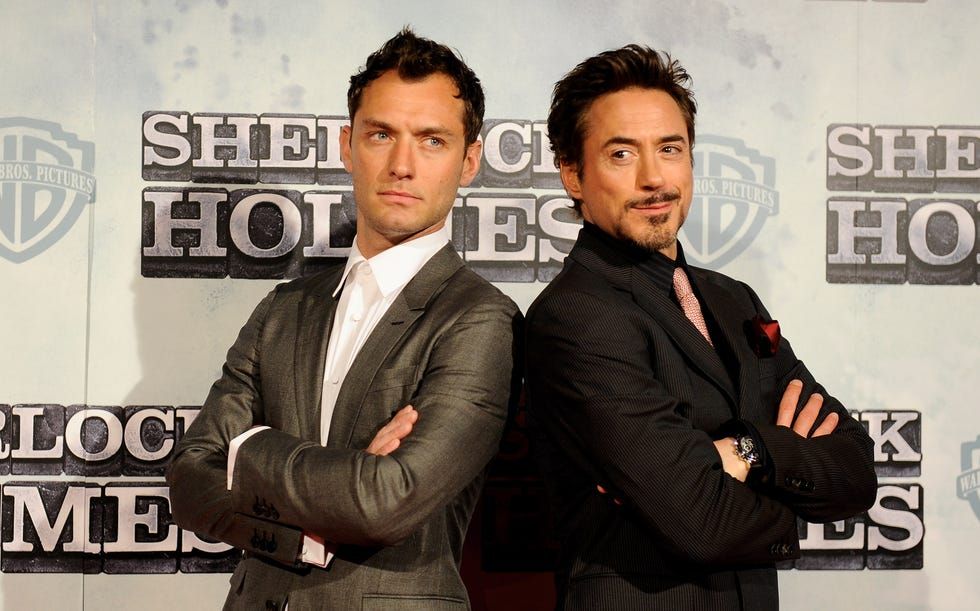
Sherlock Holmes is just one of the franchises that Jude Law has taken part in throughout his career, along with worlds like Fantastic Beasts and the MCU, where he played Yon-Rogg in Captain Marvel. In this high-action version of the stories and characters created by Arthur Conan Doyle, Law plays Doctor John Watson, Sherlock Holmes’ faithful companion in adventures. Next to a Robert Downey Jr. protagonist as Holmes, the British actor represents one of the film’s strong points.
The two, in fact, function as a couple precisely thanks to the contrast between their approaches: while Downey Jr.’s interpretation often indulges in excess and theatricality, Law keeps Watson anchored to a more concrete, solid and human dimension, giving balance to a deliberately spectacular saga. Not surprisingly, Watson’s remains one of the most recognizable and popular roles of Jude Law’s entire career.
Anna Karenina (2012)
In Anna KareninaJude Law works with Joe Wright in the film adaptation of the famous novel by Leo Tolstoy. After Pride and prejudice ed Atonementthe British director therefore continues his work on literary adaptations, however in this case choosing a more daring and openly theatrical staging. The film is in fact set largely on a stage, with revolving sets and visible scene changes that accompany the story and transform the vision into a sort of continuous representation. In this context, Law takes on the role of Count Alexei Karenin, the older husband of Anna Karenina, played instead by Keira Knightley.
Although their marriage is founded neither on passion nor on affection, what binds them cannot even be reduced to a simple unhappy union. Through measured acting, Law and Knightley show how, despite resentment and emotional distance, the two characters remain traces of mutual respectmaking their relationship more complex than it seemed on the surface.
Passionate about new and old media and an evolving scholar of over-the-top multimedia services, I write primarily about the big and small screen and environmental sustainability.
After taking my first steps as a PR Consultant for Prime Video, I moved to the other side of the “stage”, embracing the world of journalism. I have written, among other things, about cinema for Sky TG24, of innovation for Innovando News and current affairs for the Corriere del Trentino, and then landed in the world of Hearst.
In my ideal life The Office is on loop, I am surrounded by animals and the Dolomites are the backdrop. Gen Z, I am a Millennial in everyday life: eternally nostalgic, I pretend to know how to use TikTok, but I have never abandoned paper diaries.