
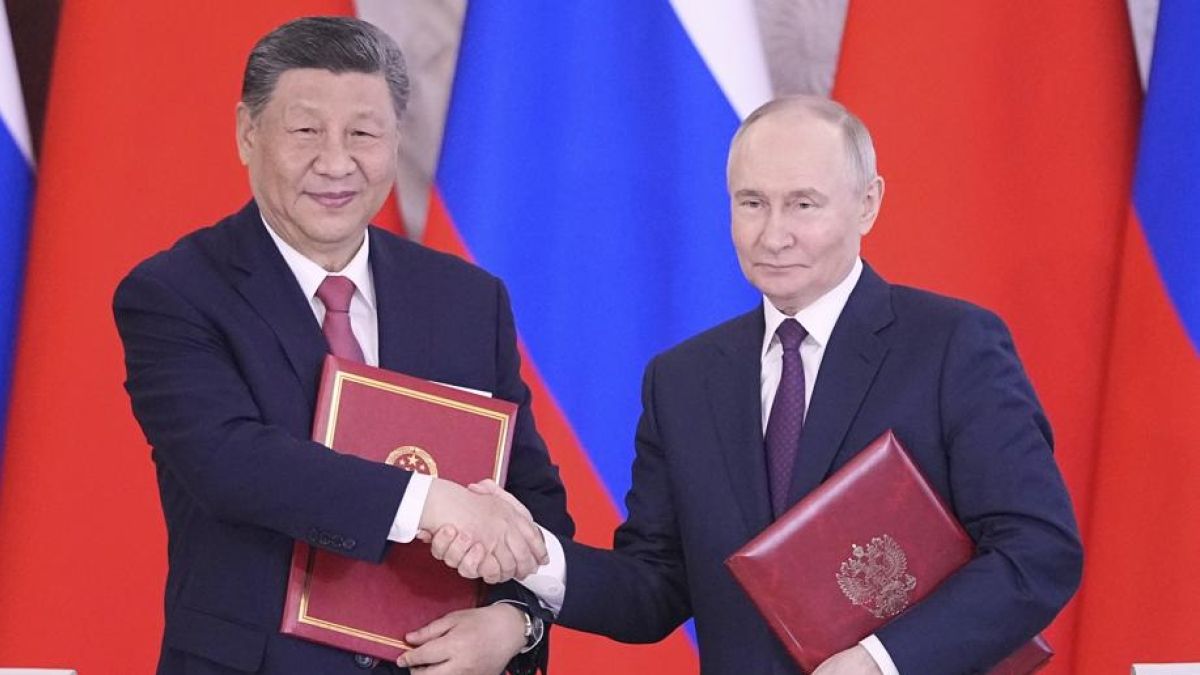
As the end of the year approaches, but unfortunately not that of the war in Ukraine, after having commented on yet another proof of European irresoluteness, I want to address a topic that is often proposed to me by readers: the option (or hope) that Chinese mediation could finally resolve the conflict. It is neither an option nor a hope, in truth: it is a myth that wanders around Europe where too many analyzes are confusing, e anti-Americanism generates illusions of all sorts.
One of these illusions concerns China’s possible role as a peace-bringing superpower. Here I offer you an enlightening read. An expert on strategic issues, Seth Jones, makes it clear (and in numbers) solidity of the alliance between Xi Jinping and Putin.
Without China’s unconditional support, the Tsar would not have had the means for this war now four years long, very costly for the Russian economy. And China’s support it is not only economic, technological, financial: It’s military. Xi has made a choice of side. The war in Ukraine created some problems for him with the West, but it brought him substantial benefits: for a few years it distracted the Pentagon at least in part and reduced American arsenals. Military cooperation with Moscow was functional to a joint war modernization and rearmament effort.
Here is the analysis published on Wall Street Journal: «Cina and Russia strengthen their “limitless” alliance. Xi and Putin have their differences, but they are united by the desire to weaken America.” by Seth G. Jones on December 18, 2025.
«China and Russia are deepening their cooperation and take aggressive actions with profound consequences for the United States. On December 9, Chinese and Russian bombers and other aircraft flew over areas near Japan and South Korea, forcing the United States and Japan to emergency scramble fighters and bombers. The episode is the latest example of an increasingly bold China-Russia axis. Beijing and Moscow consider America their main enemy and aim to expand their power at the expense of the United States and its allies. Xi Jinping e Vladimir Putin they are profoundly “revisionists” (in English this adjective indicates powers that want to “revise”, but in the sense of radically transforming them to their advantage, the balance of forces, hierarchies, the world order, ed.) and they want to re-establish the historic Chinese and Russian imperial spheres in some form. They have repeatedly emphasized that their partnership has “no limits” and have met in person over forty times.
Arms trade is one of many areas where cooperation has intensified. Since Russia’s full-scale invasion of Ukraine in February 2022, China increased exports to Moscow of what are called “high priority items”: a set of 50 dual-use (civilian-military) items that include microchips, machine tools, radars and sensors that Russia needs to support the war effort. While Russia does not have the capacity to produce many of these goods in sufficient quantities, China’s vast manufacturing sector is capable of making them on a large scale.
Chinese exports helped Russia triplebetween 2023 and 2024, the production of Iskander-M ballistic missilesused to hit Ukrainian cities hard. In 2024 China accounted for 70 percent of Russian imports of ammonium perchlorate, an essential ingredient for ballistic missile fuel. Beijing has also supplied Russia with drone hulls, lithium batteries and fiber optic cablescrucial components for the fiber optic drones used in Ukraine, capable of evading electronic warfare countermeasures.
China also benefits from this cooperation. Russia probably contributed to the development of the Chinese submarine new generation Type 096, nuclear-powered and armed with ballistic missiles, providing assistance on an advanced propulsion system. Leaked documents also indicate that Russia has agreed to sell China equipment that could be used in a possible invasion of Taiwanincluding light amphibious vehicles, self-propelled anti-tank guns, armored personnel carriers for airborne troops and special parachute systems for dropping heavy loads from high altitude.
China and Russia have too expanded the scope and frequency of joint exercises and training missions. Between 2017 and 2024 they conducted around one hundred joint military exercises in increasingly vast areas, including Asia, Europe, the Middle East, the Arctic and Africa. They flew numerous training missions, including eight joint bomber missions between 2019 and 2024. In July 2024, China and Russia flew Xi’an H-6 and Tu-95 Bear long-range bombers, respectively, on a joint patrol off the coast of Alaska. The two countries held live-fire naval exercises in the South China Sea and have frequently conducted joint flights and navigations near Taiwan, Japan and South Korea.
Beijing and Moscow are strengthening cooperation between their respective defense industrial bases. They have signed agreements relating to transfer of space and missile defense technologies and they increased the cooperation between their satellite navigation systems BeiDou and Glonass. In the future, Russia could help China develop ground-based and space-based missile warning systems, which would increase the effectiveness of China’s existing missile defenses and develop new capabilities.
Outside the military sphere, the two countries have strengthened economic and technological ties. Trade between China and Russia reached about $245 billion in 2024, up from $190 billion in 2022. China has been Russia’s largest trading partner since 2014. Beijing depends on Moscow for oil and gas supplies, which now account for approx 75 percent of China’s energy imports.
There is no shortage of differences between the two countries, as happens in all friendships. Chinese leaders have expressed concern about strengthening military relations between Russia and North Koreawhich will likely lead to an upgrade of Pyongyang’s missile capabilities. Beijing has been reluctant to help North Korea with its nuclear programwhile Russia is actively supporting it.
However, the direction of travel is clear. China and Russia are getting closer and closer on political, military and economic levels. Their goal is to undermine the United States. Instead of outlining a strategy to counter this axis of authoritarian regimes, the administration’s National Security Strategy Trump downplayed the severity of the threat. Administration officials must understand that appeasement of dictators will only strengthen them.”
December 25, 2025, 10:51 am – edit December 25, 2025 | 10:53
© ALL RIGHTS RESERVED