In recent years the power of cars has grown considerably, sometimes disproportionately. Sportswomen, obviously, are no exception, having performance at the core of their DNA. Ferrariin this area, continues to be an absolute point of reference. The leap forward achieved in just a few decades was of quantum magnitude. In 1987 the F40’s 478 horsepower seemed out of this world. Today with the 2025 F80 we are at 1,200. The 390 horsepower of the Testarossa was jaw-dropping among GTs in 1984. Today the 849 Testarossa of 2025 writes 1,050 horsepower on the technical sheet.
The 425 horsepower of the Challenge Stradale seemed like a lot for a racing car when the clock ticked to 2003. Today the SF90 XX Stradale, born 20 years later, reaches 1,030 horsepower. The merit of the substantial energy increase is mainly attributable to technological progress, the addition of electric motors and, in two out of three cases, the addition of 2 turbines (the F40 already had them). The most recent “red” protagonists of the narrative are also the most powerful and high-performance of the modern era and, therefore, of all time. They are also the 3 most powerful and fastest twin-turbo Ferraris of all time. Follow us on our journey to discover them, in order of performance in Fiorano.
Ferrari F80
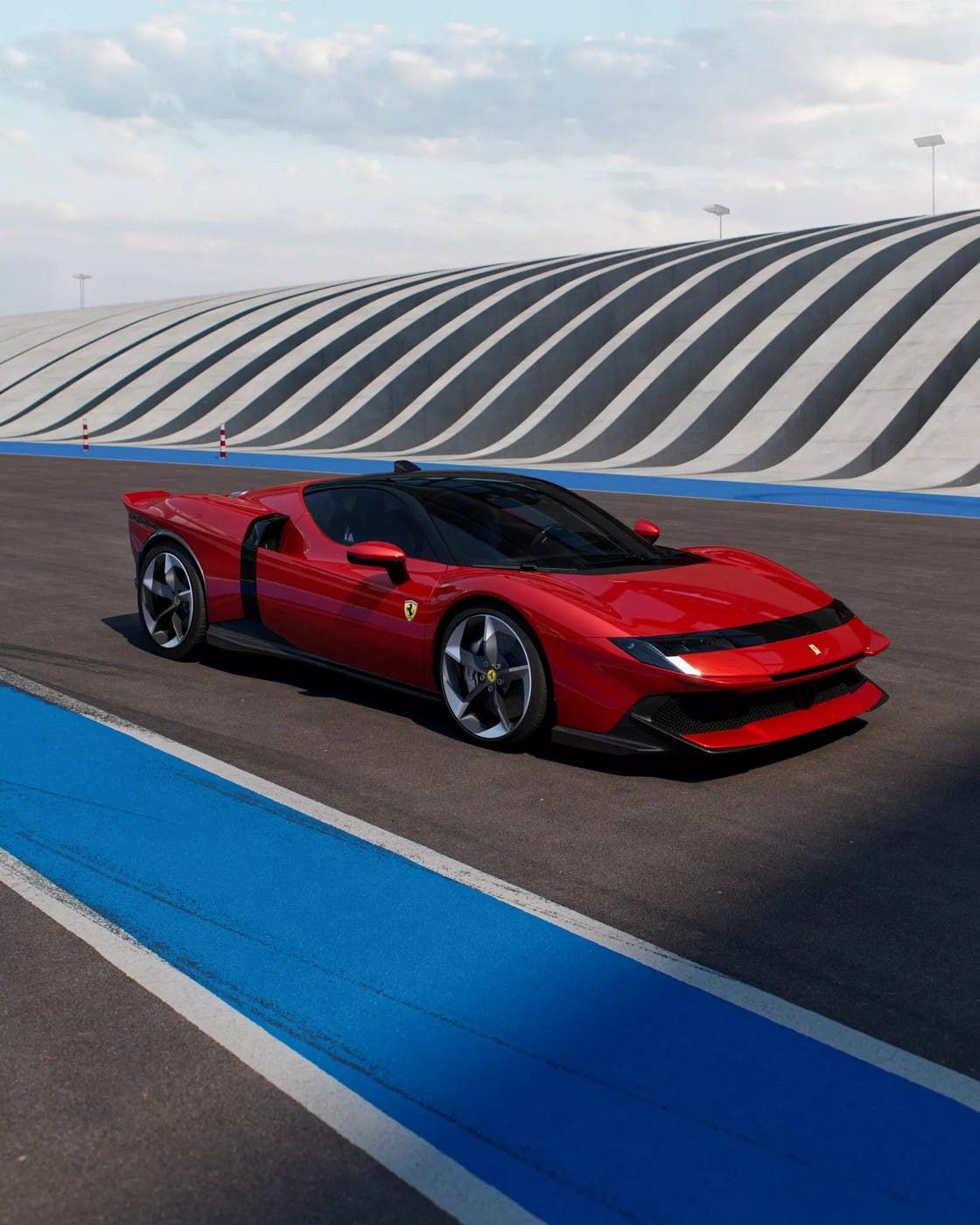
Obviously, it holds the energy and performance record among the road “red” cars. It couldn’t have been otherwise, given the nature of the medium. The Ferrari F80 is the car where the best of the engineering and research of the “prancing horse” is condensed. There has been a great transfer of technology from the world of racing, in particular from the 499P, queen of the 24 Hours of Le Mans and the Endurance universe. The last descendant of the noble lineage of limited series cars, pioneered by the 1984 GTO, this represents the new flagship car of the Emilian company.
Compared to its progenitor and the subsequent F40, F50, Enzo and LaFerrari, it pushes the bar even higher, despite the lower division of the family. We can talk about a quantum leap forward. The extreme design approach and the close synergies with the racing cars have allowed a level of performance never seen before, in all areas. Thanks to its extreme architectures, it offers track car dynamics and metrics, with great fluidity. Even in an urban environment it is at ease. A true miracle, which only the magicians of Maranello could achieve.
The power plant has as its fulcrum a twin-turbo V6 enginewith 3.0 liters of displacement, combined with the electric component. The result is a maximum hybrid power of well 1.200 cavalli900 of which were put on the plate by pistons and cylinders. These are frightening numbers, even more so when compared to the volume. Obviously the dynamic figures are at the top. The Ferrari F80 goes from 0 to 100 km/h in 2.1 seconds. In just 5.75 seconds, again from a standing start, 200 km/h is consigned to the world of memories. The top speed goes beyond the 350 km/h territory.
Even more incredible is the lap time set on the Fiorano trackequal to 1’15″30. Better than the FXX and slightly worse than the FXX-K, despite the road tires (the other two use slicks). Stuff to keep your mouth open. We are 4″4 below the Ferrari LaFerrari, which was 2″6 better than the Enzo. Thinking about how progress towards the top of the time rankings (i.e. towards the physical limit of the means) makes chronometric progress increasingly difficult, the fact that in Maranello they managed to achieve such a leap forward has the scent of an incredible feat to say the least.
The Ferrari F80 is pure excellence. Of course, its style is not the best of the species and the division leaves a little to be desired, but in terms of dynamic vigor and engineering and behavioral qualities, here we are at the highest level ever. The 8-speed dual-clutch F1 gearbox is also sublime, changing gears at the speed of light. The Brembo brakes, made of composite material, set the new standards, adhering perfectly to the profile of the vehicle.
The use of carbon fiber and other exotic materials in the body of the vehicle is boundless. This results in a weight of just 1,525 kilograms. Yes, classic sports cars weigh less, but here we are talking about a hybrid car with all-wheel drive. Taking these elements into account, even the figure read on the scales leaves you speechless. The downforce is racing level, with a downforce load of 1,050 kilograms at 250 km/h. Thus the dynamic limits are pushed even higher.
Ferrari SF90 XX Stradale
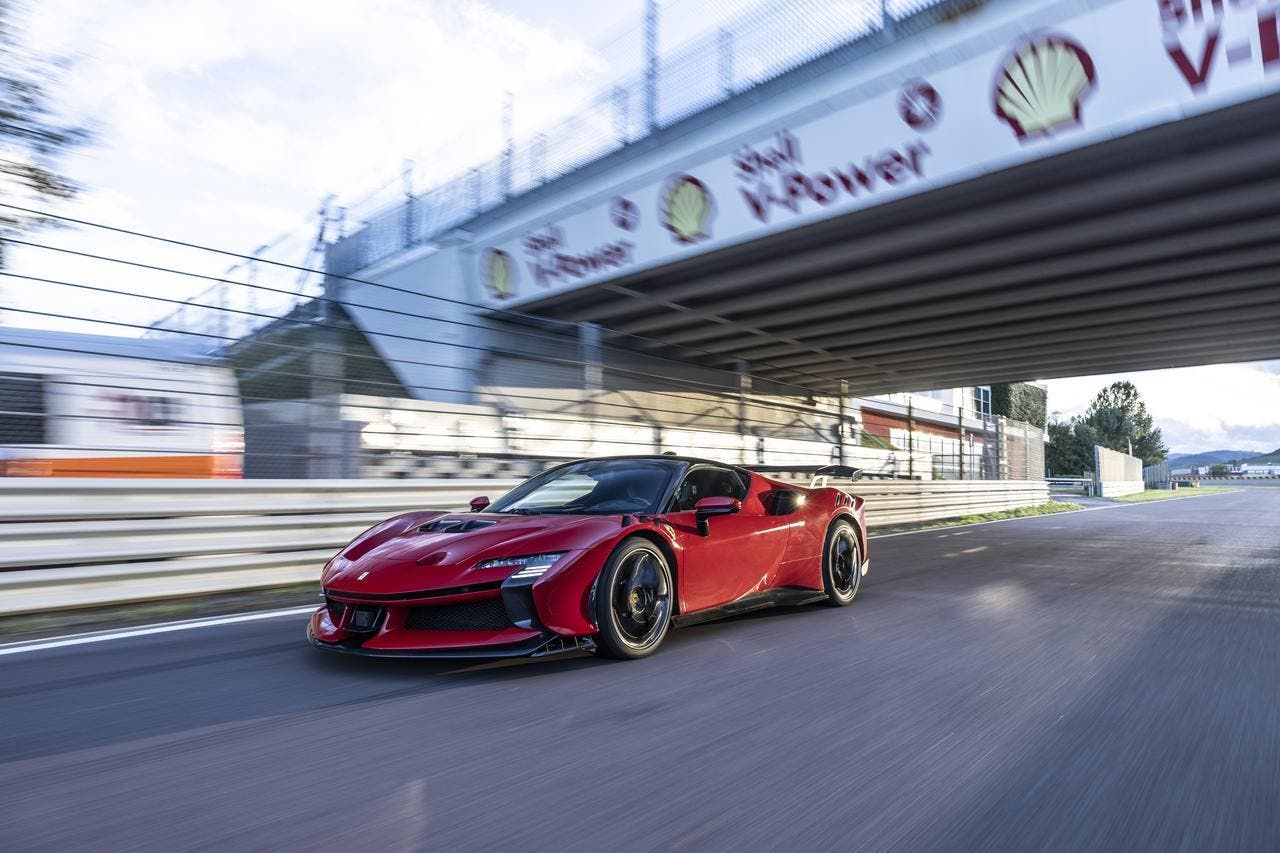
Here there are 8 cylinders. The double supercharging and the hybrid nature of the vehicle connect it with the F80. The style wins the approval of the eyes better, because despite its nature as an extreme car, the Ferrari SF90 XX Stradale is happily interpreted on an aesthetic level. Its Spider sister does even better, decidedly more beautiful in the upper section of the bonnet. The subject of our article, however, is the coupé, chosen to represent the family, because it provides the best performance level. On the Fiorano track, the “red” in question completes a lap in 1’17″31.
This time puts it in second place on the podium, among the “prancing horse” supercars, just over 2 seconds behind the aforementioned F80. A performance of absolute importance, worthy of the model’s track image. The Ferrari SF90 XX Stradale is the ideal link between the laboratory cars of the XX program and the sports cars present in the Maranello company’s price list. Racing emotions are at home here, but without creating apprehension, due to the finesse of the set-up.
Even if it flies between the curbs, like a track-day beast, the car in question manages to be usable on everyday roads, without breaking its back after 2 kilometres, as happens with extreme products from some other brands. After all, you don’t become the reference manufacturer among those who produce sports cars by chance. Proposed in just 799 examples (in addition to the 599 of its open-top sister), the Ferrari SF90 XX Stradale is a limited edition intended for some special and accredited customers. In fact, not everyone could enter the dealership to order it. A way to reward the most loyal, preserving the brand from speculation.
The scenic appearance of this “red” is incredible, which captures the eyes, launching them into an uncontrolled dance, because every detail and every element of the graphic canvas seems made specifically to inebriate the senses. In reality, the functional aspects were placed at the center of the project, but the collaboration between designers and engineers produced a bodywork of great charm, where nothing breaks the visual coherence. Even the huge rear wing fits perfectly into the picture. Indeed, one would not be able to appreciate the model with the same intensity if it were not present. A more unique than rare case, among cars where this down-force appendix is not integrated into the silhouette, as was the case with the F40 and the F50.
The sound of the SF90 XX Stradale also surprises favorably, but the magic of the V12 notes remains far away. Here the thrust comes from a 4.0-litre internal combustion twin-turbo V8 engine, integrated by three electric motors, for a system power of 1.030 cavalli. It was her turn to take third place on the power podium, among the cars on the Maranello company’s list. Acceleration from 0 to 100 km/h is achieved in 2.3 seconds, while going from 0 to 200 km/h takes just 6.5 seconds. Numbers almost close to those of the F80. Despite being track-oriented, the Ferrari SF90 XX Stradale is at home on real-world roads (potholes and bumps permitting). This is where its magic lies: in the ability to bring the emotions of racing to the road, in the most genuine form and without particular limits.
In the Ferrari 849 Testaro
With a lap time of 1’17″50 it rides almost like the SF90 XX Stradale on the Fiorano track, despite being less extreme in its concept. Once again the Maranello company leaves us speechless with its ability to infuse a racing temperament into a car from the normal price list. Born to take the place of the SF90 Stradale and available, like the other, also in a Spider version, the Ferrari 849 Testarossa is a rotated missile from the “normal” price list. Here we are not dealing with a limited series, but the very demanding price makes for a great selection.
The aesthetic part could have been managed better. The impression is in fact that of a step backwards compared to the replaced car, at least on a stylistic level. Nothing to say, however, about the technological repertoire, which creates new engineering heights among the cars of the “ordinary” series of the “prancing horse”. Under the rear bonnet of the sports car in question, in the terminal part of which there are fins inspired by the legendary 512 S and 512 M, pulsates a 4.0-litre twin-turbo V8 engine. This, together with the electrical component of the hybrid system, develops a system power of 1.050 cavalli.
The contribution of the petrol heart is 830 horsepower, sonorously given to the pleasure of the ears, even if the sound of the V12 is from another planet. With its soundtrack, a performance picture of extraordinary splendor emerges, illustrated by acceleration from 0 to 100 km/h in less than 2.3 seconds and from 0 to 200 km/h in 6.35 seconds. The maximum speed is set at over 330 km/h. These are crazy metrics, but perhaps not as much as the lap time set on the Fiorano track, which we have already told you about.
One of the greatest strengths of the Ferrari 849 Testarossa is its dynamic efficiency. With it it almost seems as if the laws of physics do not exist, despite its nature as a comfortable grand tourer, even if it has a strongly sporty soul. The level of involvement promised to the driver is incredible, without penalizing him in terms of ride comfort and refinement. The model name highlights the number of cylinders and the unit cubic capacity, reported as a fraction of a tenth. The final part of the acronym is linked to a legendary name of the Maranello company and refers to the red color of the tappet covers.
Those who think of the Testarossa of the 80s will find its look not very charismatic. Furthermore, the 12-cylinder is missing, but otherwise, there is only excellence here. The on-demand all-wheel drive contributes to active safety, made possible by the placement of two of the three electric units of the powertrain on the front axle, which overall add 220 horsepower to the combustion engine’s stable. The car in question offers, among others, the latest generation brake-by-wire, the innovative FIVE estimation system and Evo ABS, which improves braking precision and repeatability. The weight/power ratio also plays in favor of the performance profile, which is at the most advantageous level ever among the “red” models in the “normal” price list. The careful aerodynamic study has brought the Ferrari 849 Testarossa to very high downforce figures. One piece of data immediately makes the concept clear: the downforce load reaches 415 kg at 250 km/h: 25 kg more than the SF90.