
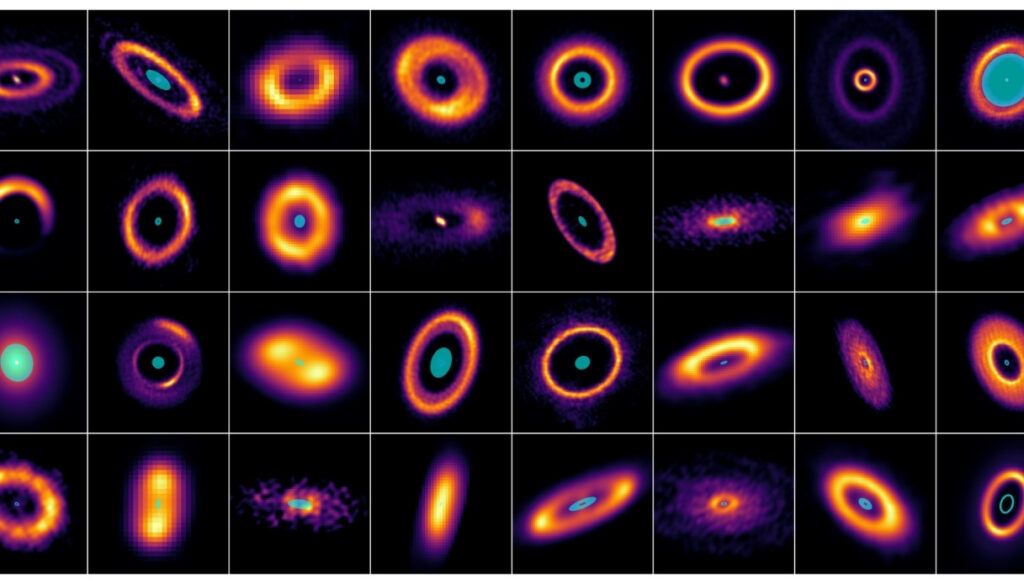
Eso, Esa/Gaia/Dpac, M. Vioque et al.
How planetary systems are born? Understanding this is one of the great challenges of modern astronomy. Today we are starting to reconstruct that process in its first and most delicate moments. As? Thanks to a combination of space and terrestrial observations which, compared to the past, are much more “refined”.
A new study, based on data from Gaia space telescopehe identified some oscillations suspicious around 31 newborn stars. These are signals compatible with the presence of:
- newly formed planets;
- nane brown;
- other companion stars.
The chaos where planets are born
They were very young systems analyzedimmersed in dense regions of gas and dust, which make extremely difficult to observe what happens inside them. It all starts with the gravitational collapse of large molecular clouds.
As the cloud contracts, the rotation increases and the material flattens forming a disk. To the center the star is bornwhile all around the protoplanetary disk remains. It is a sort of “cosmic construction site”, to simplify things, which contains the material necessary for the formation of planets.
They were 31 systems observed successfully and these disks were studied thanks to the Atacama Large Millimeter Array. The latter is capable of observe the cold material destined to aggregate to the planets. The images obtained show us complex structures, with gaps, rings and asymmetries which are often interpreted as the indirect signature of planets in formation. However, seeing these objects directly is still almost impossible. It is the dust that hides them from our “eyes”.
Gaia Mission
This is where the Gaia space telescope, part of the European Space Agency mission, comes into play. It is a tool designed for measure accurately extraordinary positions of the stars. We know that when a planet or another “companion” orbits a starit does not cause a tiny oscillation. This measurement is part of a technique already exploited for mature stars, which for the first time has been successfully applied to stars still in the formation phase.
98 were observed star systems young people and of these 31 showed subtle movements but coherent. Something impossible to explain except with the presence of an “invisible companion”. In 7 cases, the oscillations are compatible with planetary mass objects. In another 8 systems, however, the signals indicate the presence of:
- nane brown;
- intermediate bodies between giant planets and stars.
The remaining 16 systems would instead host other stars.
The distribution of results tells a complex story: not all protoplanetary disks produce planets in the same way. Some systems seem to favor the birth of giant planets, others of brown dwarfs, still others of multiple star systems. The positions of the “companions” identified by Gaia offer a precious map for understanding how the mass and dynamics of the disk influence the final outcome.
This study, accepted for publication in Astronomy and Astrophysics, marks a key step: it demonstrates that astrometry can be a very powerful tool even in the earliest stages of stellar life.