
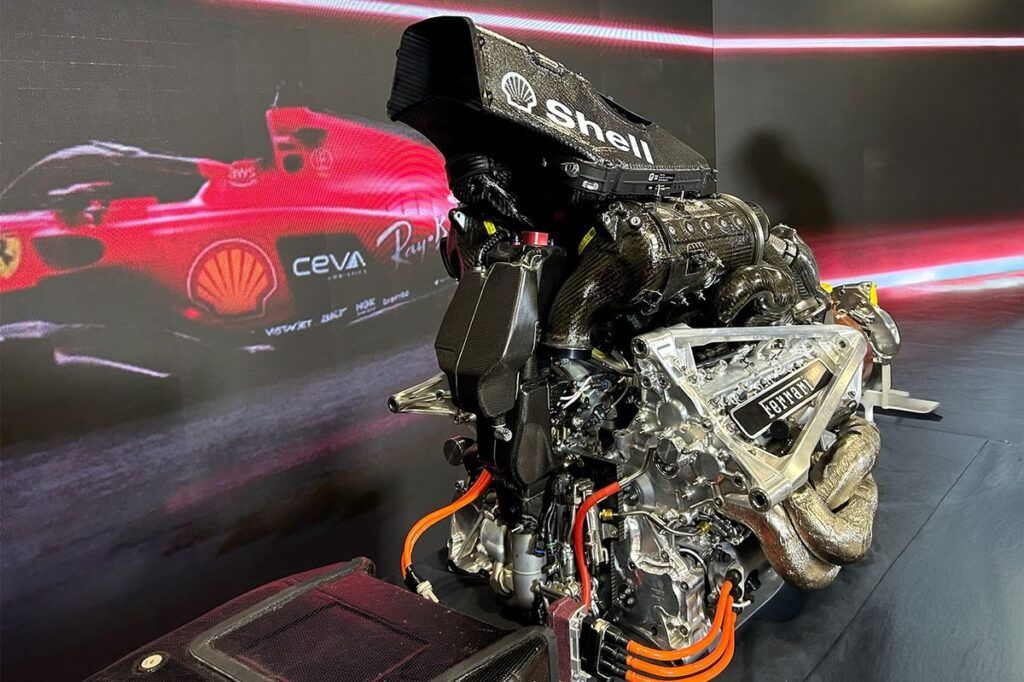
Ferrari wants to make the most of the fact that the 678 was designed and built in the same Maranello factory. The red for 2026 is the result of a great integration in the work carried out by the engine engineers led by Enrico Gualtieri and the chassis builders whose technical director is Loic Serra.
The 2026 power unit was designed to offer the aerodynamicists of Diego Tondi and Frank Sanchez the opportunity to take to the extreme some concepts useful for reducing drag. As we had the opportunity to anticipate on Motorsport.com, the new Ferrari will have smaller radiant masses and the electric battery has been designed to be light and very compact and which should favor the design of more advantageous shapes from an aerodynamic point of view.
Ferrari is preparing for the 2026 regulatory revolution
Photo by: Zak Mauger / Motorsport Images
Fred Vasseur’s technical staff must demonstrate that having stopped the development of the SF-25 in the wind tunnel at the end of April must give results at the start of the new regulation which introduces a regulatory revolution never seen before. And the opportunity given by engine engineers to push certain aspects of aerodynamics thanks to courageous design solutions cannot be missed.
In Maranello they have muted things after the bad 2025 season, so they are keeping their tone very low. And having discovered that Mercedes and Red Bull have a device that allows their respective power units to bring the compression ratio from 16:1 required by the regulation with measurement at room temperature, up to 18:1 when the 6-cylinder warms up in use.
The news triggered a strong reaction, so much so that the Scuderia together with Honda and Audi asked for clarification from the FIA which deemed the idea born in Brixworth and then copied in Milton Keynes after the migration of the Star’s technicians to the new manufacturer to be perfectly legal.
According to some observers, the measurable advantage would be of the order of 13 hp, but if it is true that each horsepower is worth 20 thousandths in terms of lap time, then it is clear that the solution can be worth 0″25 and no more than four tenths as we have read.
Enrico Gualtieri, Ferrari engine technical director
Photo by: Ferrari
The news that has been kept in great silence is that Enrico Gualtieri has brought the steel alloy cylinder head into consideration in place of the aluminum one that had been developed in parallel if a suitable life for the use of four units during a championship had not been found.
With the recent exit of Wolf Zimmermann and his deputy, Lars Schmidt, (destination Audi) it seemed that the steel alloy head (with copper and ceramics among the elements) would have a short life and, instead, Davide Mazzoni, project manager of the 2026 power unit, had already given the task for some time to Guido Di Paola, Head of F1 Internal Combustion Engine Concept and Design, to review the extreme solution that had been developed together with the Austrian AvL, to find that reliability basis that seemed to worry the Cavallino team.
Steel is heavier than aluminium, but it allows you to experience pressures and temperatures in the combustion chamber that have never been reached, which should give you an advantage given that the PU in the next championship will have to weigh 30 kg more (150 kg compared to this year’s).
The fact of having returned a more active function to Di Paola, a pillar of great experience in the Maranello engine area, is certainly a positive note because a compact working group seems to have been reformed, with qualified additions who have come from Renault and Mercedes.
We want your opinion!
What would you like to see on Motorsport.com?
Take our 5 minute survey.
– The Motorsport.com team