
Imagine a Genoese who, in 1992, convinces Diego Maradona to wear the Sampdoria shirt for an amateur soccer match and, in the end, takes home his shoes. It’s one of the anecdotes that Roberto Compaire68 years old, a former policeman from Genoa who has moved to Buenos Aires for almost four decades, spoke during the ‘Window on the world’ column dedicated to Ligurians who live abroad, broadcast from Tuesday to Friday on Primocanale at 1pm.
“I still have the shoes at home, kept like a treasure. I also asked Diego why he was a phenomenon and he replied that he thought two tenths of a second before everyone else.”
A one-way ticket with two young children
Having arrived in Argentina in 1986, at the age of 30, with his wife and two young children, Compaire left a stable job as a policeman in Genoa to pursue an uncertain future. “I was a boy, but already the father of a family. We decided to emigrate – he explains – Argentina, with its cyclical political and economic crises, forced me to reinvent myself several times: he opened a factory producing furniture, chairs and tables; he collaborated with a footballers’ agent, taking advantage of the Argentine nursery; today, at 68, I trade antique watches, a passion inherited from his watchmaker father in via Fieschi in Genoa. “I don’t repair them, but I love them and they I’m selling. It’s the job I like the most.”
Human warmth and economic crises
Buenos Aires, for Compaire, is a chapter apart. “Human relationships are spectacular: you meet someone and after an hour he invites you to eat an asado at his house. Here, not even a family member always does it – he says – sport ties everything together and the city offers parks with lakes a stone’s throw from the urban chaos. But after 38 years of governments “of all colours”, the economy weighs heavily: “The cost of living is very high. A pizza or clothes cost more than in Italy”
“Public healthcare is a disaster, non-existent shifts in hospitals, I pay 600 euros a month for a private health insurance at the Italian hospital, the only salvation if you can afford it. Yet, the Italian emigrants are doing well: many dedicated themselves to construction in the post-war period, the Spaniards to restaurants and hotels. The children of Italians prosper more than the natives” he notes.
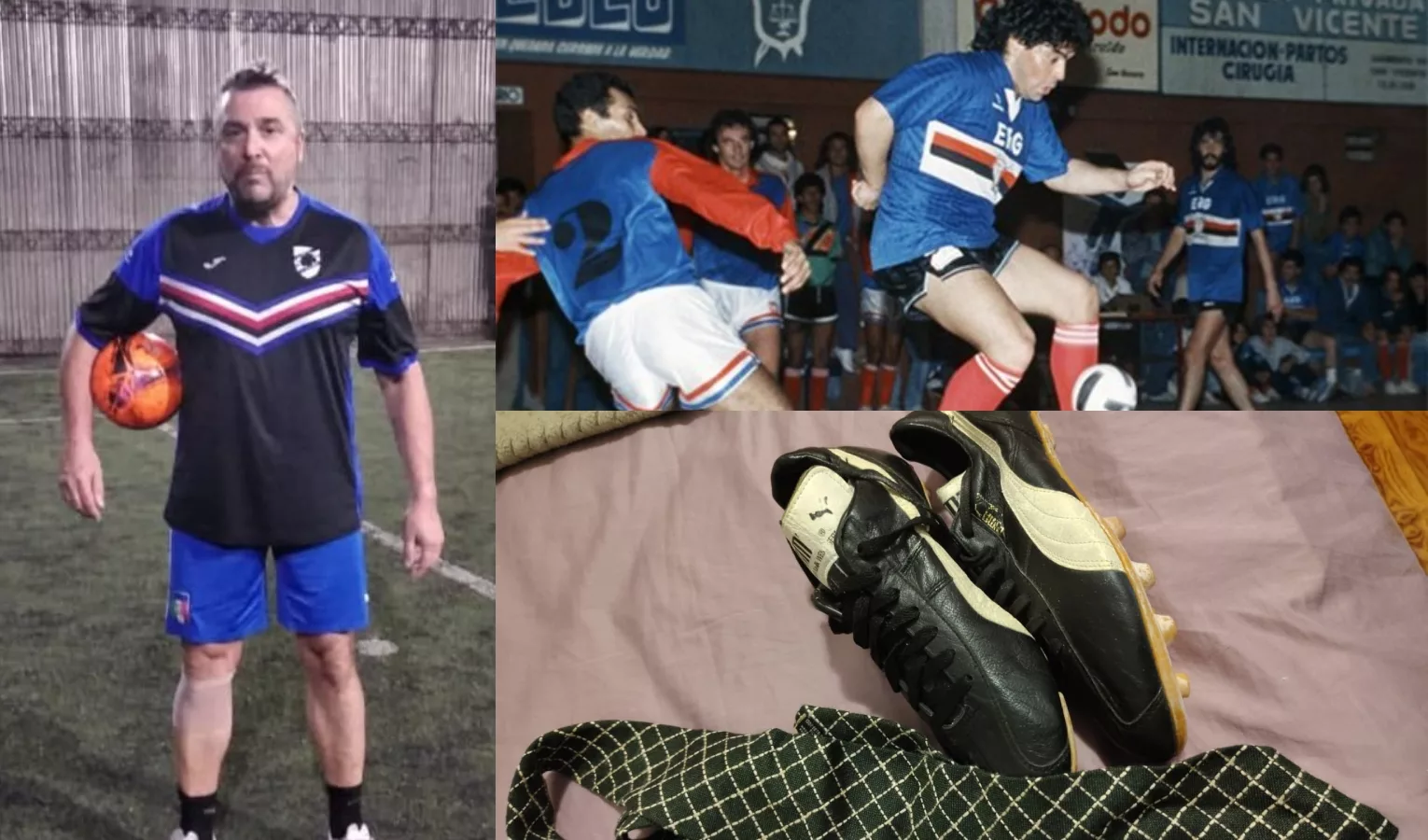 Roberto Compaire on the left, top left Maradona with the Sampdot shirt and the shoes he gave him
Genoese roots in the heart of Argentina
Italy permeates Argentina: 60% of surnames in football or politics are Italian, and ‘lunfardo’ – a dialect born in the working-class neighborhoods of Buenos Aires and Montevideo between the late 19th and 20th centuries, is full of Genovesisms such as “fainá”, “pelandrum” or “ciantapuffi”. Neighborhoods like La Boca or Bernal, with its replica of the Madonna della Guardia and processions in September with the coat of arms of Genoa, make Compaire, a huge Sampdoria fan, feel “at home”.
Argentine football? “Let’s forget about today – he sighs – but Maradona remains a legend. Affable, Italophile thanks to his Neapolitan years, I played with him several times: he was simple, despite being like Messi in terms of fame. A photo immortalises him in the Dorian shirt, made by Compaire himself after the ’91 Scudetto.
Nostalgia for the sea
What do you miss about Genoa? “Sampdoria and the sea: here for the beach I have to travel 500 km to Mar del Plata, which is a bit reminiscent of Superba”. He comes back often, “now I’m a tourist who gets emotional. Focaccia? I don’t miss it because Pietro Sorba, founder of the Sampdoria Club Buenos Aires, bakes it here, a gastronomy journalist who also teaches focaccia from Recco and Co0mparire assures “they are almost the same”.