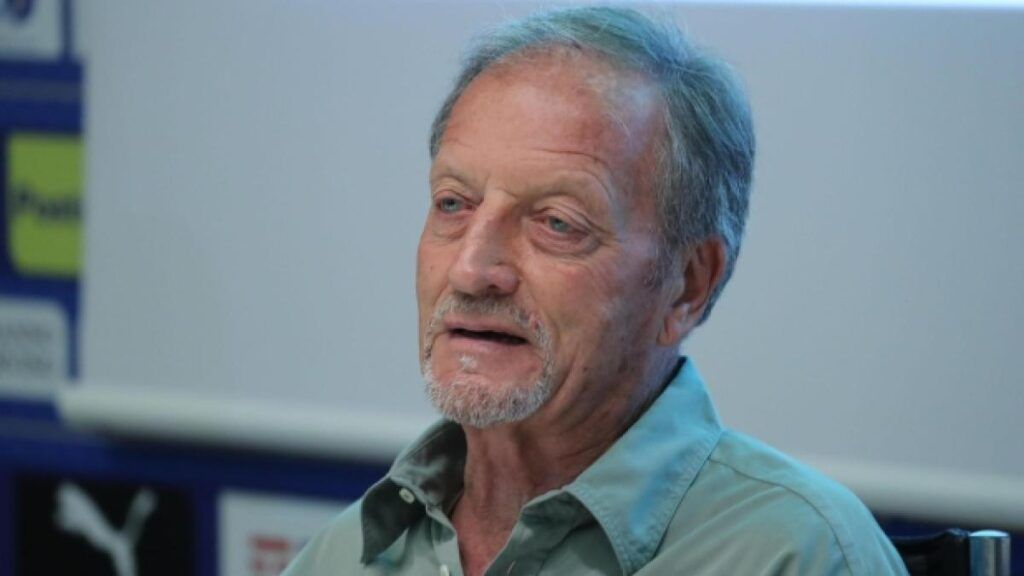
The 84-year-old Tuscan coach, president of the Assoallenatori: “The disqualification was unfair and it was proven, I lived through three years of pain. Bearzot said, I would rather be a caretaker at the Toro pitch than the coach of the national team”
Journalist
December 31 – 09:42 – MILANO
We are republishing the interviews most appreciated by readers of the Gazzetta dello Sport in 2025. The one with Renzo Ulivieri was published on 15 August.
Ulivieri, what is the first memory you have from childhood?
“The smoke. The smoke and the shouting. It was July 22nd 1944, I was three and a half years old, we were all locked in the Cathedral of San Miniato. There were German soldiers, the Allied troops were arriving, there was an explosion: fifty-five people died. All things I learned later, obviously. I was a child, I only remember the smoke and the shouting”.
The Taviani brothers made one of their best-known films about that episode: The Night of San Lorenzo.
“I was injured, they admitted me to a church, we all lived there. Every day a nurse came to treat me, my mother told me: Renzino, don’t say bad words. But I didn’t listen to her. These are memories that I’m reworking now.”
“They came to mind now, at eighty-four years old, thanks to a psychologist who has been following me since I had serious health problems. It was she who brought back these few memories of my childhood. I also have another: every time the alarm for the bombings sounded, my mother took me and my sister, took us to a ditch near the house and stood on top of us to protect us.”
His father is not in these memories.
“He was a footballer, he played for Pontedera because Piaggio was there, which was a war industry: whoever was there didn’t leave for the front. But then Mussolini invaded France, they called everyone up to arms and he had to go too. He was injured, he risked dying.”
Christian Democrat mother, practicing Catholic, and communist father: the historic compromise was signed in her house.
“But what a compromise… When there were elections, my father made my mother swear in front of the polling station: promise that you will vote the right way. Right for him, of course, and for me too. And the same scene was repeated when we left the polling station. I don’t think my mother ever broke her oath.”
Football entered his life early.
“I was sick of football, we played on the street. Even in the main ones, they weren’t asphalted. I went to Fiorentina, I stayed in the youth team for five years. Then they realized that I wasn’t good. But I was already a connoisseur, me. And how much I liked being there talking about football with those champions. The great Hidegkuti, for example.”
What kind of footballer was Ulivieri?
“A centre-half. We played with the system: three defenders, and the one in the middle was the center-half; the quadrilateral in the middle of the pitch; three attackers. I was going too slowly, at twenty they made me understand that there was no space between the starters and then I started calling in sick, I didn’t feel like being out. Meanwhile I was training the San Miniato boys.”
He coached for sixty years. And in twenty-three teams, if we haven’t missed anything.
“Maybe there are so many, yes. At twenty-seven they called me to Prato, the coach was Bearzot, I was his collaborator. It’s the only team that Enzo led besides the Turin boys and the national teams”.
What memories do you have of Bearzot?
“Eh, magical. He spoke, he told stories, and I listened to him spellbound. He had a total love for Torino. He always said: if they asked me to go and be the pitch caretaker at Torino or the coach of the national team, I would definitely choose Torino.”
He is a Fiorentina fan.
“I went there as a boy, it stayed with me. But the six years I spent in Bologna left their mark on me: the city, the fans… Everyone in the house knows that I want to be buried in the Bologna 96/97 tracksuit. I’ve already prepared it, it’s there in the drawer, folded neatly.”
In Bologna he also had his most famous argument: the one with Baggio. He put him on the bench in the match against Juventus and he left retirement.
“I explained to the team the game we had to play. I said: they are too strong, we don’t play in the first half, we throw the ball high on the attackers, Andersson and Fontolan, and that’s it. In the second half Baggio and Kolyvanov come in and we try to keep the ball on the ground.”
“But there was no argument. The evening before the match I was on the sofa with the president Gazzoni, Roberto arrived and said: I’m going home. I looked at him: you don’t have to tell me but him who pays you. Gazzoni was then fantastic. He commented: Ulivieri is right, but I’m on Baggio’s side. A stroke of genius.”
In the end you both left Bologna: you and Baggio.
“When I learned that he had decided to join Inter, I decided that I would leave too. Otherwise I would have become the one who had eliminated Baggio.”
Is Baggio the best player you have coached?
“No, the strongest is Alviero Chiorri. But now no one remembers him.”
Why not? Sampdoria, Cremonese, long hair.
“He had everything. More than Baggio, more than Mancini. To say: when Baggio was near the area he didn’t shoot, he placed the ball. Not Alviero, he could place it but he also knew how to shoot. And then he had a strong head, he had dribbling. And physically…”.
Are you physically strong too?
“At Samp I put four of them next to each other and made them run: at 50 meters Vierchowod came first, at 70 Pellegrini, at 80 Mancini, but at 100 Chiorri beat everyone.”
Why didn’t he have a great career?
“Because he wasn’t just thinking about football. Let’s put it this way: there was one thing he was much more passionate about than football. On Tuesday, when he showed up to resume training, I looked at his face and told him: Alviero, do half a lap of the pitch and go to the changing rooms, you start tomorrow.”
When he was in Cagliari, he was disqualified for an infamous accusation: being involved in football betting.
“I spent three years of pain and suffering. And – I admit it – I even thought about suicide. The forest helped me: I went into it in the morning and walked all day.”
“I fought for them to recognize my innocence, after two years the ruling from the Caf arrived. It says on my account: ‘The crime was committed in his absence and without his knowledge’. And again: ‘Ulivieri goes from the position of absolute protagonist to that of misguided generalist’. I had committed a slight, but no crime.”
He could have asked for mercy.
“I had hired the Taormina lawyer, it cost me an arm and a leg. One day, after two years of disqualification, they summoned me to the Football Federation and offered me a pardon: if you ask for it, we’ll grant it. I left those rooms insulting everyone, if I had asked for a pardon I would have admitted a fault that I didn’t have. And I got another year of disqualification.”
“I walk around with the CAF ruling in my pocket. If someone says to me ‘you’re the one who bets’, I take it out and tell them: no, that’s who I am”.
Why has he never coached a great team?
“Because I wasn’t cut out. I have a passion for teaching football, but at certain levels if you want to teach too much you’re a pain in the ass.”
In recent years a new, strange sport has been invented: walking football. What stage is it at?
“It’s growing: there were ten of us who started, now there are one hundred and forty of us and we have a championship recognized by the amateur league. Even us elderly people have the right to play sports.”
“You play with six people on the five-a-side football pitch. You can’t enter the area and the goalkeeper can’t come out of it, it’s forbidden to lift the ball and make tackles. And run, obviously: you walk.”
Next year he will reach twenty years as president of the Coaches Association.
“But don’t say that I’m attached to the armchair because mine isn’t an armchair: it’s a chair. And what we managers do is pure volunteering, we don’t get a single euro. We help the coaches, we work in the social sector: we went to the Shatila refugee camp for three years, we run courses for prisoners because we don’t like that when someone ends up in prison they then throw away the key. And we ask ourselves questions.
© ALL RIGHTS RESERVED