
It’s an ordinary morning at the end of December, one of those days suspended in the limbo of the holidays, in which you feel a little stunned by excessive eating, increased social contact, flu symptoms or after-effects, and at the same time you struggle to get back into your routine because “it’s not over yet”. I come across one of the usual short reel compilations that pass from one social network to another, posted by accounts I’ve never seen before, grainy due to the download/re-upload process, and obviously accompanied by one of the trending soundtracks of the moment in this case.
Reels lasting a few minutes have partly replaced highlights on YouTube. Compilation in which in the title next to the player’s name there was systematically some version of “best skills and goals / welcome to”. We consumed them compulsively, even though we knew that it was an abstraction compared to the reality of the game, which was much less dense. As a result of watching these compilations, we have perhaps become hyper-critical of those same players when, for most of the time played, we considered them guilty of “disappearing from the game” or having their minds elsewhere. “He can do more”, “he’s not very consistent”, “he’s not the same in big games”, “let’s see when he plays in a big league”, and so on with all the arsenal of platitudes of a fan who is disappointed or too sure of his own competence.
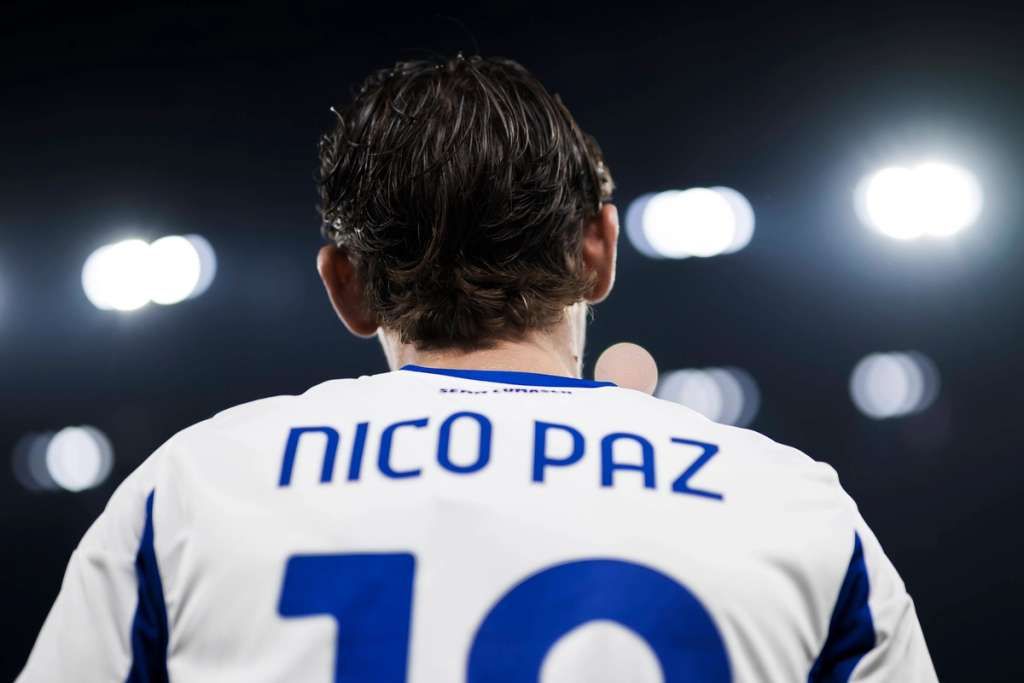
The reality of the game is much more granular than in these compilations. Similar plays, even those that become trademarks, are usually quite rarefied in the experience of watching one or more games. This is why, when we meet a player capable of reproducing them with a higher frequency than usual, when the ball reaches him, or the commentator pronounces his name, we find ourselves on the edge of our seat or we move our pupils towards the outer corner of the eye, those times when we simply have the TV on while we are doing something else. Nico Paz, the protagonist of this collection of clips, is one of those players.
In a Serie A often barren of talent and creativity – like much of contemporary European football – Nico Paz, for the second year in a row, is one of those players capable of waking us up from our torpor. Of course, Como’s number 10 is first of all an effective footballer, capable of both making his team “turn around” and producing a considerable quantity of goals and assists. But beyond the statistical veneer, which I care relatively little about, there is something in Nico Paz that captures our attention – and that’s no small thing, in times when attention is a currency.
What also caught my attention in this specific video, which collects some of Nico Paz’s plays that I had mostly already seen, was the accompanying comment: “I thought Pedri was the best spinner of the world until I saw Nico Paz” “The turns he makes are illegal”. And so, as I once again watched Nico Paz crumple backwards over the hideous winter orange ball of Serie A 25/26, allowing Matic to reposition himself between him and the goal on the Sassuolo front before sending Alberto Moreno into the goal with an “over the top ball” that was at the same time soft but decisive, I found myself thinking: of course I I like Nico Paz. It’s not just for his revival of shots from outside the box or his pinpoint assists. Nico Paz has my attention because, in addition to giving the impression of knowing how to manipulate the pace of actions and not simply being carried away, he tickles that part of me that is sensitive to everything a player is capable of doing with the space behind him. But to explain this better it will be necessary to move away from the Argentine playmaker for a moment.
Both as a coach and a spectator, my functional and aesthetic preferences have shifted in recent years towards teams, players and coaches closer to an approach that I would define, in the most concise way possible, as more oriented towards the ball and interactions, rather than towards space and the occupation of zones. This line of discussion, which I believe is wrong to define only as “tactical”, is now quite well known with variations of the term “relational”. In this article, written about a year ago together with Antonio Gagliardi, we explored this particular transition, in our personal experiences, from positional play to relationship play.
Lately, like several other coaches and/or popularizers who follow closely and try to contribute to the evolution of this style of play in today’s football, I have found myself delving deeper, on and off the field, into the possible dynamics relating to what a player can do, directly or indirectly, with the space behind him.
Among the founding themes, which we could easily define as game principles, of “relational” thinking is the use of diagonality in offensive plays, that is, that type of progression that involves one or more bodies oriented along an imaginary direction that goes from the outside (more or less extreme) towards the goal. Some of the most iconic “diagonal” plays that have contributed to the interest in this new type of approach since the first days when it began to be talked about, are the variations of the veils/decoys that could develop through these bodies oriented diagonally towards the ball. Martin Rafelt, founder of the German football analysis site Spielverlagerung, found an extremely fitting definition for this type of play: Shadow Passshadow pass, passing the ball without touching it. Continuing from this intuition, in an episode of the podcast that he manages together with Rafelt himself, the Scottish coach Jamie Hamilton, precursor of this debate on the tactical-identity Zeitgeist of modern football, explored the concept of Shadow Playthat is, you play “shadow”.
Image source Jamie Hamilton
In recent years the concept of “cover shadow” has entered the jargon to indicate the space behind him that a player could “obscure” by putting pressure on the bearer. By borrowing the same concept of space behind as shadow space, and extending it to the field of vision, we could therefore define Shadow Play as that type of play, of direct or indirect connection, oriented towards the space outside the blind spots of the player’s vision. Not only veils, baits or heel strikes, but also those small internal or external taps, perhaps from before as a bank, or even the immortal backwards head twists, could all fall into this definition.
A recent example: Cambiaso’s assist for Conceiçao’s goal against Roma.
Now we can go back to Nico Paz’s spins on the ball. The Como player seems to have a particular affinity with the space behind him, in various areas of the pitch: not only when he needs to “shake off” pressure through body feints, but also when he perceives that the flow of the game could benefit from a pause, a momentary turning back, as in the example of Moreno’s goal against Sassuolo mentioned above. For Nico Paz this “retracing his steps” is an indication of a profound connection with the development of the action, the movements of teammates and opponents, and therefore with the spaces available or manipulatable.
The concept of “going back before moving forward” is nothing new, certainly. For decades the “ball forward, ball behind, ball in space” have accompanied offensive developments on Italian pitches and beyond; in more recent times, various modulations of combinations with the third man have expanded the possibilities of action based on a similar general assumption, voluntary or otherwise: the defending team and individual can be lured forward and then hit from behind, at various levels. The defender looks at the ball and defines the spaces, the attacker looks at the spaces and defines the pace. Here, however, we are not talking about a preordained combination generated by coding, but we are limiting the discussion to a spontaneous, emergent behavior of the individual, which sometimes could even go against some generally accepted indications.
Allow me to go into personal anecdotes to clarify the concept. One of the most recurring phrases that I have heard various colleagues say since I have been on the pitch is “play where you see”. A practical indication that I have always found clear, concise and focused on the purpose of an action, on the “what” and not on the “how”. In short, from a methodological point of view, external feedback, i.e. that type of attentional focus that orients the player outside his own body, for which the most recent academic evidence has found a significantly better degree of effectiveness and transfer compared to the canonical “internal” indications, i.e. oriented towards the control of one’s body and not the purpose of the movement.
“Play where you see”, however, actually hides a very specific exclusionary constraint: someone else will take care of the space behind you. It’s not your job to take this risk, turn around with the man on you, make a dangerously interceptable bank or, even worse, a coy heel turn. All legitimate considerations from the point of view of gaming preferences: if limiting risk is considered a priority, then it makes sense to force the player to avoid games perceived as riskier than others. But we must be aware that this is not a neutral choice.
The underwater world that lies in the shadow of the visual cone is full of possibilities. By taking away this option from the player, restricting his action within the 180° field of vision, we actually also limit his creativity, and reduce his possibility of settling on a higher level of problem solving. That is, those who are more often able to open paths behind themselves will also have a greater chance of becoming a player of a higher level, and this will happen naturally through an increase in the development possibilities of their team.
Limiting the concept of “game vision” to the physical dimension of the positioning of the gaze also makes us lose a good part of the development of the perceptive sensitivity of the surroundings: the famous “eyes behind the head”. It is not just a matter of mechanically rotating the head to scan the space before receiving to obtain information, but also of actively perceiving all the imminent possibilities of action, of one’s own team and of the opponents. In short: it’s about being connected to the game in a much broader, almost total perspective.
In that video, Nico Paz doesn’t always play where he “sees”. During his matches he will certainly find himself playing where he sees, that is, first unloading backwards and then perhaps attacking the space; but one of the runs that make him special and interesting, strictly speaking, is his ability to play “where he feels”, and often this feeling involves the space behind him, even at the cost of returning there a moment after receiving. Probably, this possibility was also cultivated by the coaches he met on his way, including the current Cesc Fabregas, but we must not make the mistake of establishing a causal link by thinking that this ability was administered to him or, on the contrary, that it came out in a succession of total uncontrolled chaos.
Much of what happens on the field during a match is the result of spontaneous perceptions, more or less shared, in poorly predictable situations. Knowing how to help those who play to develop a level of perception that allows them to expand the possibilities of the game, in an adaptive manner with respect to the unpredictability of the context, enough to exploit their best qualities, and to do so through and for their team, I believe is the essence of being a coach. As Nico Paz’s actions suggest to us: it would be nice to get as many players as possible to play more “where they hear” and less “where they see”, and to do so in a way that is always connected with others. Maybe if we started to give the right importance to these possibilities of action too, we would collaterally find ourselves a football in which for the spectators the moments of pathos on the edge of the seat or of looking sideways while doing something else would be more frequent.