
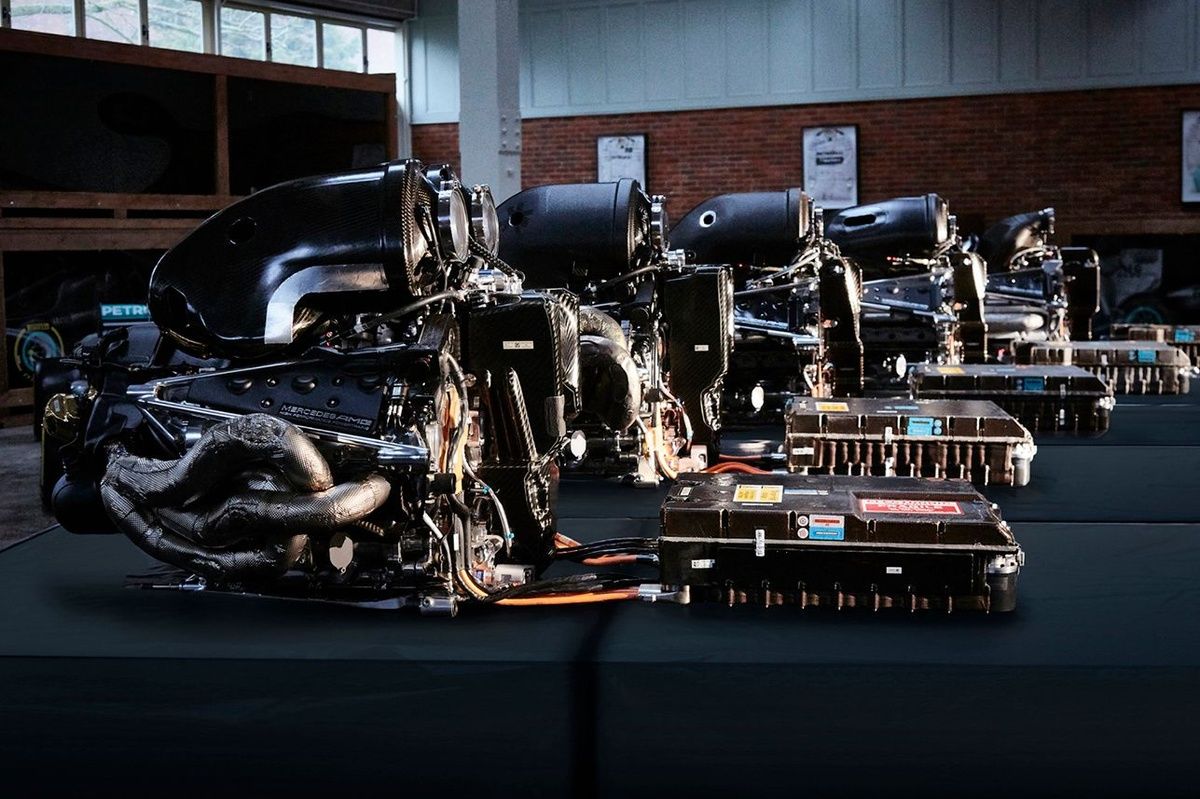
No compromise: Mercedes and Red Bull Powertrains can go their own way. The FIA would have admitted that the combustion chamber of the respective engines would be legal if a compression ratio of 16:1 was measured in tests carried out at room temperature. It matters little if, when hot, the resulting value will be greater. It’s the same concept as flexible wings: they don’t move at static test loads but then literally deform as the aerodynamic load increases.
Mercedes W16, rear axle detail
Photo at: Circuitpics.de
If the two contested units were to reach a compression ratio of 18:1, i.e. the measure allowed to internal combustion engines up to now, we would be talking about a power gain of around ten horsepower. A disparity that would justify access to the ADUO, the Additional Development and Upgrade Opportunities, which will allow manufacturers who are behind schedule to recover the missing performance with additional developments.
In fact, every 6 GPs of the 2026 season (1–6, 7–12, 13–18), the FIA will carry out a performance check on the internal combustion engines only and if there are differences that overcome a 2% power gap compared to the best engine, one development may be granted which could become two if the gap exceeds 4%.
Those in the know claim that Honda, Ferrari and Audi (who had written a letter to the FIA requesting clarification to find out the suitability of the Mercedes solution to the 2026 regulations) will not be able to intervene on the combustion chamber before 2027, considering how long it takes to make changes to the 6 cylinders.
Let us remember, however, that the engines have not yet been approved and there will be time until the first GP of the season to carry out targeted interventions, so it is not a given that someone cannot attempt a recovery, perhaps partial.
There are manufacturers, in fact, who for years have no longer used castings to create cylinder heads and crankcases, but have exploited metal additive manufacturing, 3D printing which allows the composition of very special alloys and offers the opportunity to design parts with very complex geometries.
And if we consider that the “bubo” has become known in the media for a few days, but the issue has been known to professionals for a few months: there could be those who, once they have received the green light from the FIA, try to chase Mercedes and Red Bull Powertrains in the race for performance.
Ball Powertrains Networks
Photo credit: Jon Noble
All of this, obviously, calling reliability into question: each engine engineer, in fact, carried out bench tests to find a life of at least 6 GP for each engine and we know that the cycle must be started all over again every time a substantial change is made.
The interventions, in fact, risk affecting the budget cap, reducing the economic availability for other developments. There will, therefore, be those who will wait for the first check of the ADUO (Miami GP) to introduce the new features using the extra budget that the FIA will grant and those who, perhaps, do not want to waste time and will try to intervene by introducing what some call the “second combustion chamber”.
An arms race has started which will also have effects on other regulatory aspects: the FIA wanted to keep this regulation very strict, avoiding escapes that could go far beyond the spirit of the regulation, but, according to rumours, even in aerodynamic matters we will see concepts that will try to reproduce the out wash effect on the front wing and on the flow diverters on the sides of the bellies, which will lead to an improvement in the performance of the car, but will determine a much dirtier wake, making overtaking more difficult.
Let’s also expect those with a poisoned tooth who could file a complaint at every GP to ask if the Mercedes and Red Bull engines will respect the regulatory constraints at all times of the event. In Brackley they are calm: they would have shown all the FIA engine developments on time and the International Federation technicians would have given the OK to the proposed solutions.
In 2020, however, there was the case of Racing Point which had presented brake air intakes that had been approved by the FIA and which were then judged illegal after the complaint presented by Renault. The copying of the 2019 Mercedes W10 was contested since the brake vents had become components that could not be purchased in 2020.
The FIA upheld the complaint, fining Racing Point 400,000 euros and penalizing it 15 points in the Constructors’ Championship. The question, therefore, remains very open, despite the FIA having granted one point advantage to the Star…
We want your opinion!
What would you like to see on Motorsport.com?
Take our 5 minute survey.
– The Motorsport.com team