The latest episode, the amateur cyclist who tested positive at the La Medievale granfondo, for which the organizers asked for compensation of 30 thousand euros, has brought to light a dormant controversy but which in fact continues with downward numbers in many events.
Are granfondos, as we traditionally know them, in crisis? Probably, what we are witnessing, rather than a crisis in Gran Fondos, is a questioning of a “traditional” model to which we have been accustomed for several decades. That of the granfondo understood as a real race.
On the meaning of competitive granfondo
Already in the past we asked ourselves the meaning of having cyclists (by definition, people who work and train in life as and when they can) race on competitive distances worthy of competitive categories. But if once the evidence of numbers and large participation silenced everything, in the last few years the trend seems to have definitely changed.
The world of long distance racing is going through a phase that can no longer be dismissed as a simple moment of decline. The numbers speak for themselves: in many historic events, participation is decreasing, sometimes even markedly, while only a few events manage to maintain or even increase their membership, going against the trend. It is not an isolated case, nor a coincidence linked to a single season: it is the sign of a deeper change in the way people experience cycling and free time.
That change triggered after the pandemic
The pandemic has accelerated dynamics already underway. Many enthusiasts have rediscovered the pleasure of pedaling independently, without timetables, without starting grids, without the anxiety of performance. Shorter, less stressful outings, more compatible with daily life. When events returned, some of that audience simply did not rejoin the ranks of traditional granfondos. Not out of lack of interest in the bicycle, but because the model no longer responded to new expectations.
When the format no longer reflects the audience
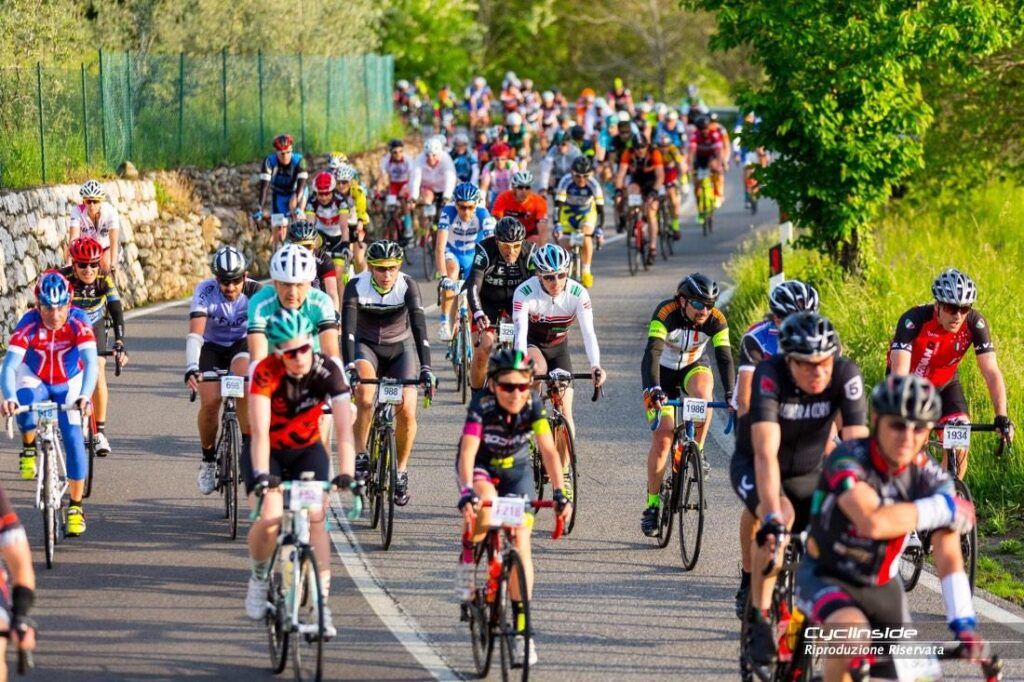
The central point is precisely this: many granfondos continue to be built around an idea of the participant who today represents only a minority part of the movement. The pure, trained competitor, willing to travel, spend and compete for a ranking, still exists, but is no longer the center of gravity of the system. All the others, the majority, soon end up pedaling beyond the end of the race.
In the meantime, then, a significant part of cyclists has moved towards a different idea of experience: less pressure, less exasperated competition, more attention to the context, to safety, to the pleasure of pedaling. When these two worlds are forcibly made to coexist without a clear plan, friction emerges: those who go fast see the rest of the group almost as ballast, those who go slow feel out of place, and in the end no one is truly satisfied.
The result is a paradox: events that are increasingly complex and expensive to organize, but perceived as less inclusive and, in some cases, less safe. This also gives rise to the sense of frustration of those who, despite paying a significant amount, find themselves in the middle of traffic after a few kilometers, without the idea of being part of a structured event anymore.
The example that works: less competition, more experience
It is in this context that models such as events with timed sections are proving to intercept a real need. Not because they give up competition, but because they put it back in its place. Those who want to push can do so, those who want to enjoy the route do so without feeling out of place or in the way. His slow participation is foreseen by the organization, without the cleaver of the end of the race to establish that he is no longer part of the event.
This approach radically changes the perception of the event: no longer a race “disguised” as cycle tourism, but a complete experience, in which performance is a component and not the only goal. Tension is lowered, the sense of community grows, the quality of the time spent in the saddle increases.
And it is precisely this experiential dimension that represents the true added value today. Not so much the stopwatch, but the story that everyone can take home: the landscape, the shared effort, the discovery of a territory, the sociality before and after the ride.
The real issue: rethinking the meaning of granfondo (with an eye on gravel)
The point, therefore, is not to save the granfondos as they have been until now, but to ask ourselves what they can become. Continuing to defend models born in another context risks further alienating those who today are looking for something different in the bike: a sustainable, safe, satisfying and compatible experience with daily life.
Rethinking formats does not mean distorting them, but evolving them. Some have “migrated” the event into a gravel experience that distanced them from the dangers and bureaucracies of asphalt roads, others are looking for solutions.
It certainly must be accepted that competitive spirit is no longer the only driving force, that the ranking is of interest to few, while the value of the event increasingly lies in the quality of the overall experience. It also means recognizing that safety, training and coexistence on the road are not organizational details, but central elements of the proposal.
Ultimately, the success of some “hybrid” events demonstrates that an alternative path already exists. It is up to the organizers to decide whether to follow it, adapting to a public that has changed, or remain anchored to a model which, numbers in hand, shows increasingly evident signs of fatigue.
And perhaps it is precisely here that the future of granfondo comes from: not from the stopwatch, but from the ability to return to giving meaning to the experience of pedaling together.
The user must become the protagonist again
The disaffection of many users starts from no longer feeling part of the event but also appearing a little out of place. Exalting the winners, focusing attention on them (and, sometimes, even cameras) leads the user who doesn’t arrive among the first to find himself in a context in which he no longer recognizes himself. It is no coincidence that those who are managing to go against the trend are those who are bringing the user experience back to the centre. It doesn’t matter whether it’s a less competitive or more exploratory version. It’s feeling excluded that makes you run away.