There is an image that accompanies this December of Carsen Edwards and it is that of a player constantly balanced between light and shadow, between the instinct of the pure scorer and the – inevitable – weight of being the offensive reference of the team The power of Bologna. A month made up of peaks and falls, of evenings in which he dragged the team along and others in which he seemed caged inside the increasingly tight meshes of the opposing defenses. And, as often happens when the talent it is so evident, the debate has been heated especially off the pitch.
On social media the judgment has become clear, at times summary: Edwards “he’s a soloist”, “holds the ball too much”, “freeze the attack”, “makes Virtus predictable”. Criticisms that emerge especially after the most difficult matches, such as the one againstOlympiakoswhere the Juventus number 3 finished with 14 points, all in the first half, shooting 3/11 from two and 2/5 from three, with 2 turnovers. A complicated match, marked above all by one suffered a blow in the first minutes (sprained right ankle with ligament involvement which will be re-evaluated in the next few days) on a long range shot, an episode which inevitably affected his effectiveness and continuity. The player tried to grit his teeth during the subsequent phases of the game, but his second half was emblematic to explain the physical problem.
However, it must be recognized that a significant part of Edwards’ difficulties against Olympiacos was also the result of the tactical choice of coach Bartzokas, who prepared a real defensive cage (and had announced it in advance during the tender presentation). He was the one who drove it, more often than not Evan Fourniertasked with taking away his pace, space and first steps, with continuous help ready to close the lines of penetration. A physical and methodical job, which took away oxygen from the former Bayern Munich player and made his every initiative extremely expensive, confirming how the most organized defenses in Europe identify him as Virtus’ main offensive danger.
Yet, reducing the discussion to a simple accusation of individualism risks being a partial reading. Because Carsen Edwards is exactly this type of playerforever. A creator of advantagesa scorer capable of lighting up in just a few possessions, a winger who thrives on rhythm e di trust. Virtus chose him in the summer precisely for this profile: a player capable of taking on himself responsibilityto break the balance, to take shots that others don’t even dare imagine. A typology that has often been missing in Bologna in recent years and which many, paradoxically, have been demanding.
The point is that a player like this inevitably lives off oscillations. The ups and downs are to be taken into account. The season is long, exhausting and thinking that he can be dominant every night is simply unrealistic. Also because the context matters: after the difficulties against Hapoel Tel Aviv and Olimpia Milano, Edwards had responded on the field with a positive streak of three important matches, between the two away games in Belgrade (Partizan and Red Star) and the championship match against Brescia. Signals of continuity which describe a player inside the project, not a foreign body.
Then there remains the theme of attitude, also evoked by Dusko Ivanovic after the match, with harsh words but deliberately not addressed to an individual. We don’t know if the reference was to Edwards or to someone else – or more simply to a collective dynamic – but it is clear that, from a technical leader, something more is always asked for on an emotional level, especially in moments of difficulty.
The numbers, meanwhile, tell a clear truth: 17.7 points on average in the EuroLeague, fifth best scorer of the competition and 14.3 in LBA, where the playing time is lower and the hierarchies are different. Data that certifies the impact of a player who remains central in the Virtus systemeven when the return is not linear.
Carsen Edwards is not – and probably never will be – a “comfortable” player. It’s a acceleratornot a metronome. Take it or leave it. The challenge, for him and for Virtus, is to find the point balance between instinct and readingbetween freedom and responsibility. Because when the balance is there, his talent becomes a weapon that few defenses in Europe can really contain.
Eugenio Petrillo
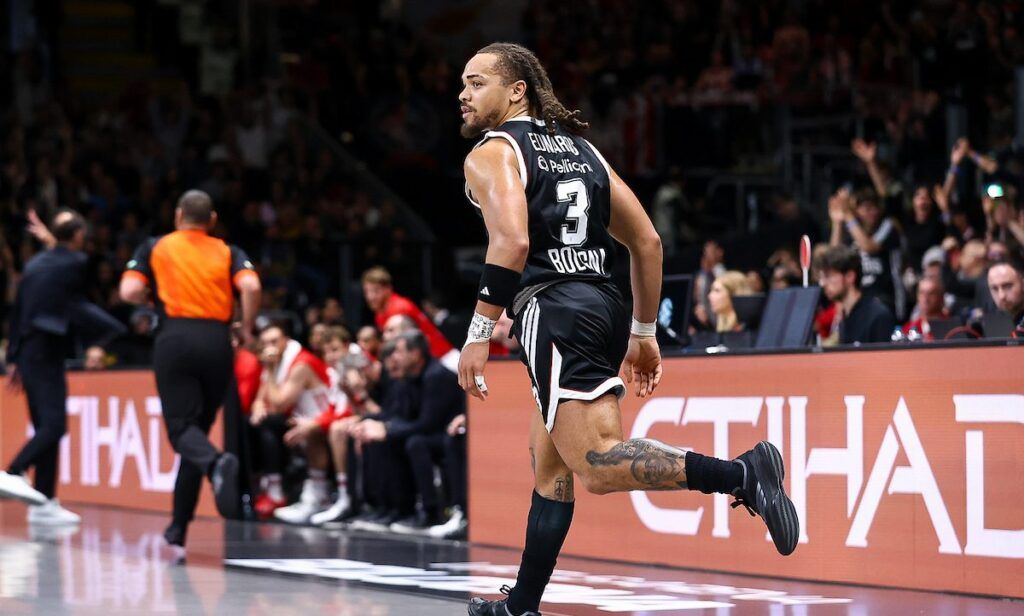
In the image Carsen Edwards, photo Ciamillo-Castoria