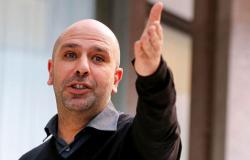
Here we go again, we had to wait almost six years to have Checco Zalone explain life and the world to us again. In the last one Tolo Toloreleased at the beginning of 2020, was an unemployed man from Puglia who left for Africa to escape the debts resulting from the bankruptcy of a sushi restaurant. In Good Wayreleased this Christmas with already record takings – almost 14 million in the first two days – we instead find him in the role of a rich, spoiled and narcissistic fifty-year-old, son of an upholsterer who in more economically prosperous years managed to make a fortune by opening sofa factories in northern Italy. The way he is presented to us – by the pool in his luxury villa, skin full of tattoos and a host of dancing servants around him – Zalone appears to be a sort of caricature of Gianluca Vacchi, without his sculpted physique and with a toupee on his head.
IN THE first scene, interviewed by an English journalist, he immediately declares that he has never needed to work because he has a rich family, and proudly shows off his twenty-five year old trophy model girlfriend. “He says he’s from Mexico City, but he hasn’t told me which city exactly.” One of many in a long list of tepid and ill-timed jokes (often played on linguistic misunderstandings) that we hear him say throughout the film. But like any good national-popular fairy tale there must be a clear moral, contained in a growth path of the protagonist, and it must already be intuitable from the beginning. And here it’s much more banal than in previous films: money doesn’t buy happiness. Not that it’s not true, but it’s difficult to believe it when it’s said by those who create feature films whose only praiseworthy aspect, and which is talked about, is that of earning a lot – with minimal effort. Checco has everything, except the love of his daughter Cristal (Letizia Arnò), who he never raised. Even if in truth it is not clear when, and above all why, you become aware of this lack, it is simply made to happen. What triggers everything is Cristal’s escape, who disappears from one moment to the next without leaving any clues.
THE DAUGHTER however, she doesn’t live with Checco but with her mother, another ex-model who has now become ugly because, according to her, “she gave up everything and started doing experimental theatre”, together with her new partner Tarek, a Palestinian director. Tarek is the character that Zalone deliberately exploits several times, in a truly unoriginal way, as a stereotype of the committed and “radical chic” artist, characterized by keffiyeh, eyeglasses and bicycle. A sort of nemesis, who wants to steal his daughter and put strange ideas in her head. And it is when all three parents find themselves talking to the police about Cristal’s disappearance that Zalone shoots his first terrifying arrow against the elusive politically correct, with a chilling and ignoble joke, especially at the end of this 2025. In reference to Tarek, he says, addressing the police: “He is the only Palestinian who occupies a territory, my gaza.”
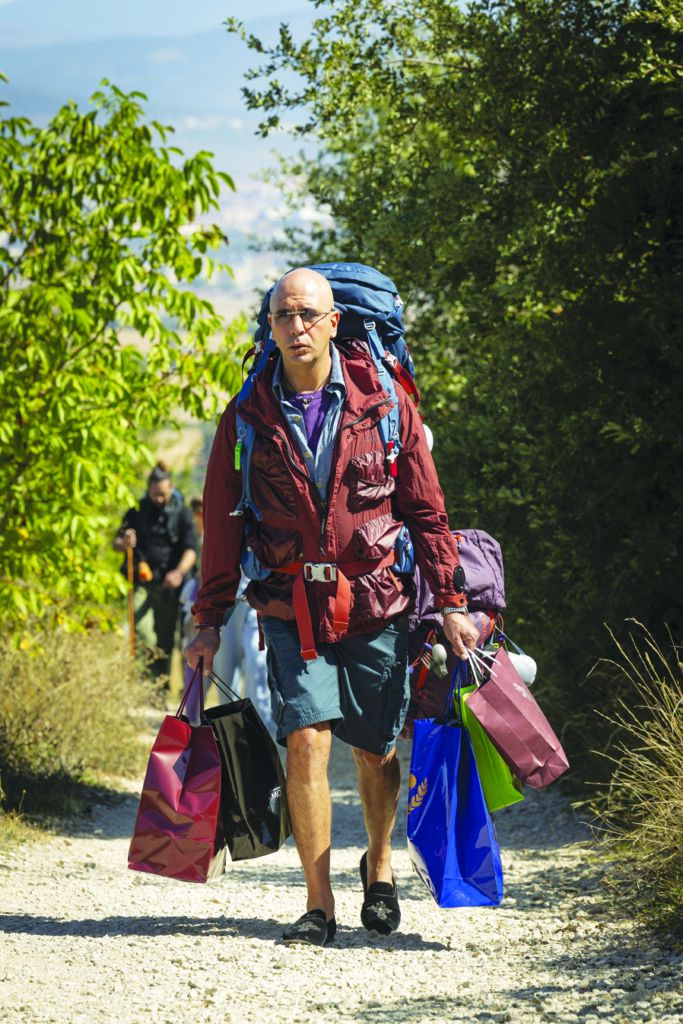
IN THE COURSE of the film Zalone then decides to wink at the anti-woke several times, such as with another joke about concentration camp showers or September 11th. In fact, he manages to obtain the destination of the escape by bribing a friend of Cristal’s with some pastries, an overweight girl whom he first tortures with mini portions of vegetables in a starred restaurant. Checco discovers that his daughter is headed towards the Camino de Santiago and decides to go and get her, and then instead start the long 800 km pilgrimage with her. As in all his films, Zalone’s parable of redemption and evolution slowly begins with the excuse of travel, Good Way in particular it moves on clear Christian-Catholic notes. Always linked to the simple moral of the film, along his journey Checco predictably strips himself of all his possessions, like Saint Francis. First the Ferrari and then the Patek Philippe, which he leaves as a gift to a sanctuary to prevent his daughter’s possible homosexuality. He also falls in love with Alma, a traveling companion-helper, who later turns out to be a nun who gives him a necklace with a small wooden crucifix.
Thanks to his spiritual journey, Checco finally manages to become a father and learns to recognize the true values of life: God, homeland (they are never lacking, as in Where am I going?the jokes about overcooked pasta) and family. Closing after the credits, the musical finale could not be missed, a song about the prostate exam, which made me wonder if it better represented the audience it is aimed at. Good Way (males over 50) or the annoying sensation you can get while watching the film.