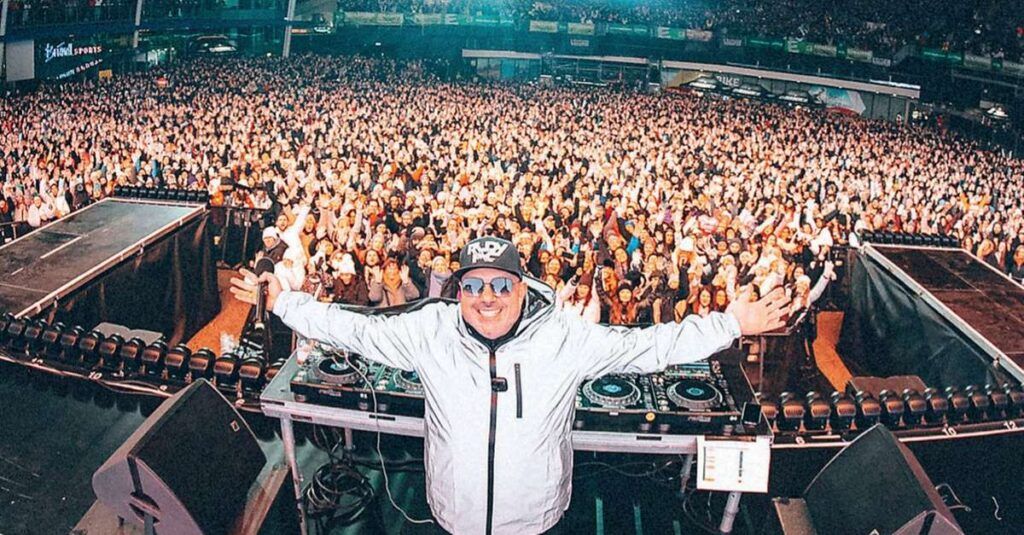
BOLZANO. In Schladming he organizes the winter season of shows for the Hohenhaus Tenne, one of the largest après skis in Europe. For the occasion, and with the prospect of playing music in front of over 51,000 people, deejay Rudi Wilhelm dug deep into his record collection to select some of the most iconic hits from the 90s to today.
Rudy MC is the stage name of the 43-year-old DJ from Bolzano who has been traveling the world with his console for years and makes music for both intimate events and large stages. In his career he first went through the vinyl era, then the digital one and today he also makes use of Artificial Intelligence.
«Every era has its transformations, which you need to know how to grasp and ride», he explains. Over the years he has also shared the stage with stars such as David Guetta, while his passion for electronic music is a legacy from his father. A DJ with an international scope, this year Rudi opened the European concerts of the Backstreet Boys on tour with “Millennium 2.0”.
Rudy MC, where does your stage name come from, which is also a business card for a DJ?
«It was given to me by another DJ from Bolzano. At the beginning of my career it wasn’t easy to make my debut in nightclubs, so I found myself as a vocalist, Master of Ceremonies. So here are the initials MC, which recall the well-known American rap battles.”
Does passion come from?
«From my father, historic après ski DJ. When the first discos arrived in Alto Adige half a century ago, he was in pole position.”
From the record era to the digital era, how has your disco music changed?
«Like the way we dress and eat: everything evolves. Without getting too technical, once upon a time in my sector the art was to match two discs, that is, knowing how to calibrate the speed. Today this operation is facilitated by technology. Now there are other possibilities connected to my work, on which a lot of work needs to be done. I have to be fast and dynamic, operating on three or four tracks at the same time. It’s another art. There is also work at home, that is, arranging the ingredients for the final mix.”
What were your first experiences as a DJ?
«I started at parties at the beginning of the century: the classic student parties, then the big move to Baila in Appiano, in 2002. I was the first DJ at Baila, a disco pub that soon became a disco».
Has the relationship with the public changed?
«Yes, especially between 2007 and 2009, when I started to become international. Then there were different moments, like Covid in 2020. From home I ran a daily podcast where I invited international guests: for an hour we talked about the nightclub and entertainment sector. There was a lot of insecurity and we didn’t know what the future would hold for us.”
It is said that we are forgetting about discos: why?
«Discos no longer satisfy our needs like they once did. In the past you went to the disco and waited for your favorite song. Today you go to a platform and immediately satisfy that need. You used to go to the disco to meet people, today there are cell phones and social media: moments of meeting 24 hours a day. We no longer meet up at the disco every weekend.”
So where are we going?
«There are intimate situations, which are very popular, or big festivals like Tomorrowland, where you also go to say you’ve been there. Then there are the après ski parties, especially in winter.”
How has Artificial Intelligence changed your work?
«I’ll give you an example: recently I had three shows of 100 minutes each. The music production and selection were done by me, but the video section, what we show on the screens, is 80% produced by AI. It’s a resource that speeds everything up. Previously ten people were needed, today three are enough. If you need a voice announcing something, do it all with AI. Once upon a time you had to record in the studio. The point is knowing how to use it. Do you remember the song “Video killed the radio star”? Things change, but they don’t kill. Today I don’t play like I did in 2002: AI integrates my work.”
Returning to the topic of nightclubs, today we see smaller venues and a less lasting relationship with the public. In the past you perhaps always played in the same place, you knew who came in and out and you knew which were the so-called workhorses to play.
Today instead?
«In my case, by doing more unique evenings of booking, as they say in jargon, rather than residency, I can establish a perhaps more superficial feeling with the public. But people also get to know you through social media. Everything changes, but new possibilities arise.”
Do you prefer to perform in front of a crowd or in more intimate locations?
«I look at the feeling. The biggest party isn’t necessarily the best. In a stadium the background noise of 40,000 people creates a buzz: everyone is talking and you can’t interact with a single person. The imposing stadium is beautiful, but also playing in a location for 100 people, where direct contact is created, gives great satisfaction. I like to ride the wave of intimacy, regardless of the number of spectators.”
Can you tell us about the experience with the Backstreet Boys?
«It was my first such interactive show with so many people. Since 2007 I have been in charge of the artistic programming of a nightclub in Schladming and I came up with the idea of creating an interactive opening show for the Sky Opening, which started in 2007. We involved the public in a modern way: at a certain point we interrupted the music for a digital ski race, controlled by the public on a 36 meter screen. We zapped on a TV with theme songs from TV series from the past and a karaoke with 17,000 people playing music by Robbie Williams. The cold of the evening has vanished.”
Will 2025 be an unforgettable year?
«Yes, especially considering that, as already in 2023, I played at the Donauinselfest in Vienna, one of the largest events in the world».