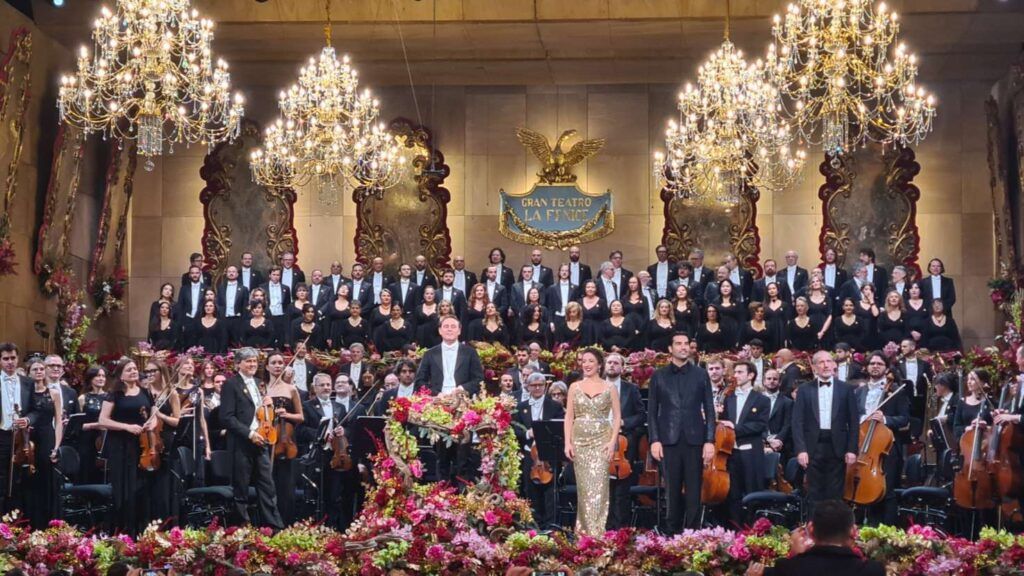
The review refers to the evening of December 30th 2025. The concert will be repeated on 1 January 2026 and the second part broadcast live on Rai1 at 12.20
One of the most frequent criticisms aimed at the traditional New Year’s concert of the La Fenice Theatre it concerns the poor ability to renew itself over time, with often predictable choices both in layout and in directorial presence. Daniel Harding, for example, has reached the podium five times in the last five years – last year with less than memorable results. The event has always been divided into two unconnected parts: the first dedicated to nineteenth-century symphonism, mainly Beethoven, Tchaikovsky and Dvořák; the second built according to a now crystallized formula: a potpourri of arias, choral and orchestral pieces – mostly taken from the great Italian opera repertoire – designed according to the live television are Rai1 il January 1st.
The 2026 edition marks a turning point, not sensational but significant: for the first time the program is unitary, entirely dedicated to Italian melodrama, and is entrusted to a director fully in tune with the project. Michele Mariotti today, among the Italian batons of his generation, he is the most authoritative in the operatic repertoire between Rossini and Puccini, and his presence gives the Venetian concert a performance level and stylistic coherence that had often been lacking in previous years. It is no coincidence that he is an exemplary concertmaster, capable of never routine readings and of great freshness, always attentive to the breath of the singing.
In the first part of the concert, Mariotti combines symphonies and interludes of nineteenth-century Italian melodrama – from Rossini to Puccini – not according to a strictly chronological order, but following a line of theatrical coherence that crosses different authors and styles. What emerges is the profound transformation that orchestral pieces underwent over the course of the century: from an introductory function, intended to prefigure the atmosphere of the drama, to an integral part of the theatrical construction, with a dramaturgical role capable of anticipating, commenting on or prolonging the stage action.
The concert opens with the grandiose symphony dalla Semiramis by Rossini, addressed by Mariotti with a wide and solemn breath. No hyper-fast times, which are fashionable today. The construction is solid, monumental, and clearly highlights the supporting elements of the drama: the relaxed lyricism of theAndantinothe martial impulses, the heroic outbursts, but also a sense of restlessness that finds its outlet in the final crescendo, where the sonic magnificence – although firmly anchored to a neoclassical aesthetic – allows us to glimpse the tragic shadow that weighs on the work.
The symphony has a different stylistic position Normain which Mariotti clearly highlights Bellini’s definitive detachment from the opening Rossini. Here we are already on the ridge between classicism and early romanticism, perceptible in the tense reading, characterized by a variety of colors and elastic tempos that allow the melody to unfold with the necessary naturalness. Also noteworthy is the ability to make theOrchestra of the Phoenixwho supports the conductor in a commendable way throughout the concert, as demonstrated by the excellent quality of the timbre mixtures and solo interventions, the calibration of the dialogue between the sections and the attention to dynamic detail.
Mariotti’s approach to the late nineteenth-century works of Mascagni and the young Puccini is completely original. The interlude of the third act of Guglielmo Ratcliffimbued with a “Wagnerism” relived in the light of Mephistopheles by Boito, is returned by the director with melancholic abandon and at the same time a slightly convulsive intensity that evoke with subtle ambiguity the seductive presence of infernal forces. This is also confirmed by the performance of the famous intermezzo da Rustic cavalryin the second part of the concert: Mariotti’s realism is not visceral and congested, but linear and rational, almost a moral atmosphere, which nevertheless thrives on strong contrasts, combining drama and passion, amended by the rhetoric of manner, with transparency and sweetness. Similarly, in the execution of the To be taken down and The Villi – a tarantella deformed into a ghostly vision – Mariotti captures the essence of the page without emphasis and without weighing down its heavy romanticism, allowing the symphonic tensions and Italian theatricality to emerge which at times anticipate the dramatic strength and color sensitivity of the more mature Puccini.
The “funny” parenthesis represented by the symphony is also perfectly defined Don Pasqualewhere the highly mobile agogic and the finely calibrated dynamics combine with an elegant brilliance, far from any farcical legacy. Mariotti naturally tunes into the bourgeois dimension of Donizetti’s masterpiece, capturing its panache and irony without ever indulging in caricature, but allowing veins of melancholic lyricism to emerge between the folds of the musical discourse.
Closing the first part of the concert is the dai symphony Sicilian Vespers by Verdi, which Mariotti – at least in this context – seems to remove from any grand operatic trappings. The dramatic tension, imprinted right from the threatening rhythmic cell of the Largodevelops with compactness and clarity of sound, which is counterpointed by the nobility of the phrasing and the measured passion with which the famous cello theme is returned. A high profile performance, which best seals the first part of the programme, undoubtedly the most successful of the evening.
The second part of the concert proposes, as per tradition, the formula of the layout “in pieces”, with a succession of arias, duets and famous choral and instrumental pieces: a now indispensable approach for television logic, to which Mariotti adapts by inserting a single more refined piece – the Barcarola and Silvano by Mascagni – and avoiding the further effect of fragmentation represented, in the most recent editions, by the final chorus of the Turandot (also not written by Puccini). Here too the director ensures a satisfying variety of colours, dynamics and agogics, confirming himself as an attentive and flexible baton, capable of following and naturally supporting the breathing and phrasing of the protagonist voices.
Rosa Feola she confirms herself as a serious professional, possessing a tonally luminous soprano voice, supported by a homogeneous emission and notable musicality. Sing «Sombre forêt» from Guglielmo Tell by Rossini with roundness of sound, appreciable legate and right abandon. The «Casta diva» of Normahowever, although overall correct and controlled, it does not possess the lunar character nor the desirable smoothness and bel canto style.
Even more interlocutory is the proof of Jonathan Tetelman: even in a room that is not very large like that of the Fenice, the sounds do not appear particularly full-bodied in the medium-low register. As the voice rises, it acquires greater timbre and volume, with high notes that are not very ringing but certainly sonorous and of great impact, as demonstrated by the ovation that the audience pays him after the natural B of «Nessun dorma». One does not have the impression of a vocality naturally suited to the lyrical-spinto repertoire with which the American tenor often engages. Both in Puccini’s pages and in «Cielo e mar» dalla Mona Lisathe softness and roundness of “Italian-style” singing are missing, and the phrasing, although supported by good intentions and a certain variety, is not free from rigidity and artifacts.
With these premises, the duets from Bohemia (“O sweet girl”) and from Traviata (the Brindisi which closes the evening, invariably repeated) are functional and at times appreciable, but do not leave their mark. The interventions are excellent in terms of precision and ductility Phoenix Choirprepared by Alfonso Caianiwhich compactly performs «Feste! Bread! Parties!” from the Mona Lisa and, from Nabuccoa «Go, thought» impeccable for its softness and style. 

The second part of the program will be broadcast live on Rai1 at 12.20pm on New Year’s Day and will then be broadcast again on Rai5 at 9.20pm. The concert will be broadcast in full on Rai Radio3, again on Thursday 1 January 2026, at 8.30 pm.
La Fenice Theatre
NEW YEAR’S EVE CONCERT 2026
Music by Rossini, Bellini Mascagni,
Puccini, Donizetti Verdi, Ponchielli
Soprano Rosa Feola
Tenor Jonathan Tetelman
Orchestra and Choir of the Teatro La Fenice
Director Michele Mariotti
choir master Alfonso Caiani
Venice, 30 December 2026