
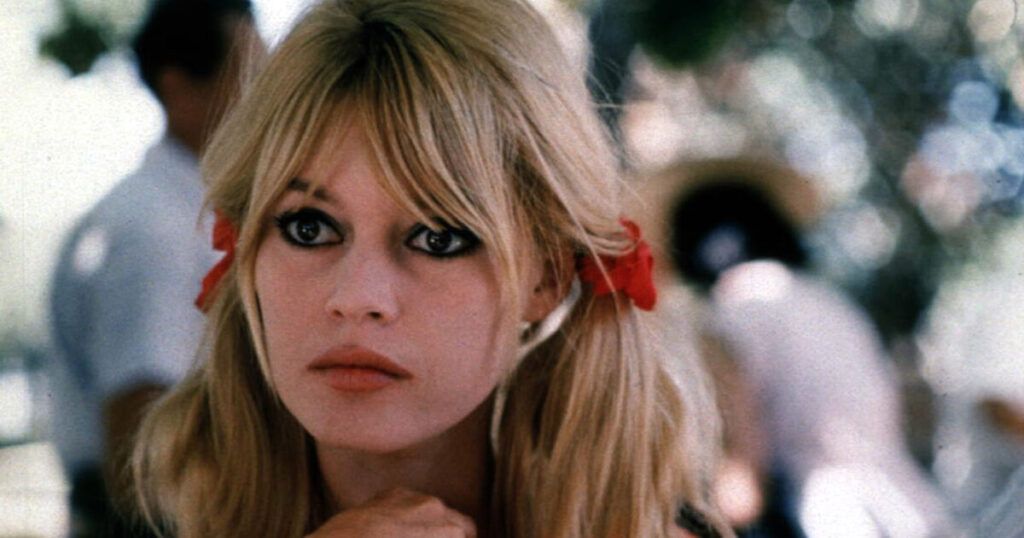
Goodbye BB. When God created woman he thought of Brigitte Bardot. Never an actress was more of a sex symbol, fashion icon, champion of female pride and sexual freedom, as she was 91enne Bardot. A hypnotic shimmer and an international following that go far beyond the performances for the cinema (certainly not memorable), which mostly lasted not even fifteen years, between the late fifties and the mid-seventies. Not only that actress BB, but also a singer and model, but above all an important, passionate, combative animal rights activist, as well as founder and president of a foundation that bears her name. Daughter of a wealthy Parisian industrialist, she received a very strict education. Passionate about dance, she entered the Paris Conservatory in 1949 and at fifteen became the mascot of Elle magazine.
Brigitte Bardot was then offered her first role in 1952 by the director Jean Boyer in Le Trou Normand alongside the great actor Bourvil. On her eighteenth birthday her father allowed her to marry Roger Vadim (you were of age at 21 at the time ed.), assistant director to Marc Allegret, who was ultimately responsible for the discovery of Bardot as a face and body for cinema. He then played a small role for the American director Anatole Litvak in An Act of Love alongside Kirk Douglas, then in Hollywood he was also in Helen of Troy by Robert Wise. Back in France, here she is with Michèle Morgan and Gérard Philipe in Les Grandes Manœuvres by René Clair and then in the role of Poppea in My Son Nerone with Alberto Sordi and Vittorio De Sica directed by Steno.
But it was in 1956, thanks to her husband Vadim’s film (from whom she separated in ’57), And God created woman, to enter the legend of cinema and definitively transform into an icon of beauty. A series of displays of a perfect body which also began in Cannes in 1953 when she was photographed in a bikini on the beach in front of the Palais, causing fainting and passion. And God Created Woman is a case of preventive scandal that shocks censors and right-thinking people (even if in reality there is nothing scandalous in the film). If anything, BB meets Jean Louis Trintignant on the set, a soon-to-be clandestine lover, and will make a not yet mythologized Saint-Tropez, where the film is shot, her lasting home – La Madrague – when the time comes for an early retirement (1974).
After Vadim’s film, the producers began to insistently knock on his door. In 1958, Brigitte Bardot even becomes the highest paid actress in French cinema (twenty years later she would be surpassed by Juliette Binoche ed.), starring, even just in the next twelve months, in four films: En cas de malheur (where she acted with Jean Gabin), Les Bijoutiers du clair de lune, Une Parisienne and La Femme et le Pantin. ’59 is the year of Babette Goes to War (on the set she meets and becomes engaged to the actor Jacques Charrier) and of Clouzot’s Truth where plays a role that will make her suffer: that of a woman who is accused of murdering her husband, but who the villagers judge as a man-eater and no good.
In 1960 she gave birth Nicolas, his only son. A complicated and painful relationship with the newborn that mother Brigitte immediately rejects by giving him to a nurse, and with whom over time she will never have a good relationship. The birth causes BB to have suicidal instincts which seem to materialize a few months later when she is narrowly saved from self-induced death. On the set of Private Life she meets the actor Sami Frey who becomes her new lover after the liaison with Raf Vallone and before that with the rich German playboy Gunther Sachs with whom she gets married and from whom she divorces in 1969. In 1963 another crucial date for BB: she is the protagonist of Godard’s cult, Contempt – even if we know that Bardot was a last minute name because the director wanted Kim Novak while the producer Ponti wanted his wife Sophia Loren -; but it is also the year in which he began his active militancy as an animal rights activist.
The first battle is ithe attempt to promote a weapon that painlessly kills animals in slaughterhouses; This initiative will be followed by dozens of others – perhaps the most famous and significant will be the one against fur, which we will return to. In 1964 Louis Malle wanted her alongside Jeanne Moreau in Viva María!, but now it was music that rang the doorbell at Bardot’s house. Here she recorded the songs Le Soleil (1966), Harley-Davidson (1967), then Serge Gainsbourg’s gift of love: Je t’aime… moi non plus (1967). The song still causes a scandal and she embarks on a relationship with Gainsbourg, while the relationship with another singer, this time of Italian origin, Nino Ferrer, dates back to 1972.
BB continues his film career where he meets colleagues Annie Girardot – Les Novices (1970) and Claudia Cardinale with whom he remakes a couple of sexy gunslingers in Les Pétroleuses. L’Histoire très bonne et très joyeuse de Colinot trousse-chemise (1973) is the last film of his career. From now on, it must be said, it is only a fight for the protection of animals. In 1976 he joined Brian Davis of the IFAW and launched a vast international campaign to denounce seal hunting. In March 1977, French President Valéry Giscard d’Estaing banned the import of sealskins into France. In her fight, Bardot was supported by numerous personalities from French showbiz and beyond such as Isabelle Adjani, Kim Basinger, Johnny Hallyday, Alain Delon and Jacques Chirac.
In 1978 Bardot published an illustrated book for children – “Noonoah, the little white seal” – which tells the story of a seal pup saved from hunters by an Inuit. In 1982, music and animal rights came together when BB returned to the recording studio for one last song, in homage to animals: Toutes les bêtes sont à aimer. The Brigitte Bardot Foundation to help animal causes dates back to 1986, while in 2001 PETA awarded her the Peta Humanitarian Award. BB’s opinions influence French parliamentarians, so much so that in 2003 and 2006, following what we would today define as pressing lobbying activity, France banned the import and then the trade of dog and cat skins. A Gaullist from the first hour, Bardot has always lined up on the right. She has been convicted five times of inciting racial hatred for her criticism of immigrationthe ritual slaughter of animals, some aspects of homosexuality and the “Islamic invasion” of France. Married in 1993 to Bernard d’Ormale, advisor to Jean-Marie Le Pen, in 1997 BB supported Catherine Mégret, the candidate of the Front National, while from 2012 onwards she supported the candidacy for the presidency of the republic of Marine Le Penoften defined as the Joan of Arc of today.