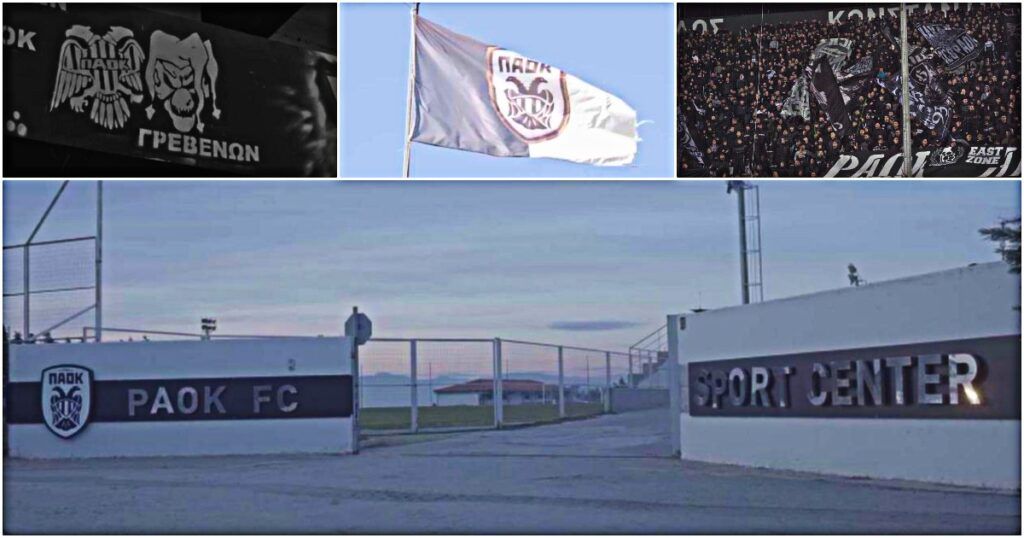
They call themselves the “team against the system”. Their three main rivals – Olympiakos, Panathinaikos e AEK Athens – they play 500 kilometers away. And their connection with (the) Napoli it is well recognizable in numbers and style. To the extreme nord of Greeceon the border with Macedoniathe city of Thessaloniki it is a tourist destination and sporting attraction. Thanks to Panthessalonikeios Athlītikos Omilos Kōnstantinoupolitōna multi-sports club better known as PAOK. The football team, among many ancient of the Hellenic territory, is among the favorites for the final victory of the championship and plays in Europa League. And for a few months it has been the nucleus of the most important Italian football enclave in the country.
A little history
Founded in April of 1926 by the fugitives of Istanbul during the Greek war–Turkishthe social colors are chosen to symbolize the sadness of conflicts (the nero) and the hope of a rebirth (the bianco). Currently ranked 52nd in the ranking UEFAthe Russian owner Ivan Savvidis – with the CEO Maria Goncharova – inaugurated an era that had never been seen in Thessaloniki. Since 2012, in fact, PAOK has won as many titles as it had lifted in 87 years old precedents. Famous throughout Europe for heat of the fans and for the evocative history of the Toumba Stadium (from Greek tymvosor grave), PAOK has returned to compete (and win) with the powers of the Greek championship.
The Italian enclave
For an Italian footballer – or manager – Greece has become one new opportunity to get back into the game. It is a fundamental stage in a career that still has so much to offer. The defender knows this well Alessandro Vogliacco and the midfielder Alessandro Bianco: the exes Genoa e Monzaafter their experience in Serie A, they decided to test themselves in a different context, but stimulating. If we talk about impulse, we cannot fail to mention the scouting manager Matteo Serra. Former Juventus player with a Sardinian heart, his was a professional choice that allows him to look beyond and live life as a manager from another perspective. Alongside an “adopted” Italian (because he lived many years in our country) like Razvan Lucescu – son of the best known Mircea – there is the assistant coach Gianpaolo Castorinaex Entella.
Naples and Maradona
Then there is a red thread that connects Thessaloniki a Napoli. Club and city, in fact, have similarities with the Italian team: for the year of foundation (1926), the number of championships won (4) and for a marked multiculturalism. Their ideal”twinning” was born more precisely in 1988 season/1989. In Coppa Uefa PAOK hosts Napoli Maradona for the first round of the competition: a historic and one-of-a-kind event that still binds the two fans today. The Ten he scores from a penalty kick and the fans in the city give him pay homage a few years later dedicating a to him murals outside a school. That neighborhood, today, is a place of pilgrimage and a moment to remember his presence in Thessaloniki in the golden years of his career. Furthermore, part of the curve, as in Naples, is identified with the #31symbol of belonging and memory. Well recognizable among graffiti sui muri esterni del Toumba.
In addition to football there is also a cultural aspect that unites them: the passion of the people and the chaotic flow of the city center. And it’s not just appearance, because the citizens themselves feel “Neapolitan”. And even the Italians who arrived a few months ago think the same: “It feels like walking through the streets of Naples”. Who do the inhabitants of Thessaloniki in Italy support? There answer And obvious.
Thessaloniki is not the classic globalized and cookie-cutter European city. The town center offers rich archaeological sites and remains of one history millennial. Strongly linked to theirs Macedonian origins (for historical and geographical reasons), the sense of belonging influences an entire community and a football club solid in ideas and philosophy. Port city on the Mar Aegean with Roman-Byzantine influences, in Thessaloniki there is one of the most clubs identity of the whole of Greece. Which however also has a bit of Italy.