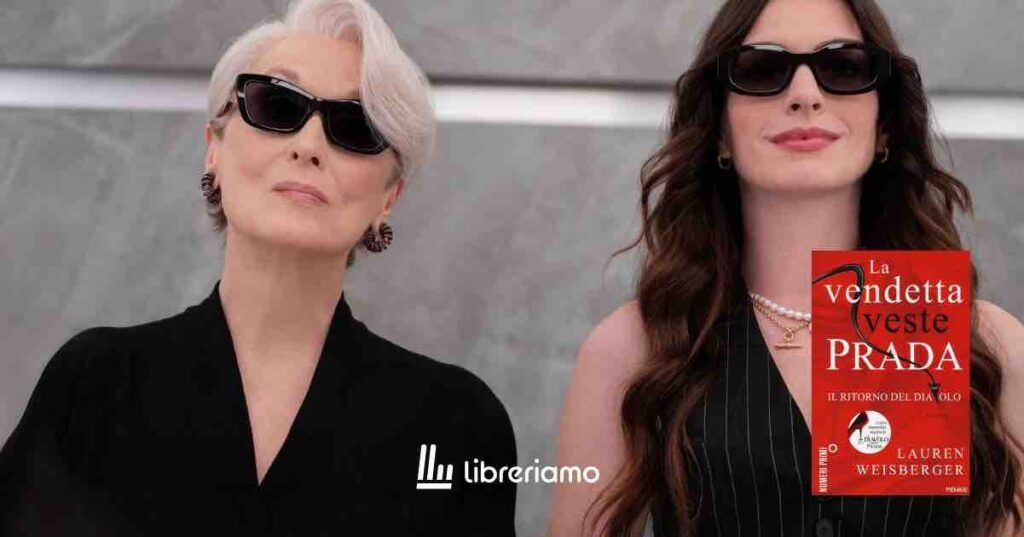
There are stories that don’t age because they don’t just talk about an era, but about a mechanism of power. “The Devil Wears Prada” is one of these. Almost twenty years after the release of the original film and years after Lauren Weisberger’s novel, the announcement of “The Devil Wears Prada 2” is not just cinematic news: it is the return of a modern myth.
The first images from the set, with Meryl Streep and Anne Hathaway next to each other again, have rekindled an imagery that has never really stopped inhabiting pop culture. Because Miranda Priestly is not just a fashion director: she is the sophisticated and icy face of contemporary power.
“The Devil Wears Prada 2” From book to pop myth: the novel by Lauren Weisberger
When “The Devil Wears Prada” arrived in bookstores at the beginning of the 2000s, it was read as a novel of manners. A brilliant, ferocious, seemingly light-hearted story that tells the story behind the scenes of the New York publishing and fashion industry. But beneath the glossy surface, Lauren Weisberger builds a true bildungsroman for women.
Andrea Sachs, Andy, is an ambitious, cultured young woman, convinced that that job, “that millions of girls would kill for”, is just a stage. Miranda Priestly, director of Runway, becomes his testing ground, his nightmare, his initiation.
The novel stages a conflict that remains very current: how much are we willing to sacrifice to be recognized? And above all: at what price?
“Revenge Wears Prada”: ten years later, nothing is really finished
In the literary sequel, “Revenge Wears Prada”, the story starts again with a different Andy. It’s been almost ten years since he left Miranda. Her life finally seems to be under control: a successful magazine founded with Emily, her former rival turned ally, an imminent marriage with Max Harrison, a symbol of stability and recognition.
Yet, Miranda has not disappeared. It remained like a ghostly presence, an elegant trauma that returns in dreams and fears. Because no one challenges the Devil without paying the consequences.
Here the novel changes tone: from a coming-of-age story it becomes a novel about the memory of power. It is no longer just a question of career, but of identity. Did Andy really choose who to be, or did he just change the battlefield?
The return to cinema: what we know about “The Devil Wears Prada 2”
According to the previews on the plot and the images from the set, the film sequel moves precisely on this ridge: the past that returns, the comparison between who we were and who we believe we have become.
Fashion remains central, but it is no longer just glamour. It is language, control, representation of the self. Miranda Priestly, today, is not just a feared boss: she is an almost mythological figure, a woman who has been able to exercise power in a system that rarely grants it to women without asking a very high price.
The film also seems to want to question this: can there be female power that is not interpreted as cruelty?
Miranda Priestly: icon, antagonist, mirror
Miranda is one of the most complex female characters in contemporary pop culture. She is not a classic villain, but not a reassuring model either. She is competent, uncompromising, visionary. She is feared because she does not apologize for her authority.
In this sense, The Devil Wears Prada anticipated a discussion that is central today: the difficulty of accepting powerful women without demonizing them. Miranda is not loved, but she is respected. And perhaps this is precisely the most uncomfortable point of his figure.
Andy Sachs and the question of identity
If Miranda embodies power, Andy represents conflict. Her parable is that of many contemporary women: the desire for affirmation, the rejection of a toxic model, the attempt to find an alternative path.
The sequel presents Andy with a crucial question: can you really escape the system, or do you always end up reproducing it in different forms? The independent magazine, success, love: are they authentic achievements or just a more digestible version of the same world?
Because The Devil Wears Prada still speaks to us
The return of this story is not nostalgia. It’s a sign. In an era in which work invades private life, in which image is a currency of exchange and success is continually performed, The Devil Wears Prada remains a very clear lens on our present.
Fashion, publishing, career: everything becomes a metaphor for a deeper question. Who are we when no one is looking? And what are we willing to lose to get where we want?
The Devil never left
“The Devil Wears Prada 2” doesn’t come to close a story, but to demonstrate that that story never ended. Miranda Priestly, Andy Sachs, the world of Runway continue to speak to us because they tell the most elegant and ruthless side of our time.
And perhaps this is precisely why, once again, we will all be there watching. With a mixture of fear, fascination and irresistible attraction for the Devil.