
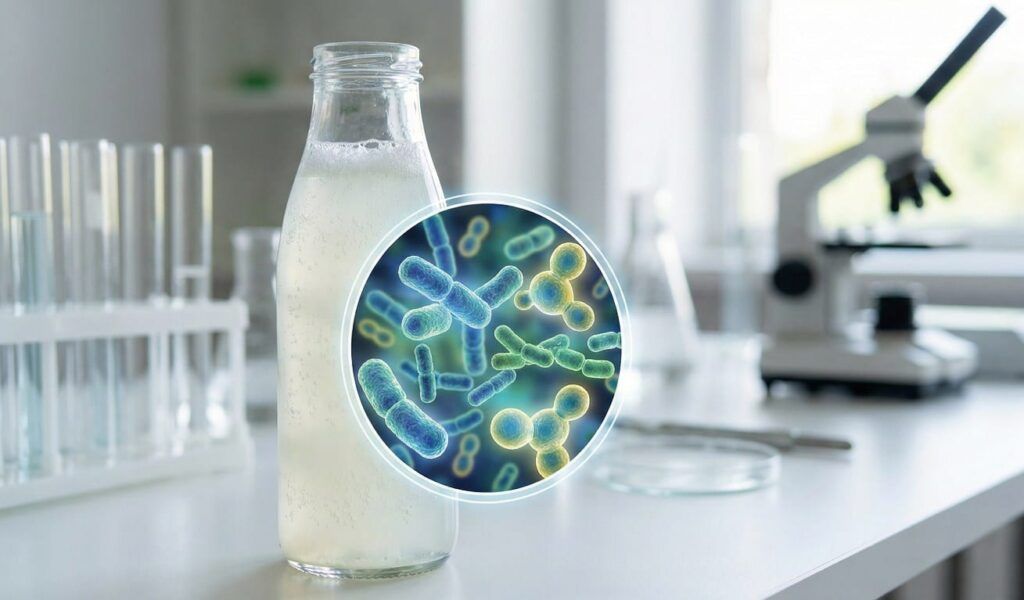
Probiotics could slow down the aging of the immune system: not all, not always, but some specific strains show measurable results. A Korean study published in December 2025 on Journal of Functional Foods proves that the Lentilactobacillus kefiri YRC2606isolated from kefir, reduces chronic inflammation in aged mice by blocking the IL-6/STAT3 signaling pathway.
After weeks of oral administration, the animals’ thymus weighs more, cellular senescence markers decrease in the spleen and kidneys, and proinflammatory cytokines decrease in the blood. The mechanism is clear: less inflammaging, more immune function. It remains to be seen whether it also works in humans. Researchers are working on it.
Not all probiotics are the same
The Korean team tested the YRC2606 strain on aged mice to evaluate its effect on immunosenescence. The hypothesis was that this probiotic could attenuate chronic inflammation by modulating the IL-6/STAT3 pathwayone of the main causes of inflammaging1. The results confirm: the treated group shows a significantly higher thymic index compared to controls, a sign that the thymus (key gland for the production of T lymphocytes) maintains greater functionality. Cellular senescence markers, such as p16 and p21, are instead reduced in spleen and kidneys.
Study sheet
- Research body: Korea University (not specified in the original paper)
- Year of publication: 2025
- Magazine: Journal of Functional Foods
- DOI: 10.1016/j.jff.2025.107053
- TRL (Technology Readiness Level): 3-4 – Experimental proof of concept on an animal model, validation in the laboratory.
The mechanism of these probiotics: turn off STAT3
The YRC2606 probiotic acts on a protein called STAT3key mediator of inflammation and senescence. When STAT3 is phosphorylated (active), it fuels the production of proinflammatory cytokines such as IL-6, TNF-α, IL-1β. In mice treated with the probiotic, STAT3 phosphorylation was significantly suppressed. Less active STAT3 means less cytokines, less inflammaging, less cell damage. A bit like turning off the switch on a circuit that keeps systemic inflammation on.
Serum levels of proinflammatory cytokines drop measurably. The same dynamics is also observed in the tissues (spleen, kidneys). As we said when talking about the microbiome and longevity, it is not just a question of the intestine: some bacteria modulate systemic immune responses.
And in humans?
It works in mice. This is clear. In humans, it is yet to be proven. Clinical trials require years, large samples, rigorous protocols. Senolytics, for example, took over a decade to move from the animal model to the first human trials. Probiotics have one advantage: they are already consumed by millions of people, so the basic safety is known. It remains to understand dosage, duration, individual response.
The YRC2606 strain is not yet available as a commercial supplement. It probably will become one, if some company buys the rights and starts production. Meanwhile, other kefir probiotics may have similar effects, but without specific studies it’s just speculation. As with NAD+, the road from discovery to commercial product always passes through clinical validation.
The most interesting fact? The reduction in inflammation is not at all marginal. Proinflammatory cytokine levels drop statistically significantly, thymic index increases, cellular senescence markers are reduced in key organs.
If replicable in humans, the effect of these probiotics could become a concrete tool to slow down immunosenescence.
The mechanism is identified. The strain as well. The rest is a question of time, funds, clinical trials. Probiotics, meanwhile, continue to be studied not only for digestion, but for the systemic modulation of inflammation.
The boundary between “lactic ferment” and “anti-aging molecule” is blurring.