
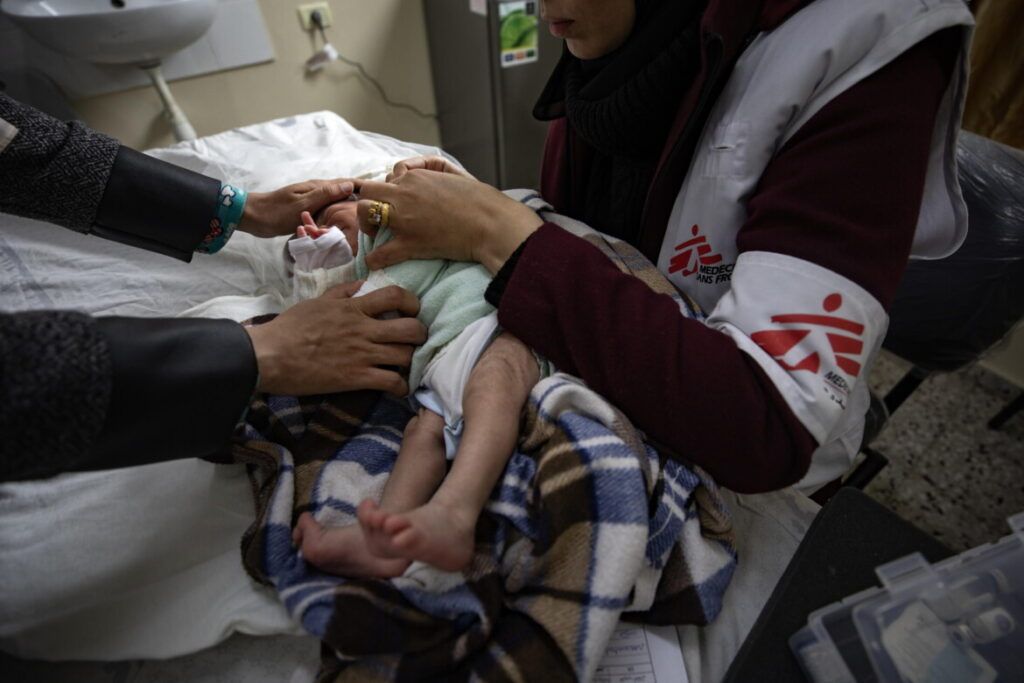
At midnight today, with the start of the new year, Gaza will become even more alone. Some of the most important international humanitarian organizations will have to begin to dismantle structures and programs, preparing to completely abandon the Strip by March 1, 2026. International pressure, always weak and submissive when it comes to Israel, seems to have succeeded in doing nothing other than postponing the moment of farewell by three months. Already in January, NGOs and the United Nations had defined as unacceptable the new registration rules imposed by Tel Aviv to operate in Palestine, in the territories occupied by Israel, among refugees who are denied return and a population of Gaza reduced to rubble and poverty.
THOSE NEW RULES they are not tolerable for most NGOs, because they would violate national and community laws and would put hundreds of employees, together with their families, in danger. Israel demands news and personal information on those who work for those organizations, including sensitive data on their family members, without providing any guarantee on how that confidential content will be used, stored or transmitted. It’s a request that undermines various data protection laws and puts individuals at risk of pressure, intimidation and revenge. The new registration system, which came into force in March, poses a major risk to humanitarian operations across the occupied Palestinian territories, not just Gaza but also the West Bank and East Jerusalem.
According to the UN and NGOs, it “imposes requirements that organizations cannot meet without violating international legal obligations or compromising fundamental humanitarian principles”. The calls for intervention from the international community and governments have multiplied but Tel Aviv has not changed its requests and requirements. Last night, after the press release with which the Ministry of the Diaspora said it was ready to formalize the expulsion of 37 international humanitarian organizations, there was still hope for a jolt from world governments. On that list there are several NGOs that have declared themselves unable to deliver the requested data: Doctors Without Borders, Oxfam and ActionAid among the best known. All are likely to appeal the decision.
BUT THE MASS AND NATURE of the information requested is not the only, nor perhaps the most serious, obstacle imposed by Israel. “It is on this, but also on other parameters, that Tel Aviv’s real motivations are hidden,” Paolo Pezzati, spokesperson for humanitarian crises for Oxfam Italia, told us. Because even if they decide to violate data protection laws and hand over that information, organizations could be expelled at any time and for a variety of completely arbitrary reasons.”
Among the numerous causes of the ban from the Palestinian territories, Tel Aviv has included, for example, the “delegitimation of the State of Israel”, calls for a boycott (by even just one of the employees), the denial of the existence of Israel “as a Jewish and democratic state”.
«They are interpretable, broad, vague and political definitions – continues Pezzati -. Anything could be called a delegitimizing action, even the delivery of humanitarian aid. Yet, all we ask is to let us work, exactly as we have been doing for decades in every corner of the world.”
THE LAST CALL of the Oxfam spokesperson is addressed once again to governments and world institutions: «We hope for a diplomatic wing that will finally intervene to block this latest act hostile to the international humanitarian system. We ask governments to change diplomatic strategy and pressure, to act in ways that go together with the requests that have emerged from the mobilizations of international civil society.”
The press release from the Ministry of Diaspora Affairs makes direct reference to Doctors Without Borders, one of the largest health organizations operating in Gaza, accusing two of its employees of “terrorist activities”, without providing evidence in this regard. Tel Aviv also believes, contrary to the United Nations and the rest of the international humanitarian community, that the expulsion of the NGOs will not affect the conditions of the civilian population.
THIS READING does not agree with the foreign ministers of Canada, Denmark, Finland, France, Iceland, Japan, Norway, Sweden, Switzerland and the United Kingdom, who, in a joint statement, said they were seriously concerned “by the renewed deterioration of the humanitarian situation in Gaza, which remains catastrophic”, asking Tel Aviv to take urgent action.
But nothing but bombs fell on Gaza yesterday. In violation of the ceasefire, the army carried out a series of attacks in different areas of the Strip: Rafah, Khan Younis, the Maghazi refugee camp, Beit Lahiya. These were mainly artillery shells, probably fired to displace people from homes beyond the “yellow line” drawn by Tel Aviv, which still occupies more than half of the Strip.
The continuous violations of the truce evidently do not worry the United States, which yesterday announced the awarding of an 8.6 billion dollar contract to Boeing for the supply of F-15 fighters to Israel.