
Francesco Tullio Altan, born in Treviso in 1942, is a cartoonist, illustrator and author of political satire cartoons published in “L’Espresso” and “La Repubblica”, as well as for the creation of characters such as the polka-dotted dog Pimp and the metalworker cipputi. After studying architecture and working in cinema, he lived in Brazil where he began his career, before returning to Italy in the Seventies and becoming one of the most sharp and loved pencils on the Italian scene.
As always, the first question I ask concerns your decision to attend the Faculty of Architecture; you enrolled in Venice, at the IUAV (University Institute of Architecture of Venice), right?
No: I started in Florence. When I was about fourteen I wrote a letter to my father telling him that I was thinking of being a painter. He replied yes, good idea, but first finish high school. And so I finished high school. Then, at that point, the idea was to continue doing something that had to do with art, in some way… And architecture seemed to me to be the closest faculty. A discipline, in short, that brought together art with a “profession”, with something concrete. But in Bologna – I lived there at the time – there was no Architecture and so, partly out of laziness, I enrolled in Engineering. I did a year of Engineering, I took a couple of important and good exams for Architecture too, and the following year I enrolled in Florence, with a group – there were two or three of my classmates from high school – who did the same thing: we went up and down from Bologna to Florence. Then we found a small apartment in Florence and moved: we spent our first year there. During the second year we came up with the idea of all going to Venice, because it was the IUAV was the Faculty richest in personality and stimuli. So we moved from Florence to Venice, three or four of us – always this small group of old comrades now friends – and we went to Venice.

What year was it?
It was 1962 more or less… 1962 or 1963.
And what do you remember about the courses at the IUAV in Venice? Which teachers did you attend?
The director was Giuseppe Samonà, then there was Leonardo Benevolo…
Who taught History of Architecture?
No, Benevolo did urban planning. History was still taught, I believe, by Bruno Zevi…
Yes, of course: you’re right. Bruno Zevi moved to Rome at the end of 1963… Who else do you remember?
There was Carlo Aymonino, assistant to someone I don’t remember. Then Paolo Portoghesi…
Maybe Zevi’s assistant…
Then there was Ignazio Gardella, in short: a few important architects. However, I have never been a very regular attendee of the courses: I rather stayed at home and made my drawings. But I went, also because I took twenty-seven exams in total, so not very many.
You almost graduated, you had three to go. Or at least that’s how it was when I graduated.
No: at the time there were thirty-six or thirty-seven, there were a few missing. However, since I had never taken an exam – which I no longer remember what it was called exactly – among the fundamentals of the two-year period… Something that had the word “ornamental” in the name, held in Florence by a professor with a German surname…
Giovanni Klaus Koenig!
Him! Here: I have never taken that exam, so I have never officially failed: all my exams were in the IUAV janitor’s drawer while waiting for me to take this two-year exam to be able to register them. And I’ve never done it…
Why the dislike for that exam?
It was considered stupid. I remember Klaus Koenig having a train carriage drawn.
Oh yes, he was obsessed with trains, it was one of his obsessions, he recognized them by the sound of the engine…
Well, I never did it and then I took it lightly… In reality I realized quite early that I had never thought of being an architect in my life, even if I didn’t know what alternatives I had. But I liked school, because there were courses of all types: you came into contact with problems, apart from the artistic, technical, social ones… In short: for me it was a kind of super high school.
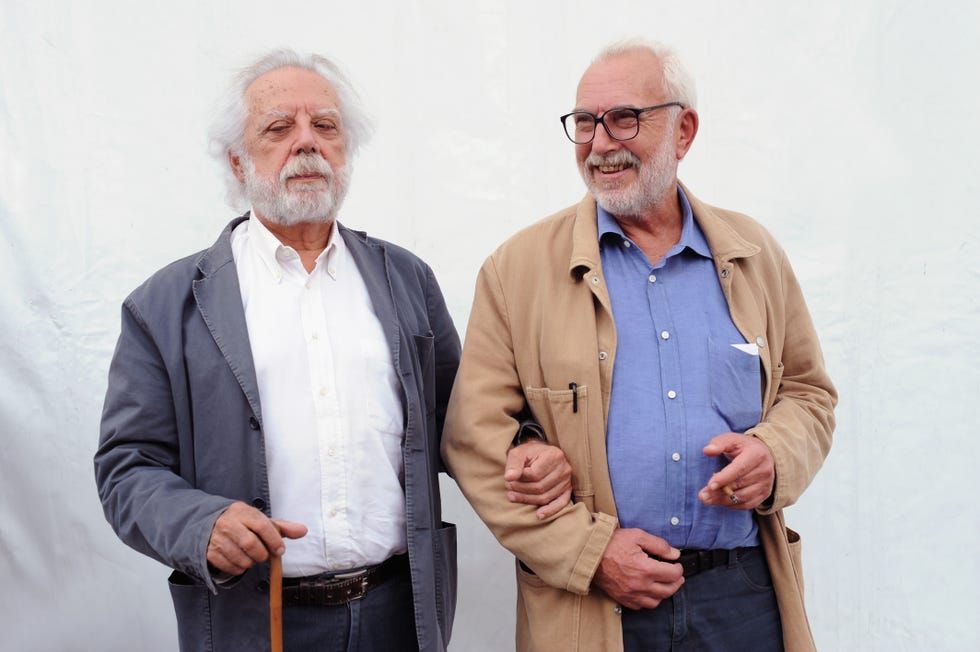
Sergio Staino and Francesco Tullio Altan
The Faculty of Architecture opened up various perspectives and therefore even if you understood that being an architect would not be your profession, what you were doing was educational.
Yes, I did it willingly, there were courses that I liked a little more, others a little less, but I did it with these ideas underneath…
Were you also painting in the meantime?
Not much, I painted more before, I drew a lot, I made little drawings: I think you may have seen it.
Yes, I remember them. Were there also some of your other classmates who were also a bit like yours and then didn’t become architects?
One was Giorgio Poppi, who unfortunately died two years ago: he became a painter, a good painter… But he argued with the galleries, so he never became famous.
It’s true: you showed me his works…
Yes: we have many. Two other classmates of mine, who instead became architects, were Roberto D’Agostino and Gianni Predieri. They worked in Venice, where they still live and I’ll see them tomorrow because I’m going to Venice. D’Agostino was a councilor for the Municipality of Venice, Predieri was an architect but taught at the same time.
And then?
At a certain point my friend Gianni Barcelloni – who had left the Faculty and gone to Rome, where he had become an author, director, producer of cinema and documentaries – proposed to me togo to Brazil with a small team for a RAI project on Brazilian popular music. I didn’t know anything about cinema but I said yes immediately and so I spent a year in Brazil… Then I returned to Italy, to Rome, where I stayed for a year and a half more or less. Then again in Brazil for another film. After that the team returned to Italy and I stayed there for five years. I worked in cinema with Mara Chaves: my wife. She did the costumes, I did the sets.
So no longer with RAI but you continued to work there?
Yes, although, since I was rather irregular in terms of my residence permit, I did things a little secretly. With Mara we also got a prize called golden owl – Golden Owl – which is the Oscar of Brazilian cinema for costumes and scenography The Condemned – The Condemned – (1975), a film by director Zelito Viana. I also rented a kind of tuxedo for the awards ceremony.
After that time we took a couple of quick trips to Italy. I was designing and I had met an agent in Milan, Marcello Ravoni, who took me to “Linus”, where since 1973 I began to publish my drawings. This is why we returned to Italy to stay for a year: to start this work, which went faster and stronger than we expected… So we have been here for fifty years…
Both the outward journey to Brazil and the return journey to Italy were not calculated. You were overwhelmed by the things that happened and that changed your plans…
My whole life has been like this. I had doubts every now and then but I’m happy with all this.
Has your training as an architect, what you learned at the IUAV, had an impact on your work?
Frankly I don’t know. Maybe like climateas speeches, as acquaintances, friends… That was certainly very important for training, but not for my work in particular.
Even if you didn’t graduate, have you ever been an architect? Have you ever built anything?
The only thing I did was expand my mother’s house who lived in the countryside, in Zenson di Piave. Because, at a certain point, we lived in Bologna and she decided to return to this house which was a bit small compared to our needs. So I drew an extension: “Then we’ll put some nice ivy on it so you can’t see it…”
Then your interest in architecture completely disappeared?
My daughter Kika – Francesca – has taken to the road again. At a certain point she decided, I’m not sure why either, but she decided to do Architecture: she went to Venice and it all started again: because she is friends with the children of my friends from Venice and tomorrow we will all see each other again! When she graduated, I was very happy to go to her graduation.
And architecture today? Architects today? Did this training leave you curious?
A curiosity certainly yes. I learned something, also to be able to see things. But I don’t follow it that closely. I happened to do a job inside Renzo Piano’s architecture. He did a project in Bologna hospice for children who have very serious health problems: the Ark on the tree (2024), supported by the Chiantore Seràgnoli Hospice Foundation. I did some illustrations on panels. It was good and fun. Then the landscape designer Paolo Pejrone created the gardens. The hospice is called this because it is a building suspended among the trees: a kind of ark in the green sea. Pejrone is eighty-four years old, Piano is eighty-eight, I am eighty-three…
It is proof that vitality and ingenuity become sharper…
I had completely forgotten, now that you told me I remembered this job that brought me back to architecture!
Thank you Francesco!
Me too: Happy New Year!
Roberto Dulio is associate professor of History of Architecture at the Polytechnic of Milan; deals with modern and contemporary architectural culture and its relationships with art and photography. He has curated exhibitions, published books and essays. He was editor of the magazine «L’architettura chronice e storia» and collaborator of other newspapers including: «Il Giornale dell’architettura», «Casabella», «Domus» and the Sunday newspaper of «Sole 24 Ore». Among his books: Aldo Andreani 1887-1971, visions, constructions, images (with Mario Lupano, Electa, Milan 2015); A worldly portrait. Photographs by Ghitta Carell (Johan & Levi, Milano 2013); Introduction to Bruno Zevi (Laterza, Rome-Bari 2008); Giovanni Michelucci 1891-1990 (with Claudia Conforti and Marzia Marandola, Electa, Milan 2006).